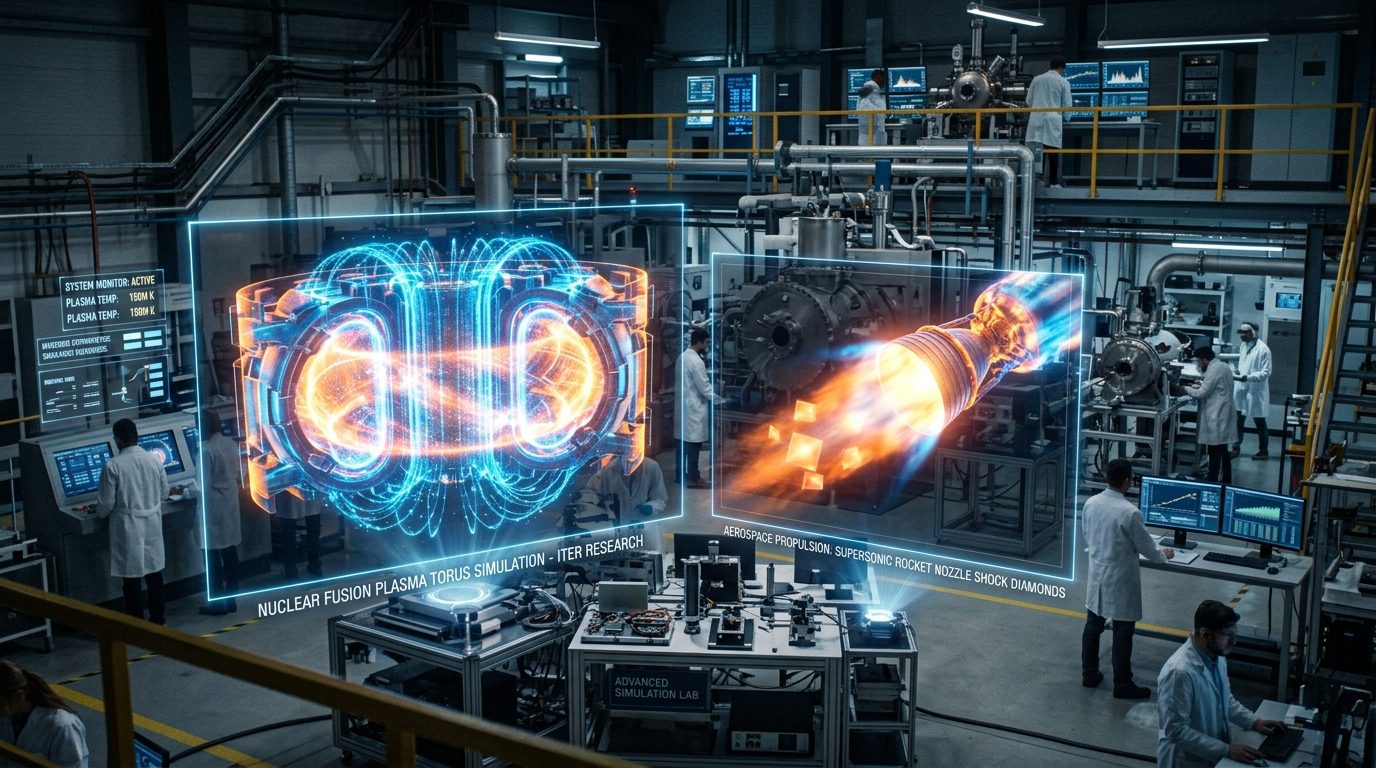
As consumer artificial intelligence labs race to master text, code, and 2D video, a specialized cohort of deep-tech startups is pursuing a far more demanding ambition: training foundation models that comprehend the fundamental laws of theoretical physics.
On September 30, 2026, London-based artificial intelligence startup Zenithon AI announced the completion of a $10 million seed funding round led by Wilson Sonsini, European innovation funds, and prominent industrial angels.
Founded by computational physicists and machine learning researchers from Imperial College London and Cambridge, Zenithon is pioneering 'physical world models.'
In commercial engineering sectors like magnetic confinement fusion energy and hypersonic rocketry, traditional numerical simulations represent a massive bottleneck. Solving the coupled Navier-Stokes and Maxwell magnetohydrodynamic equations governing 100-million-degree plasma or supersonic shockwaves requires weeks on national supercomputing clusters.
Zenithon AI replaces classical finite-volume meshing with Physics-Informed Neural Operators (PINOs) and continuous Fourier neural operators.
Unlike standard generative video models that generate visually plausible but physically absurd hallucinations, Zenithon's architecture embeds strict mathematical conservation laws directly into its loss functions, guaranteeing that mass, energy, and angular momentum are rigorously preserved across every simulation step.
The result is a neural simulator that predicts nonlinear plasma turbulence and combustion boundary dynamics up to 10,000 times faster than legacy Fortran CFD codes, enabling aerospace and fusion engineers to conduct thousands of virtual design iterations in an afternoon.