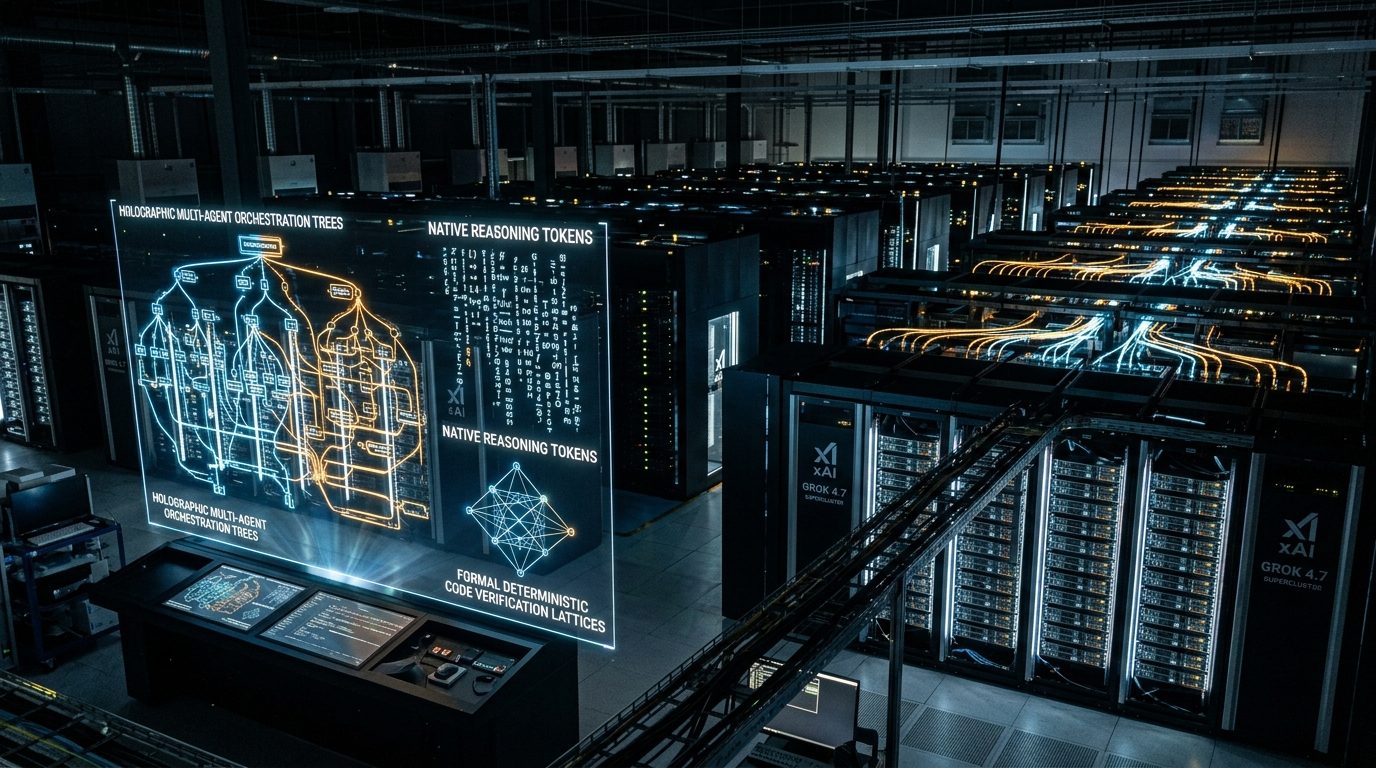
On September 21, 2026, xAI took the wraps off Grok 4.7, marking the laboratory's most aggressive leap into autonomous agentic systems and test-time verification. Trained on an expanded 200,000-GPU footprint at the Memphis Colossus facility, the frontier model is explicitly architected to dismantle the performance plateau experienced by conventional autoregressive transformers when tackling complex, multi-step engineering tasks.
At the core of Grok 4.7 is a fundamental re-engineering of the inference decoding loop. Rather than generating a monolithic sequential chain of thought, Grok 4.7 incorporates special 'agent-branch' control tokens directly into its vocabulary. When confronted with ambiguous, high-entropy architectural challenges, the primary model autonomously bifurcates execution into parallel worker personas—each tasked with formulating hypotheses, writing exploratory test suites, or identifying edge cases.
These sub-agent branches execute in sandboxed memory isolates before their findings are dynamically merged back into the primary reasoning spine via an integrated consensus layer. This native architecture eliminates the serialization overhead and context degradation that plague external orchestration frameworks like AutoGen or LangChain.
xAI's model documentation lists no SWE-bench Verified, MATH-500 or OSWorld results for Grok 4.7, and the model is not on the official SWE-bench or OSWorld-Verified leaderboards as of October 11, 2026. On the arena.ai text leaderboard it scores 1443 (#90 of 414 entries).
Context processing has also been fundamentally transformed. Leveraging a hybrid sparse-dense attention mechanism that dynamically compresses low-entropy tokens, Grok 4.7 supports a 500,000-token context window. This allows engineering teams to feed entire monolithic repositories, architectural documentation, and historical commit logs into a single prompt without losing needle-in-a-haystack recall fidelity.
To address inference economics, xAI priced Grok 4.7 at $2.00 per million input tokens and $6.00 per million output tokens for prompts under 200,000 tokens ($4.00 / $12.00 above that), with cached input at $0.50 per million tokens. The pricing structure undercuts closed proprietary competitors while delivering native multi-agent verification out of the box.
The release cements xAI's position at the frontier of autonomous AI research, transforming reasoning from an abstract linguistic exercise into an empirical, self-verifying engineering tool.