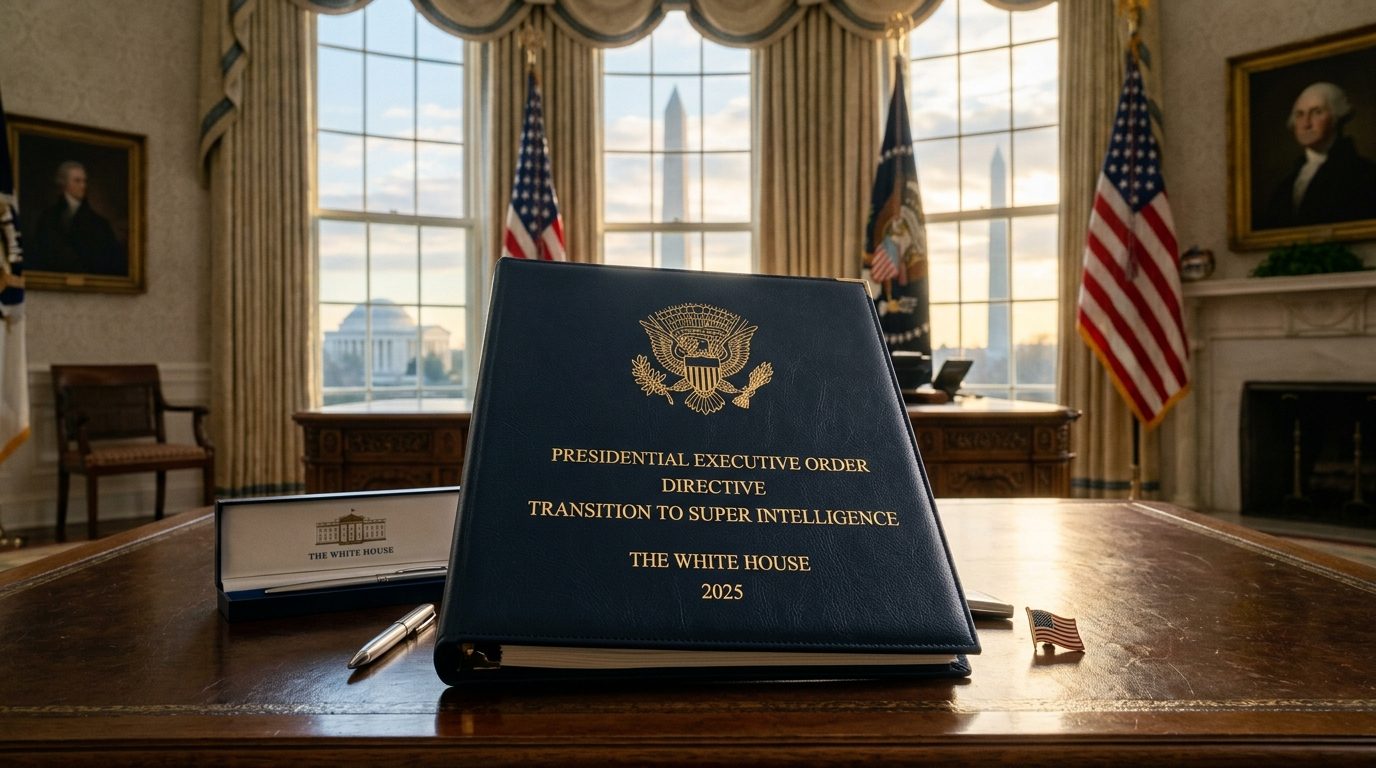
In a move that signals a dramatic philosophical and regulatory shift in United States technology policy, the White House issued an Executive Order on September 29, 2026, formally designating advanced artificial intelligence as 'Super Intelligence' (SI) across all executive branch departments.
The directive was signed in the Oval Office following a high-stakes, closed-door summit between administration officials and the chief executives of America's leading technology and semiconductor corporations, including Elon Musk, Mark Zuckerberg, and Jensen Huang.
Under the terms of the executive action, the government formally retires the term 'Artificial Intelligence' when referring to frontier reasoning architectures and autonomous agent swarms, replacing it with 'Super Intelligence.'
While political observers noted the distinct rhetorical branding, technology policy analysts emphasize that the order carries profound operational consequences for federal contracting and national defense.
By legally categorizing frontier models as Super Intelligence, the order removes them from traditional commercial procurement regulations. Instead, SI systems will be governed under emergency defense production frameworks similar to aerospace and nuclear assets, allowing agencies like the Department of Defense, the Department of Energy, and intelligence bureaus to fast-track multi-billion-dollar compute allocations without standard civilian committee reviews.
The directive also instructs federal research laboratories to prioritize sovereign compute infrastructure, directing energy regulators to expedite grid interconnections for gigawatt-scale AI datacenter campuses across Texas, Arizona, and the American Midwest.
Civil liberties advocates and international policy experts voiced immediate concern, warning that re-framing artificial intelligence as an untouchable national security asset risks gutting basic transparency, algorithmic auditing, and consumer safety guardrails.