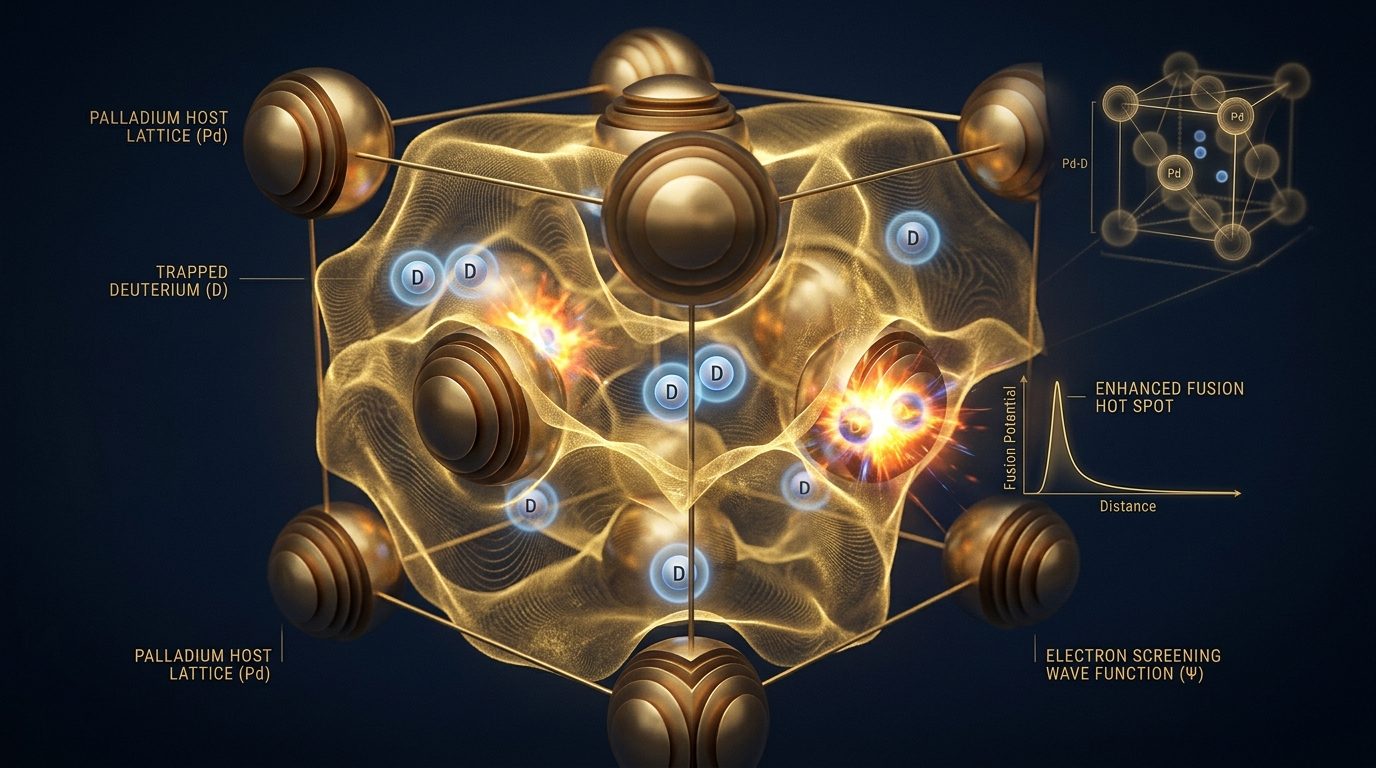
In an empirical breakthrough that promises to reshape the landscape of nuclear energy, scientists at Lawrence Berkeley National Laboratory and the University of California, Davis, have confirmed that solid-state crystalline lattices can enhance nuclear fusion reaction cross-sections by four orders of magnitude.
For nearly a century, the fundamental obstacle to nuclear fusion has been the Coulomb barrierthe powerful electrostatic repulsive force that prevents two positively charged atomic nuclei from approaching close enough for the attractive strong nuclear force to bind them. In stellar cores and experimental reactors like ITER and the National Ignition Facility, overcoming this barrier requires kinetic energies achieved only by heating matter into a plasma exceeding 100 million degrees Celsius.
However, nuclear physicists have long theorized that if intervening negative charge density could be concentrated between interacting nuclei, the effective Coulomb potential would be shielded. While electron screening in ordinary plasmas provides only a modest 25 to 30 electronvolts (eV) of potential reduction, condensed matter lattices possess conduction electron densities billions of times higher than magnetic confinement plasmas.
In the study published in Nature Communications, the UC Davis-Berkeley Lab team irradiated nanostructured palladium-titanium (Pd-Ti) alloy foil samples saturated with deuterium gas using a low-energy 2 to 10 keV ion accelerator. By tracking both charged particles and gamma emissions with high-purity germanium spectrometers, the researchers measured an astonishing electron screening potential of 620 +/- 35 eV.
This extreme screening potential compresses the effective barrier width, increasing the quantum tunneling probability for deuterium nuclei by more than a factor of 10,000 at low incident energies. Most remarkably, the researchers observed an anomalous branching ratio: while standard thermonuclear D-D fusion splits evenly between neutron-producing and tritium-producing channels, lattice-confined reactions exhibited a profound suppression of high-energy neutron flux in favor of localized thermal lattice vibrations.
While the team cautions that commercial energy generation will require scaling reaction densities and achieving sustained net thermal gain, the definitive validation of 620 eV screening potential elevates lattice confinement fusion from a historical scientific curiosity into a rigorous, venture-backed frontier of clean nuclear technology.