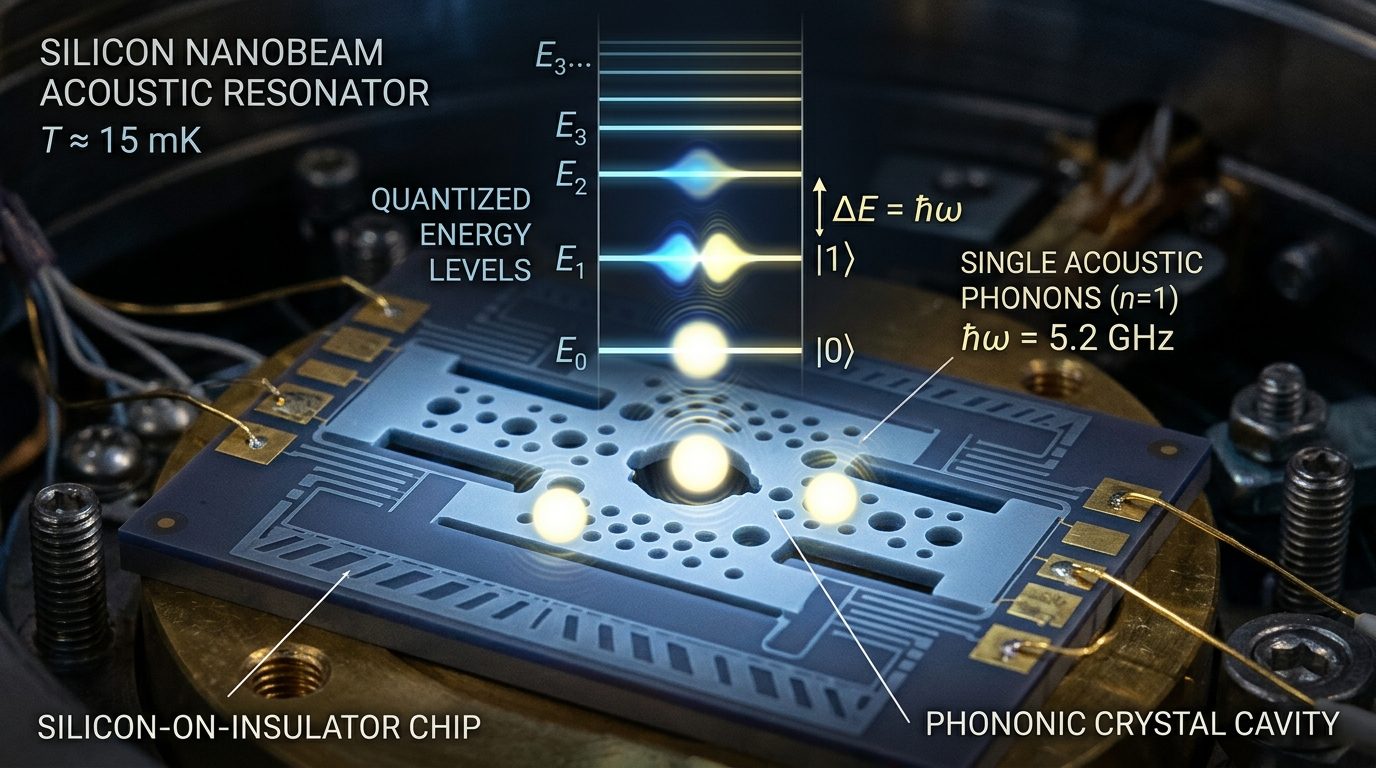
When a cathedral bell is struck, its ring fades smoothly and continuously to the human ear. However, at the absolute smallest scales of physical reality, sound energy is not continuous—it is composed of discrete, indivisible quantum packets known as phonons.
In a historic breakthrough published in Science in late September 2026, researchers at Stanford University achieved the world's first direct, real-time observation of 'quantum jumps' in sound, directly measuring individual phonons abruptly leaping between energy levels.
Quantum jumps were first observed in individual trapped ions in 1986, confirming Niels Bohr's controversial early hypothesis of atomic energy levels. In 2007, physicists repeated the feat with photons of light. Yet extending this observation to sound was considered an almost insurmountable hurdle.
Unlike light, which consists of fundamental elementary particles, sound in a solid is a collective mechanical oscillation involving billions of interconnected silicon atoms. In classical physics, mechanical vibration was viewed as inherently continuous.
To detect individual phonons without destroying their quantum state through measurement collapse, the Stanford team—led by Professor Amir Safavi-Naeini—engineered a microscopic acoustic resonator that functions as a nanoscale tuning fork on a silicon-on-insulator chip.
The resonator was isolated in a dilution refrigerator cooled to 15 millikelvin, a fraction of a degree above absolute zero. Through precision phononic crystal patterning, the team achieved an unprecedented mechanical coherence time: sound waves reverberated inside the nanobeam cavity for over two milliseconds, permitting hundreds of sequential non-destructive measurements.
By dispersively coupling the mechanical cavity to a superconducting transmon qubit, the researchers recorded discrete, discontinuous jumps between the zero-phonon ground state |0⟩ and the single-phonon excited state |1⟩. The milestone proves macroscopic mechanical devices can operate as pure quantum systems, opening the door to acoustic quantum memories that store qubits in sound waves 100,000 times more compact than electromagnetic microwave resonators.