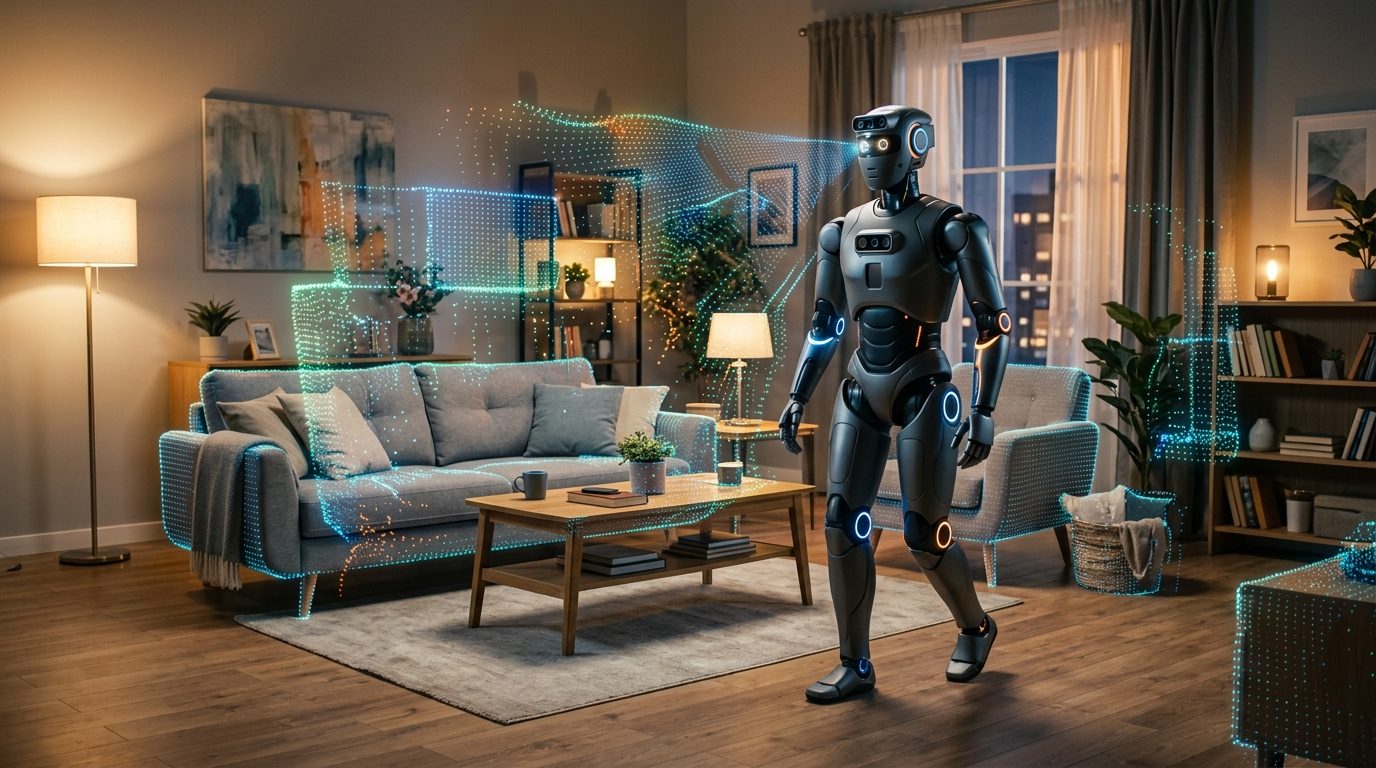
In a major leap toward truly useful domestic robotics, researchers at the Stanford Movement Lab (TML) introduced HomeBody, an integrated embodied AI architecture that grants humanoid robots persistent episodic spatial memory and open-ended exploration capabilities.
While robotic manipulation models have advanced rapidly with transformer-based policy networks, long-horizon autonomy in unstructured residential spaces has remained an intractable challenge. Human homes are dynamic: clutter accumulates, doors open and close, and everyday objects migrate continuously between rooms.
HomeBody bridges the gap between high-level reasoning foundation models and real-time physical locomotion. Deployed on a commercial Unitree G1 bipedal humanoid equipped with stereo depth cameras and an onboard compute module, the robot enters an unfamiliar home with zero prior architectural maps.
Using active visual SLAM combined with a frontier-based exploration heuristic guided by a Vision-Language Model (VLM), the humanoid systematically walks through hallways and living spaces. As it traverses the home, it constructs a real-time 3D semantic Gaussian splatting representation overlaid with a topological scene graph.
Crucially, HomeBody treats memory as an evolving, multi-tiered database. High-level spatial landmarks (couches, tables, doorways) form rigid anchor nodes, while movable objects (keys, mugs, laptops, books) are registered as probabilistic child entities stamped with temporal observation vectors.
During extensive empirical trials in multi-room apartments, human occupants asked the robot natural language questions regarding displaced belongings (e.g., 'Where is my work laptop?'). The Unitree G1 queried its episodic scene graph, generated collision-free bipedal footstep trajectories, navigated to the target bedroom, and verified the object's presence with an 88.4% success rate across 14-day continuous evaluations.
By eliminating the requirement for manual teleoperated pre-scanning, HomeBody provides the missing foundational software stack needed to transform humanoid robots from choreographed factory demonstration units into adaptable domestic assistants.