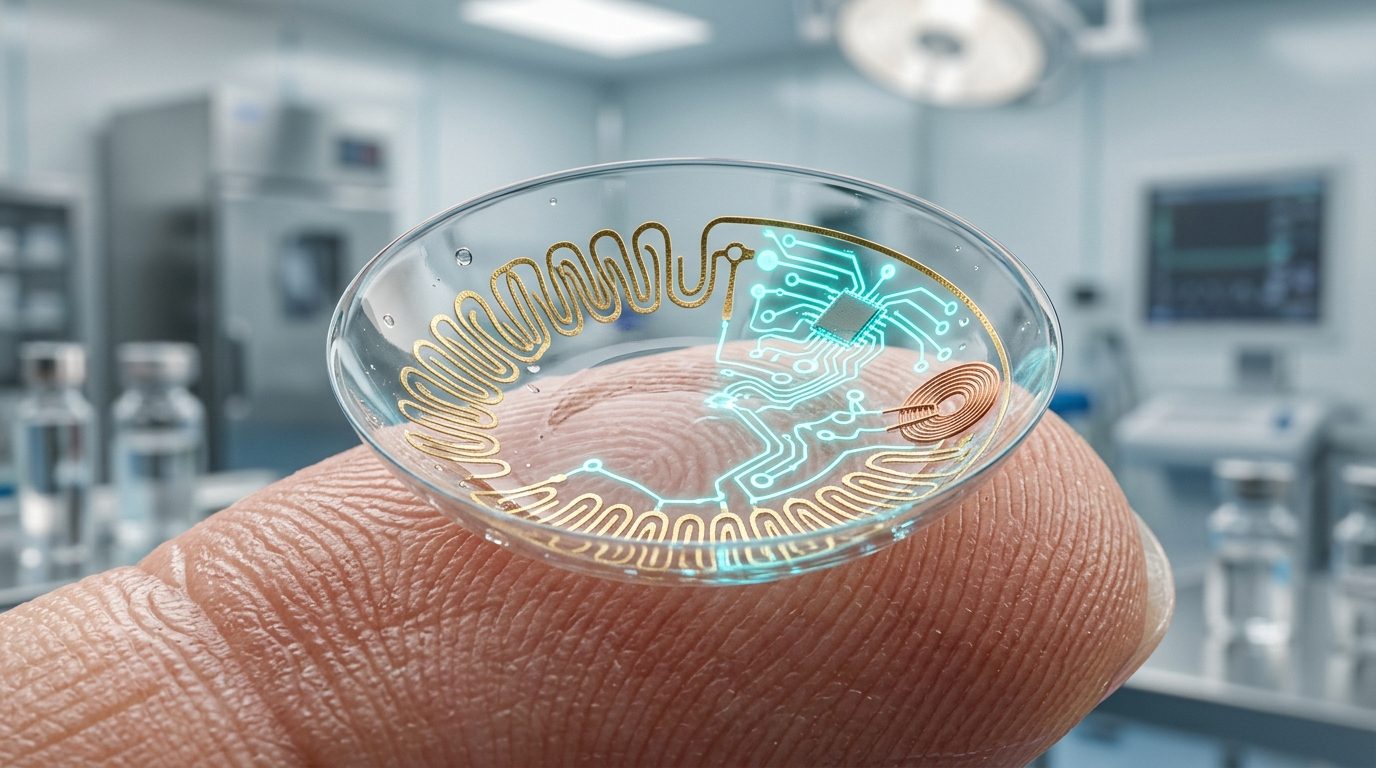
In modern psychiatric medicine and neurology, diagnosing and treating mood disorders such as major depressive disorder (MDD) and post-traumatic stress disorder (PTSD) remains fundamentally limited by the absence of real-time objective biological markers.
While clinicians know that neurotransmitters like serotonin, dopamine, and cortisol govern mood and neural plasticity, measuring their concentration has traditionally required painful venous blood draws or invasive lumbar punctures—methods completely unsuited for tracking dynamic hourly fluctuations in daily life.
On September 26, 2026, researchers from Pohang University of Science and Technology (POSTECH) and Stanford University unveiled a clinical breakthrough published in Nature Electronics: a fully integrated, wireless smart contact lens that continuously monitors serotonin concentrations directly from tear fluid.
The eye represents an exceptional anatomical window for biochemical diagnostics. The lacrimal gland produces tear fluid through rapid diffusion from surrounding blood capillaries, allowing biomarkers to mirror systemic bloodstream concentrations with less than a five-minute temporal offset.
To overcome the physical challenge of placing electronics on the cornea without obstructing vision or causing corneal hypoxia, the engineering team developed serpentine nano-porous gold electrodes with individual trace widths under 800 nanometers. When patterned across the outer perimeter of a standard silicone hydrogel lens, the sensor maintains 92% optical clarity and permits full oxygen permeability.
The sensor's electrochemical interface utilizes aptamer-functionalized graphene channels specifically calibrated to bind serotonin molecules. Binding events modulate the channel conductance, allowing the sensor to register serotonin variations down to 50 picomoles per liter—well within the physiologic range of human tears—while completely ignoring interferents such as ascorbic acid, uric acid, and glucose.
Power is supplied wirelessly via a resonant near-field communication (NFC) coil embedded along the edge of the lens, which harvests energy from an eye-tracking antenna integrated into commercial smart glasses or a handheld reader. Sensor readings are transmitted at 1 Hz intervals to an encrypted smartphone health repository.
In preclinical animal models and pilot human volunteer trials, the smart lens accurately tracked diurnal serotonin fluctuations and captured sharp drops corresponding to acute stress episodes, marking an extraordinary leap toward quantitative, closed-loop psychiatric diagnostics.