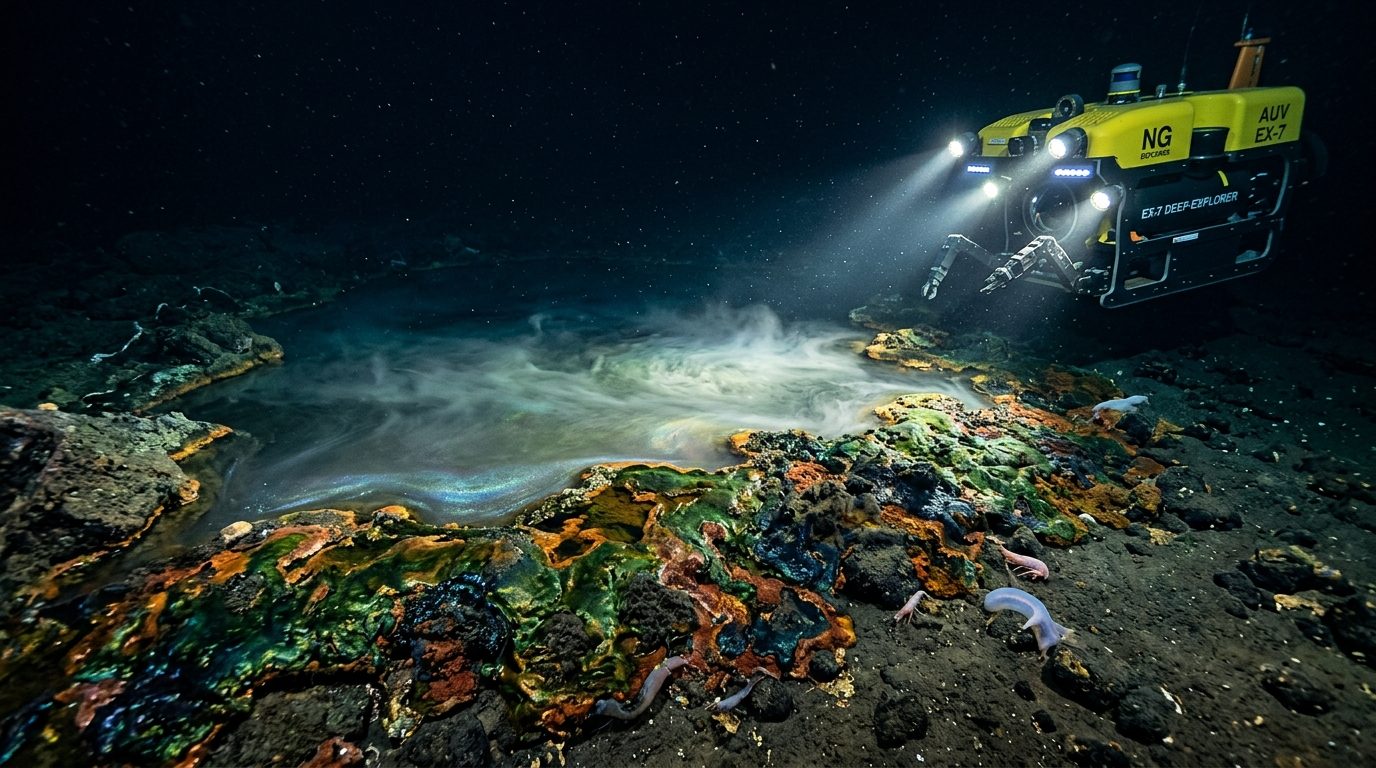
Plunging more than two kilometers beneath the shimmering surface of the Red Sea lies one of the most chemically hostile environments on planet Earth: deep hypersaline anoxic basins (DHABs). Known informally in deep-sea oceanography as 'death pools,' these dense, super-saline underwater lakes are completely devoid of dissolved oxygen and exhibit salt concentrations up to eight times higher than normal seawater, instantly pickling fish or crustaceans that inadvertently drift across their sharp pycnocline boundaries.
However, a pioneering study published in the peer-reviewed journal AGU Advances (DOI: 10.1029/2026AV002570) reveals that these anoxic brine pools are far from lifeless. Instead, they serve as thriving, highly energetic biospheres that provide a living geochemical window into the dawn of biological life on Earth more than 2.5 billion years ago.
Deploying deep-rated autonomous underwater vehicles (AUVs) and high-precision benthic sediment core samplers across several Red Sea brine pools (including the Kebrit and Atlantis II Deeps), researchers recovered vibrant, multi-layered microbial mats flourishing directly at the brine-seawater interface. Metagenomic sequencing of the microbial communities identified diverse assemblages of extremophilic archaea and bacteria, with a heavy representation of previously uncharacterized manganese-oxidizing lineages related to the phylum Nitrospirota.
Geochemical profiling of the underlying sediment cores revealed an extraordinary anomaly: the sedimentary layers beneath the microbial mats contained concentrations of transition metals—most notably manganese, iron, molybdenum, and copper—that were more than 100 times greater than baseline sediments in adjacent, oxygenated deep-sea basins.
Historically, the prevailing consensus among geobiologists held that substantial marine metal precipitation and complex redox cycling were strictly dependent on free molecular oxygen generated by cyanobacterial photosynthesis during the Great Oxidation Event (GOE), roughly 2.4 to 2.2 billion years ago. The new Red Sea data dismantles that assumption, demonstrating that microbial oxidation of divalent manganese (Mn(II) to Mn(III/IV) oxides) can proceed vigorously in anoxic, metal-saturated brine using alternative electron acceptors.
This chemotrophic metabolic engine generates substantial free energy without relying on sunlight or atmospheric oxygen. The authors propose that similar metal-driven microbial ecosystems likely dominated Archean shallow seas and hydrothermal basins, establishing a robust bioenergetic framework for early life long before the evolution of oxygenic photosynthesis.
The implications extend beyond terrestrial paleobiology into astrobiology. Across the solar system, planetary scientists have gathered compelling evidence of subsurface liquid water oceans beneath the icy crusts of Jupiter's moon Europa and Saturn's moon Enceladus. In the absence of sunlight and atmospheric oxygen, any potential extraterrestrial biosphere would depend on chemotrophic pathways.
The unique isotopic and mineralogical fractionation patterns identified in the Red Sea brine sediments provide a definitive biosignature roadmap for upcoming exploration missions, such as NASA's Europa Clipper and future lander probes equipped with laser-desorption mass spectrometers.