Source: Curtin University media release reporting the Nature Astronomy study led by Dr Sam McSweeney and Associate Professor Natasha Hurley-Walker, published November 12, 2026.
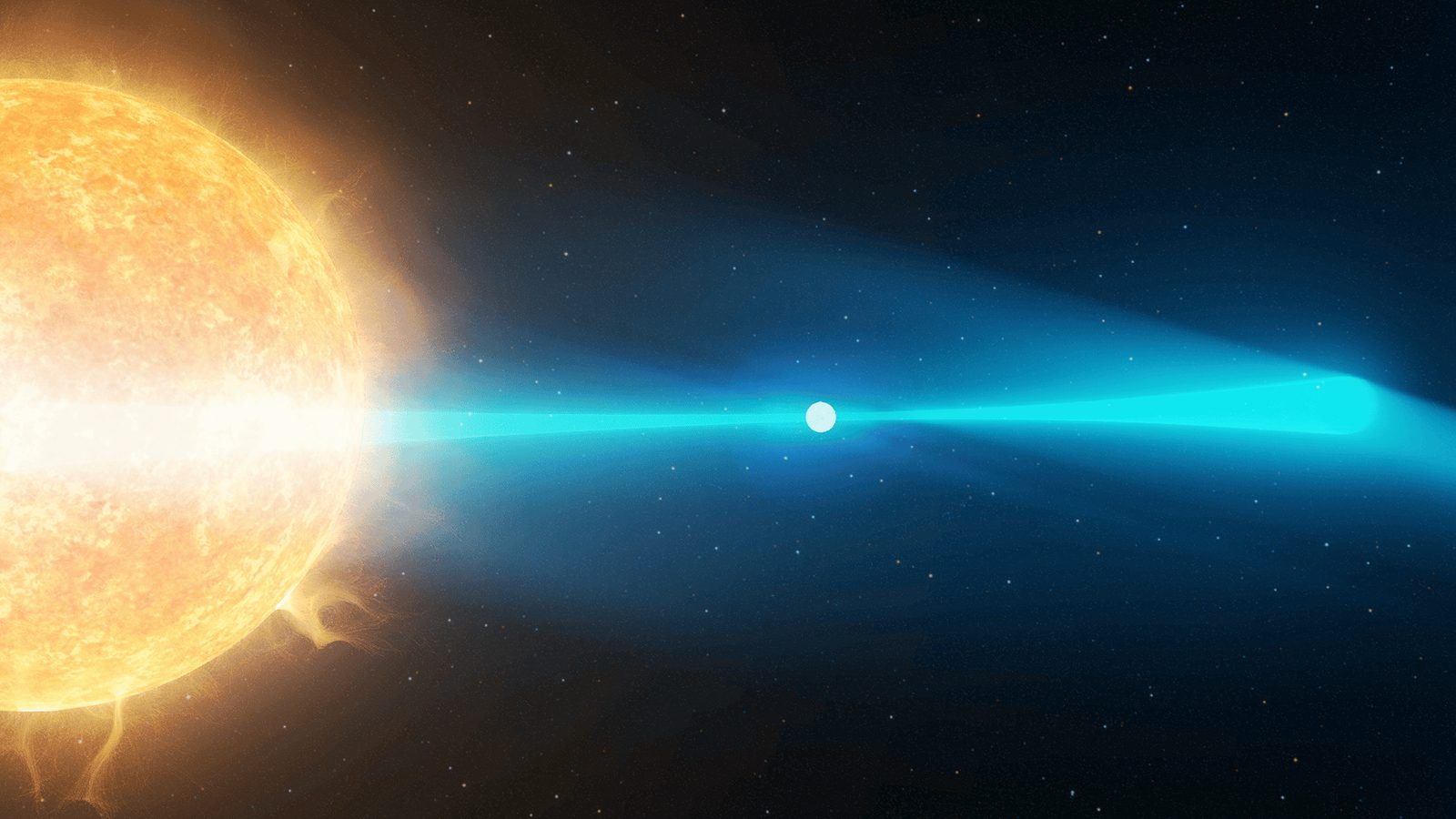
Long-period transients (LPTs) switch their radio emission on and off over timescales stretching from minutes to hours—orders of magnitude slower than conventional millisecond or second-scale neutron-star pulsars. Since ICRAR scientists discovered the first LPT in 2021, roughly twelve systems have been cataloged, yet ambiguities remained around their physical engines. "This is the first time the pulses are clear enough to see the white dwarf moving in its orbit around its companion, so we know that the pulsations are coming from a region close to the white dwarf, or possibly even from the white dwarf itself," said Dr McSweeney, now a commissioning scientist with the Square Kilometre Array Observatory.
Because the radio beam swept behind the Sun-like G-type companion's magnetized atmosphere during orbit, the team extracted magnetic diagnostics of a distant main-sequence star over 5,000 light-years away. Co-author Associate Professor Hurley-Walker noted the team watched the compact star pass behind what appeared to be a "stellar prominence"—an erupting plasma loop analogous to solar flares that drive geomagnetic aurorae on Earth. Optical verification at Hawaii's W.M. Keck Observatory confirmed the G-type classification following radio triangulation between Western Australia's MWA and South Africa's MeerKAT arrays.
Limits: Even with over 100 hours of radio data processed at the Pawsey Supercomputing Research Centre, Curtin researchers noted astronomers still have not pinned down the exact plasma emission mechanism accelerating particles near the white dwarf, and full global population statistics await completion of the full SKA-Low and SKA-Mid arrays.