Ever since German psychiatrist Hans Berger recorded the first human electroencephalogram in 1924, neuroscience has wrestled with a fundamental question: do electrical brain waves actively drive thought, or are they merely the incidental exhaust of underlying neural computation?
On September 30, 2026, an exhaustive research report published in Quanta Magazine presented definitive evidence resolving the debate, showcasing groundbreaking empirical findings led by Columbia University neuroscientist Josh Jacobs and Abhishek Das.
Utilizing high-density subdural electrocorticography (ECoG) grids placed directly onto the cortical surface of neurosurgical patients undergoing clinical monitoring, researchers recorded millisecond-level neural electrical fields while participants performed complex memory and navigation tasks.
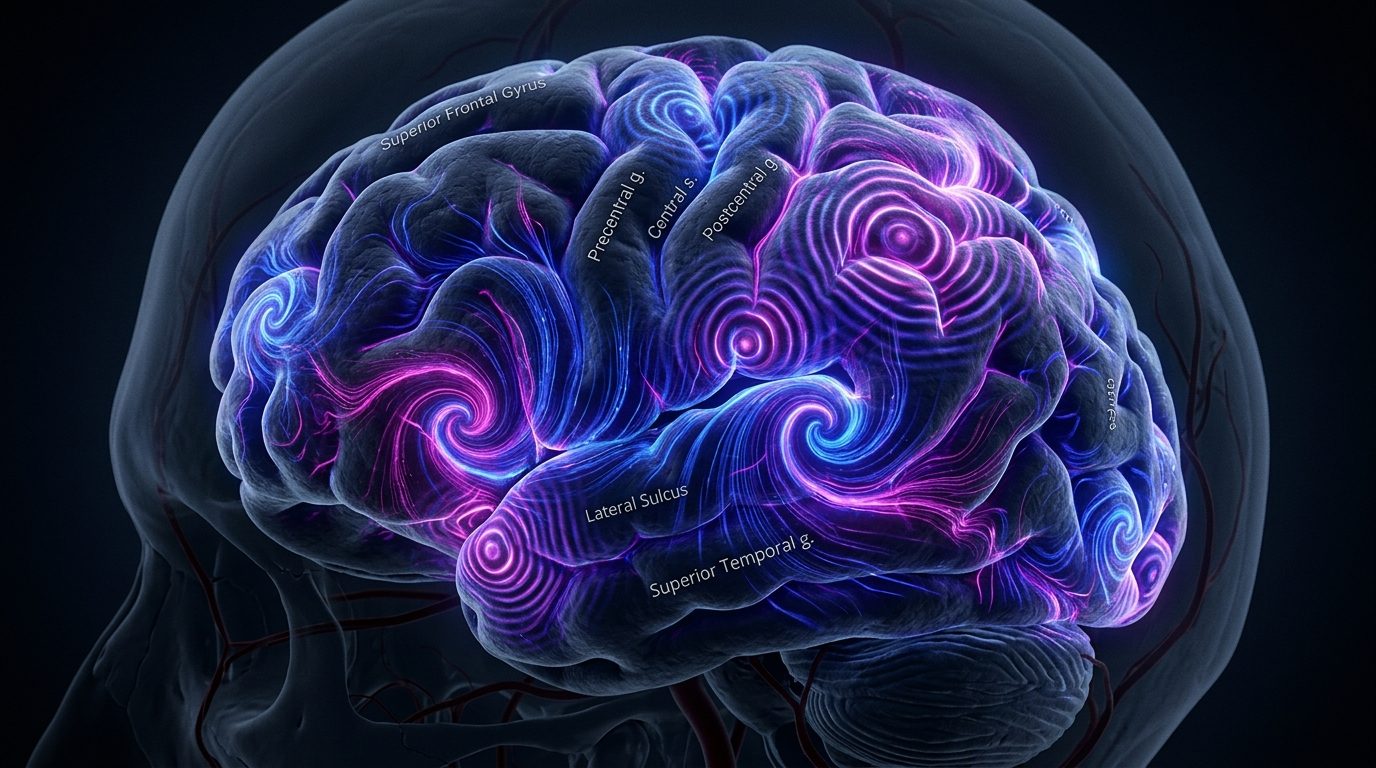
Rather than finding uniform, planar oscillations across the cortex, the high-resolution electrode arrays captured two previously unknown classes of geometric wave dynamics: concentric ripples expanding from central focal points, and elegant rotating spiral waves that spin clockwise and counter-clockwise across cortical gyri.
Crucially, these wave dynamics were directly tied to cognitive performance. When patients navigated intricate virtual 3D mazes requiring spatial memory recall, the density of rotating spiral waves spiked dramatically across the association cortex.
The researchers demonstrated that these spiral vortices create localized phase gradients that act as dynamic computational routers, aligning the receptive windows of distant neural assemblies so that sensory perceptions can bind with episodic memories.
'We are seeing that the brain does not operate like a static telephone switchboard,' observed lead author Dr. Das. 'It is a self-organizing hydrodynamic medium where waves of electrical excitation sculpt the flow of information in real time.'