When Qualcomm introduced the initial Snapdragon X Elite generation in 2024, it proved that ARM architecture could match x86 performance in personal computing. However, for the open-source engineering community, the platform was severely constrained: hardware was locked into proprietary Windows on ARM software stacks, while running Linux required third-party reverse engineering and experimental kernel trees.
On September 23, 2026, Qualcomm announced a decisive paradigm shift: an official, company-backed 'upstream-first' Linux strategy for its upcoming Snapdragon X2 Series processors, accompanied by an Early Developer Preview.
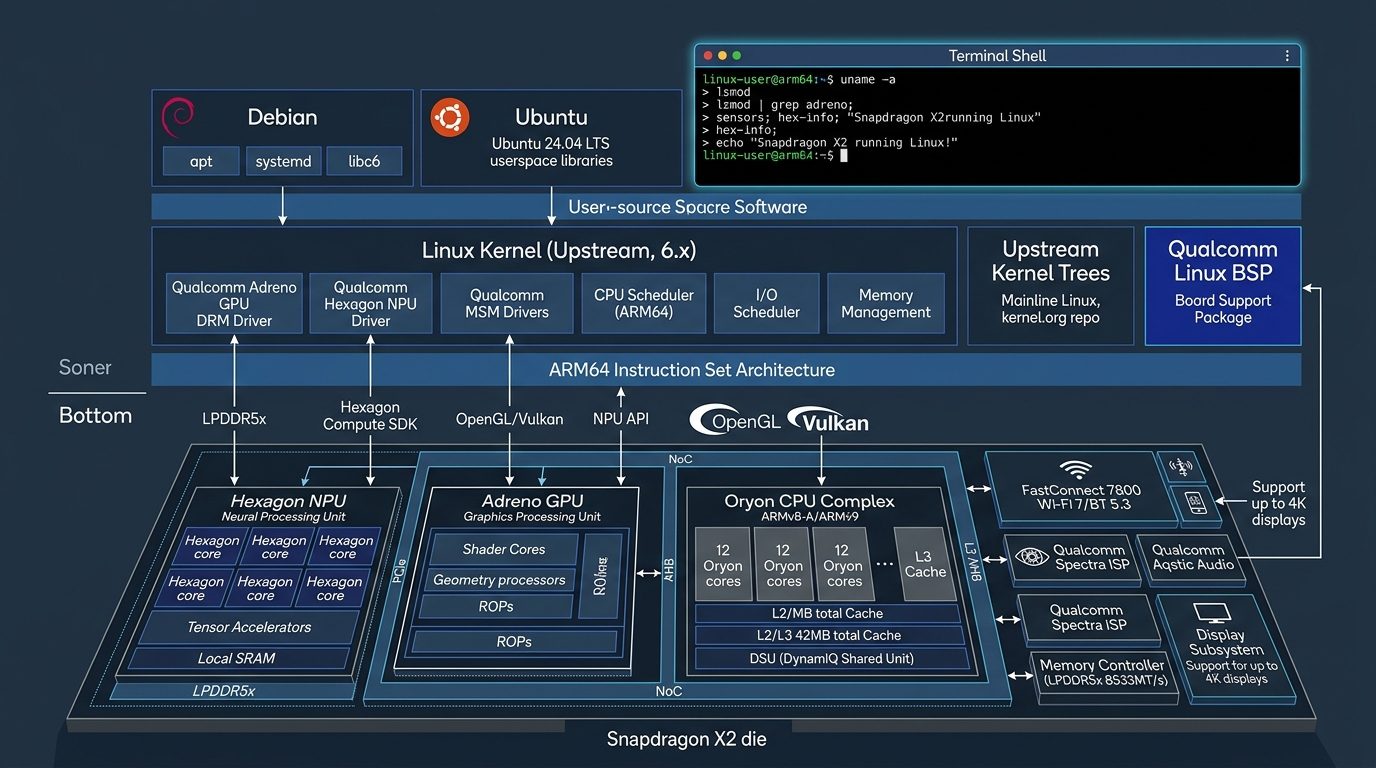
Rather than maintaining proprietary downstream Board Support Packages (BSPs) that inevitably bitrot across Linux releases, Qualcomm's kernel engineering division is submitting patch sets directly to Linus Torvalds and the mainline Linux kernel maintainers. The patches encompass the complete SoC subsystem: Oryon CPU core power states, system interconnects, the Adreno graphics pipeline via the open-source MSM DRM driver, and crucially, the Hexagon Neural Processing Unit (NPU).
The inclusion of upstream Hexagon NPU drivers is a watershed moment for on-device AI engineering. By integrating with the kernel's standard acceleration subsystem (accel/npu) alongside open-source FastRPC userland libraries, developers can dispatch INT8, FP16, and micro-tensor matrix operations directly from frameworks like PyTorch, llama.cpp, and ONNX Runtime without proprietary vendor blobs. This positions Snapdragon X2 laptops as formidable, power-efficient local development workstations capable of hosting quantized 7B-to-14B models on battery power.
Qualcomm confirmed that Debian 13 ('Trixie') serves as the active testing environment, with Canonical officially certifying Ubuntu for Snapdragon X2 platforms for release in the first half of 2027. Major OEM partners have already committed hardware: ASUS will offer Ubuntu pre-loaded on its upcoming Zenbook A14 and A16 laptops, with Dell Technologies and HP Inc. preparing enterprise developer configurations.
By eliminating the proprietary driver wall, Qualcomm is establishing ARM64 as a first-class citizen in the Linux workstation ecosystem, delivering the battery longevity of Apple Silicon paired with the open flexibility of mainline GNU/Linux.