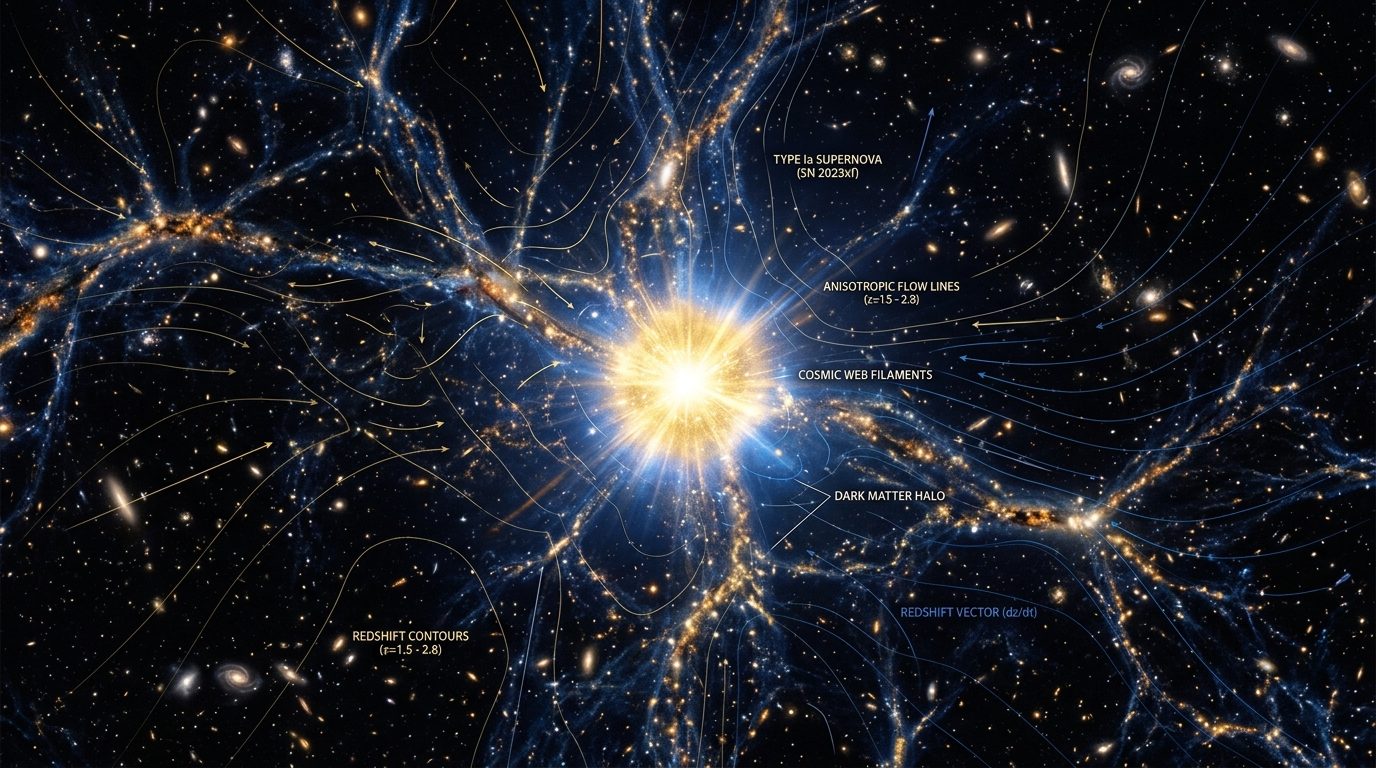
In a paper published in Nature Astronomy that has sent shockwaves through the global astrophysics community, researchers from the University of Oxford and the Tata Institute of Fundamental Research (TIFR) have presented evidence challenging one of modern physics' central dogmas: the accelerated expansion of the universe driven by dark energy.
Since 1998, when observations of Type Ia 'standard candle' supernovae revealed that distant stellar explosions appeared dimmer than expected in a matter-dominated universe, modern cosmology has been anchored to the Lambda-Cold Dark Matter (Lambda-CDM) paradigm. According to this model, an unobserved, uniform vacuum energy densitytermed dark energypermeates all space and drives runaway cosmic expansion, constituting roughly 68% of the total energy budget of the cosmos.
However, standard cosmological analyses have historically rested on the Cosmological Principle: the assumption that, on sufficiently large scales, the universe is strictly homogeneous and isotropic. Working within this mathematical framework, any dimming in supernova luminosity distance is interpreted as isotropic spatial acceleration.
The Oxford-TIFR research team revisited the Pantheon+ supernova catalog, comprising more than 1,700 calibrated Type Ia events, using an unconstrained Bayesian hierarchical model. Rather than forcing the data into an isotropic expansion metric, the researchers simultaneously fitted for both cosmic expansion and large-scale peculiar velocity bulk flowscoherent gravitational drift motions of galaxy clusters moving toward massive cosmic overdensities.
Their analysis revealed that our local region of the cosmos is embedded in an extensive, anisotropic dipole bulk flow moving at approximately 420 kilometers per second out to a redshift of z = 0.15. When this directional velocity field is disentangled from the cosmic expansion rate, the apparent accelerating component of the cosmic expansion collapses from an undeniable 5.4-sigma statistical significance to a marginal 2.8-sigma result.
While the authors emphasize that dark energy cannot yet be conclusively ruled outas independent evidence exists from CMB angular power spectra and Baryon Acoustic Oscillations (BAO)their work underscores that cosmological standard models have severely underestimated the influence of local astrophysical structures. With the Vera C. Rubin Observatory and Euclid space mission currently capturing unprecedented catalogs of high-redshift supernovae, cosmology stands on the cusp of an empirical reckoning.