In a breakthrough published in Science Advances in late August 2026, an international research team led by Professor Vlatko Vedral at the University of Oxford successfully demonstrated that Einstein’s Equivalence Principle holds firmly within the quantum regime.
For over a century, physicists have searched for empirical regimes where General Relativity and Quantum Mechanics interact directly. Einstein’s Weak Equivalence Principle asserts that the trajectory of a falling body in a gravitational field is independent of its mass and internal composition—famously illustrated by Galileo dropping cannonballs from the Tower of Pisa.
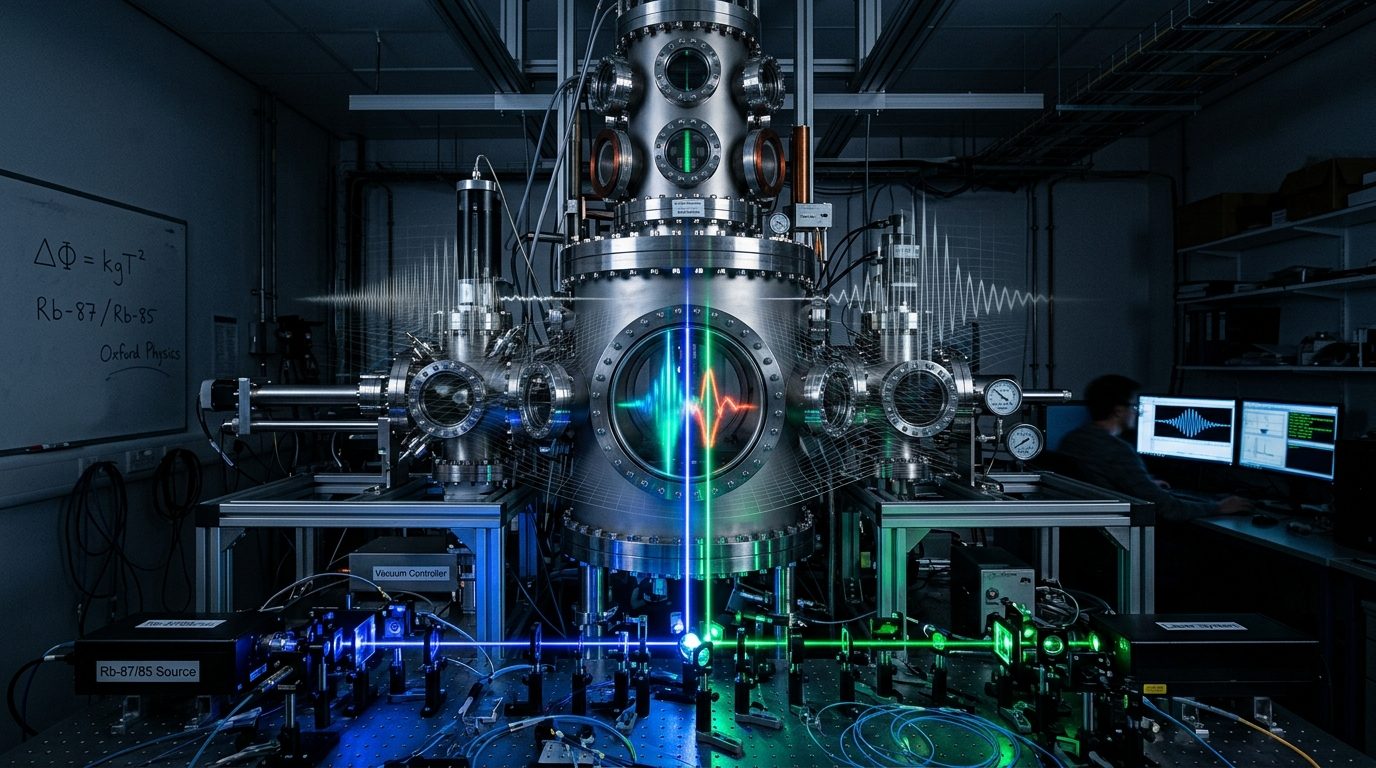
To test whether this principle applies when a single particle occupies two places at once, the team engineered the Quantum Galileo Interferometer. They laser-cooled clouds of rubidium-87 atoms down to nanokelvin temperatures, approaching absolute zero. Using resonant optical pulses, they created a quantum superposition where each atom simultaneously followed two distinct paths: one wavepacket was suspended in place using a tailored magnetic trap, while the twin wavepacket fell freely under Earth’s gravity over a millimeter distance.
When the two trajectories were recombined, the resulting quantum interference fringe shifted by exactly the phase angle predicted by combining Schrödinger’s wave equation with classical Newtonian gravitational potential. The measurement confirmed that gravity couples to quantum wavefunctions without inducing anomalous decoherence.
While the experiment does not yet prove that gravity is quantized, it establishes the most rigorous empirical bridge yet constructed between the two pillars of modern physics, providing a concrete testbed for high-precision quantum sensors and satellite-based geodesy.