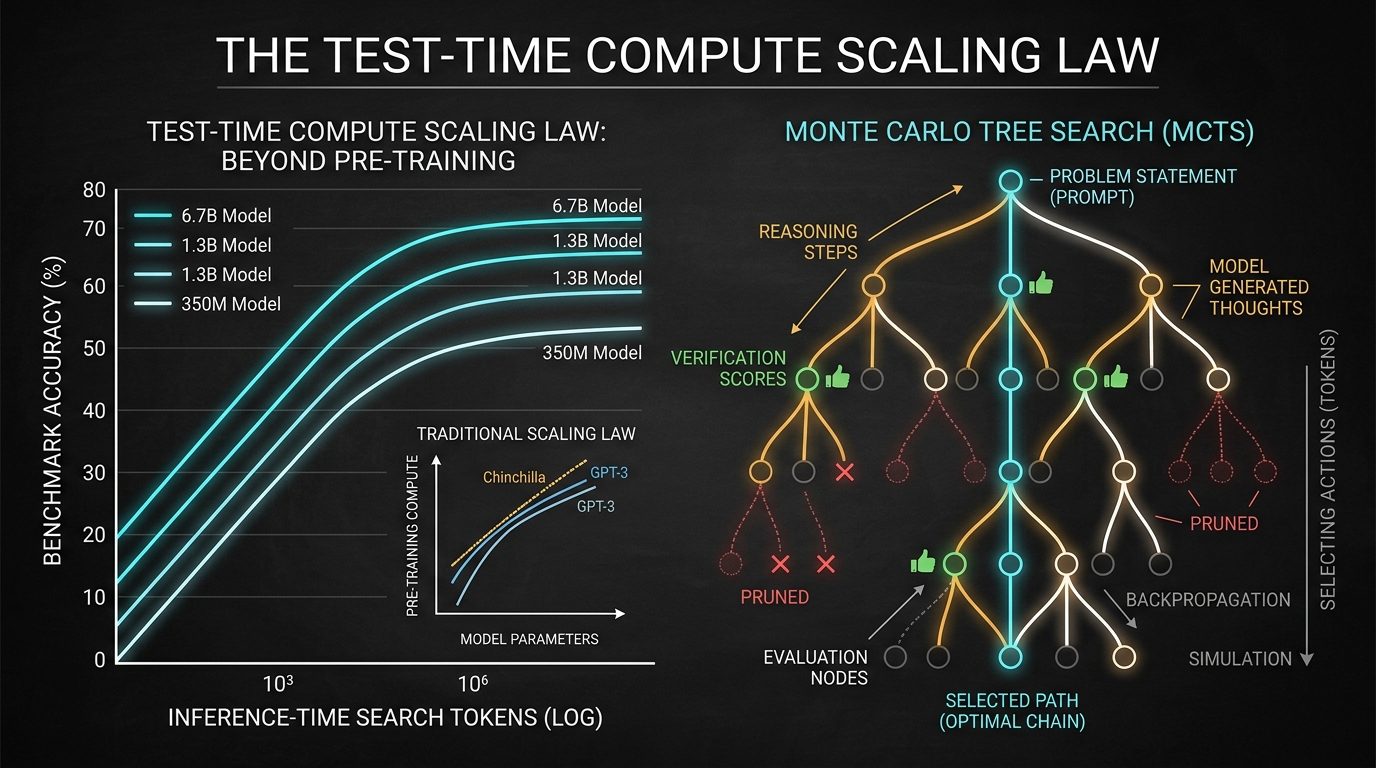
On September 6, 2026, OpenAI released empirical data formalizing the 'test-time compute scaling law,' demonstrating that foundation models can achieve orders-of-magnitude reasoning gains without expanding parameter counts.
Historically, improving AI performance required scaling dataset sizes and parameter counts during pre-training, governed by the Chinchilla scaling laws. However, as frontier models approached hundreds of billions of parameters, pre-training returns began encountering diminishing returns and high capital expenditures. The o1 architecture bypasses this constraint by scaling compute during inference.
Trained with novel reinforcement learning algorithms, o1 learns to produce an extensive chain of thought before providing a final response. Crucially, the model's thinking tokens are not simply longer prompts; they represent active heuristic search. The model learns to break down multi-step proofs, construct counterexamples, catch its own arithmetic errors, and backtrack when a hypothesis fails.
Empirical results published across competitive benchmarks showed steep vertical gains. On GPQA Diamond—a benchmark of PhD-level physics, chemistry, and biology questions—o1 achieved 78.0%, surpassing human expert baselines. On SWE-bench Verified, it solved 48.9% of real-world GitHub issues.
The findings establish a dual-scaling era: pre-training builds the underlying world knowledge, while inference-time search unlocks rigorous formal reasoning.