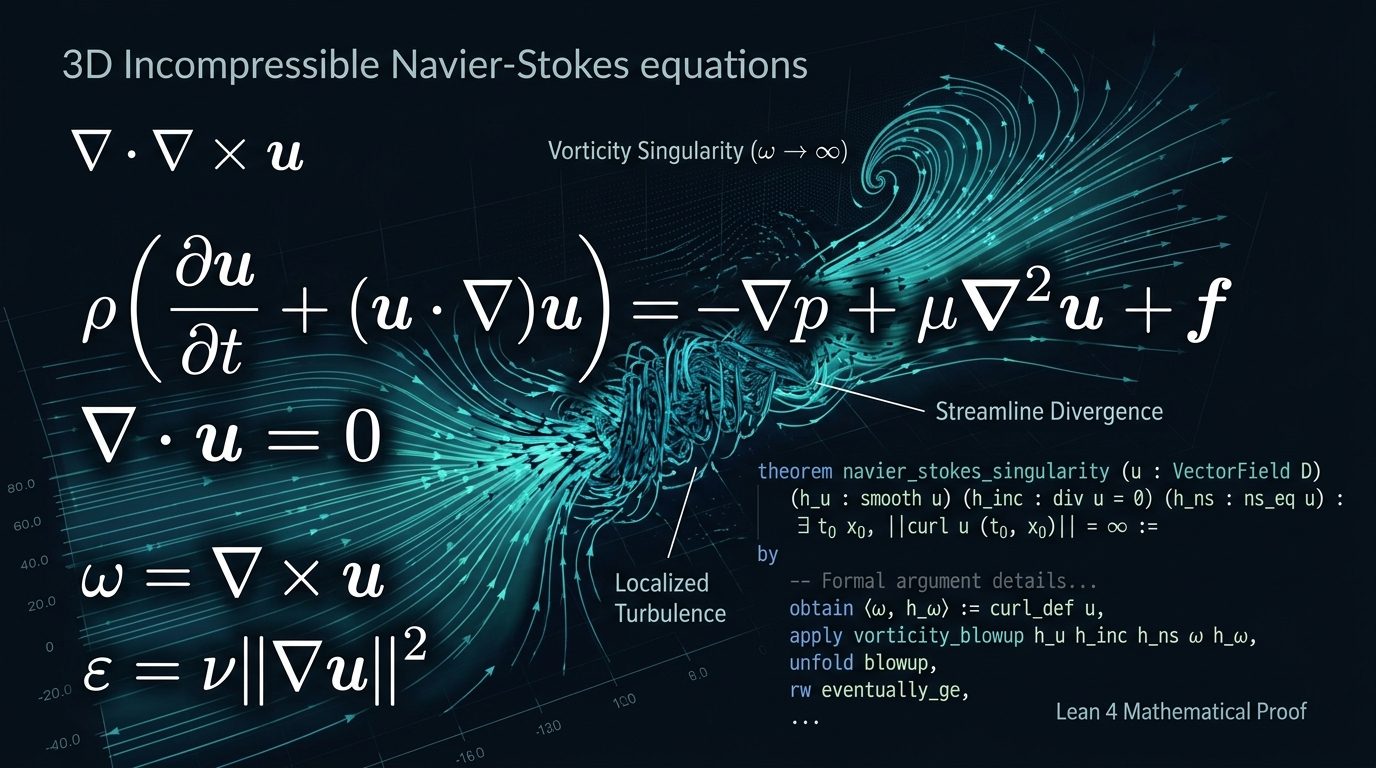
On September 10, 2026, OpenAI released a 166-page research manuscript alongside a public GitHub repository containing thousands of lines of machine-checked formal code in Lean 4, claiming the first computer-verified proof of a finite-time singularity in three-dimensional incompressible fluid dynamics.
The result addresses the renowned Navier–Stokes existence and smoothness problem—one of the seven Millennium Prize Problems designated by the Clay Mathematics Institute in 2000. Under standard conditions, the Navier–Stokes equations govern the motion of viscous fluid substances, from atmospheric air currents to water turbulence in pipelines. A central question in mathematical physics for over a century has been whether smooth, physically realistic initial velocity profiles can evolve over finite time into a 'singularity'—a catastrophic blowup where fluid velocity or vorticity reaches infinity.
According to technical documentation released by OpenAI, the formal proof was synthesized by an internal distributed system orchestrating roughly 10,000 automated reasoning agents operating over massive parallel search trees. Rather than relying on standard autoregressive next-token prediction, the system coupled deep reinforcement learning with the Lean 4 formal proof assistant. Whenever an agent proposed a lemma, the Lean kernel executed deterministic syntactic and semantic validation. If a candidate proof step failed, the system generated structured execution traces to prune invalid deductive branches and backpropagate error signals.
The generated proof establishes that given a smooth, localized external forcing term f(x, t), solutions to the 3D incompressible Navier–Stokes equations on the torus T³ develop infinite vorticity ||ω(·, t)||_{L∞} in finite time T* > 0. The proof constructs a self-similar contracting vortex profile that concentrates kinetic energy into an infinitesimal volume, overcoming classical dissipation barriers.
Crucially, OpenAI explicitly stated that it does not claim the $1 million Millennium Prize from the Clay Mathematics Institute. The official Millennium Prize formulation strictly requires the unforced Navier–Stokes equations (where external forcing f = 0). While introducing a smooth forcing term alters the physical conservation constraints, mathematicians agree that resolving the forced case with formal Lean verification is a monumental milestone in geometric fluid analysis.
The announcement also triggered an intense priority dispute within the academic community. Mathematician Tristan Buckmaster of New York University and researcher Levent Alpöge of Anthropic had recently shared related preprints and partial Lean formalizations investigating forced Navier-Stokes blowups. Buckmaster voiced concerns regarding how OpenAI's automated reasoning clusters ingested academic work. OpenAI maintained that its agent swarm derived its energy inequalities and self-similar ansatz independently from first principles in Lean's Mathlib.
Regardless of the academic dispute, the deployment demonstrates that frontier AI has graduated from conversational assistance into high-dimensional formal mathematics. As verification pipelines scale, formal proof assistants like Lean 4 are poised to transform how theoretical science is conceived, validated, and disseminated.