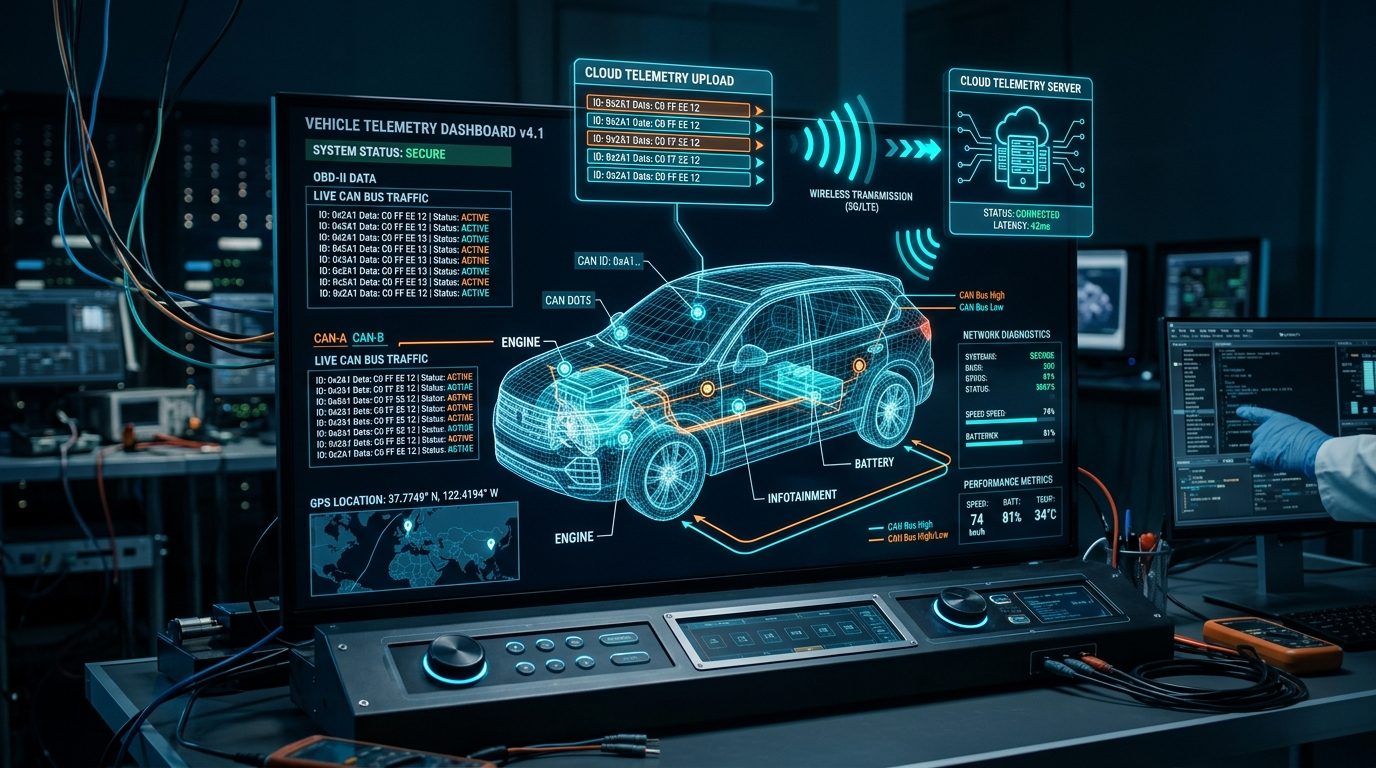
Modern passenger automobiles have quietly completed a structural metamorphosis from mechanical transportation machines into dense, network-connected sensor arrays. In a landmark academic security study titled 'Automatic Transmission: An Empirical Study of Data Privacy in the Connected Vehicle Ecosystem,' researchers from Northeastern University's Khoury College of Computer Sciences revealed that modern vehicles systematically harvest and transmit sensitive driver behavioral telemetry directly to third-party advertising networks and data aggregators.
The Northeastern research team executed a rigorous, multi-month forensic hardware and network audit. The study tested 21 modern connected vehicles across 19 global original equipment manufacturers (OEMs)—spanning American, European, and Asian automakers—alongside 30 associated companion mobile applications across iOS and Android platforms.
The empirical findings are stark: 19 of the 21 tested vehicles (90.5%) were documented transmitting outbound telemetry streams to external commercial entities unrelated to vehicle operation or emergency roadside assistance. Using custom hardware man-in-the-middle network interception proxies positioned between the vehicles' cellular Telematics Control Units (TCUs) and cellular base station emulators, researchers decoded packet payloads containing real-time GPS coordinates, vehicle speed, seatbelt sensor states, acceleration vectors, and unique hardware identifiers.
Furthermore, the accompanying mobile smartphone apps proved to be massive privacy vulnerability multipliers. Of the 30 companion apps analyzed, seven transmitted raw or lightly hashed personal identifiers—including the driver's legal name, primary email address, mobile phone number, and unique 17-character Vehicle Identification Number (VIN)—directly to commercial tracking networks. On average, activating a vehicle's companion mobile app doubled the driver's exposure to commercial data brokers.
Network packet analysis revealed that exfiltrated telemetry flowed directly to major technology ecosystems, including Alphabet (Google), Amazon, Meta, Microsoft, Pinterest, and Reddit, as well as specialized automotive insurance risk evaluators. In many instances, the data streams were structured to allow advertising exchanges to correlate a vehicle's precise geographic location in real time with the driver's mobile advertising identifiers (IDFA and AAID).
When the researchers confronted automotive manufacturers with their empirical packet captures, automaker representatives claimed that all data transmissions complied with their published customer service agreements and privacy disclosures. However, the study notes that vehicle terms of service are notoriously expansive, frequently burying telemetry-sharing authorizations across dozens of dense legal pages that drivers must accept to activate basic navigation or climate control features.
The findings arrive amid escalating regulatory pushback against automotive surveillance. The Federal Trade Commission and state attorneys general have already signaled investigations into auto insurers purchasing driving score data without explicit affirmative consent, leading to arbitrary rate spikes.
Security engineers emphasize that mitigating connected vehicle surveillance requires architectural isolation. Similar to modern avionics, automotive electronic architectures must physically sever the safety-critical CAN bus and engine control modules from the infotainment and cellular telemetry units, implementing hardware-enforced packet filtering that blocks non-essential telemetry exfiltration at the physical layer.