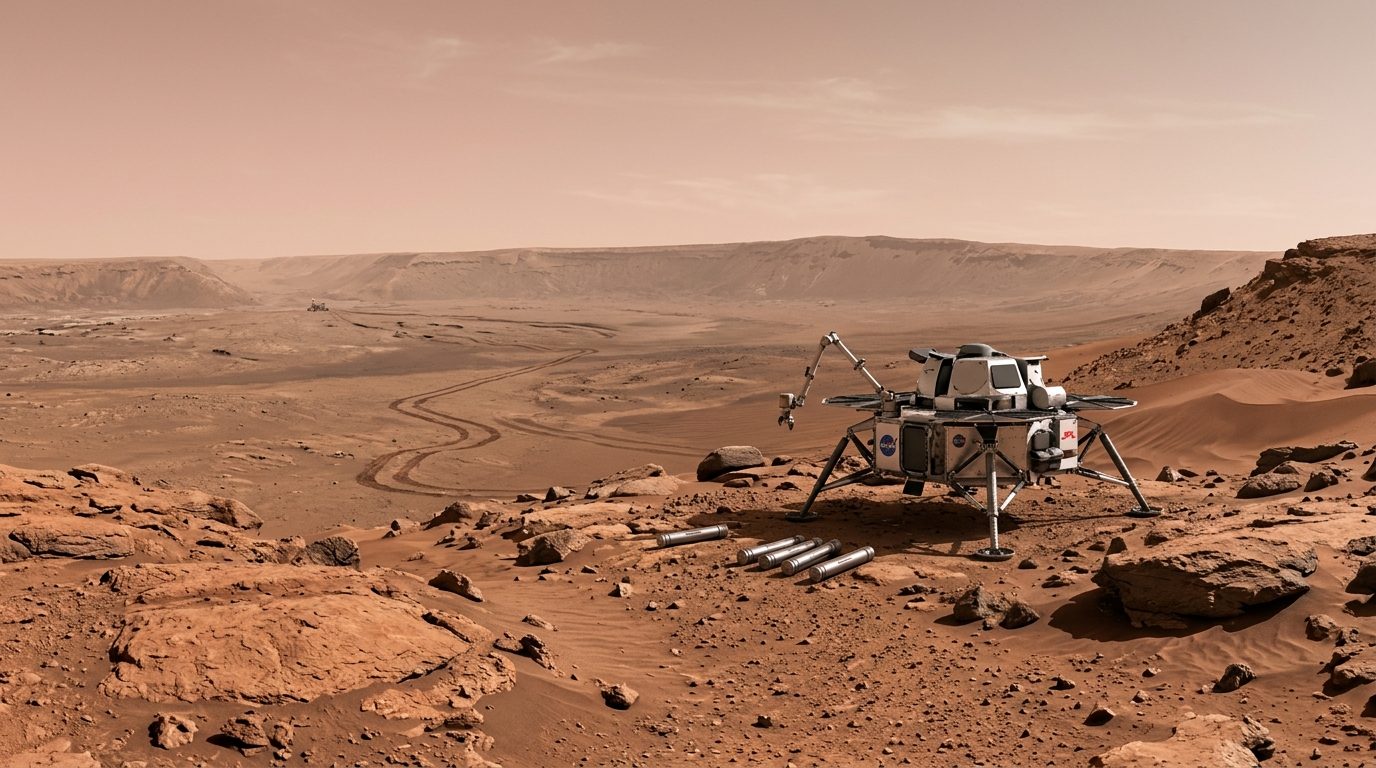
On September 21, 2026, NASA leadership and the European Space Agency announced the cancellation of the Mars Sample Return (MSR) campaign, marking one of the most consequential and agonizing programmatic retreats in the history of robotic deep-space exploration.
The decision, detailed in an exhaustive report published by Science Magazine, follows months of internal soul-searching after an Independent Review Board (IRB) concluded that NASA's baseline architecture—consisting of a Sample Retrieval Lander, Mars Ascent Vehicle (MAV), and Earth Return Orbiter—was structurally unaffordable. The projected lifecycle budget had exploded from an initial estimate of $4.4 billion to more than $12.8 billion, with projected return dates slipping from 2033 to beyond 2040.
The cancellation creates an unprecedented scientific heartbreak. Since touching down on Mars in February 2021, NASA's car-sized Perseverance rover has meticulously drilled and hermetically sealed 38 titanium sample tubes containing rock cores, regolith, and atmospheric gas from the ancient lacustrine delta of Jezero Crater. Planetary geologists widely consider these pristine samples the most valuable astrobiological specimens ever collected, holding the highest probability of containing fossilized microbial biosignatures from Mars's warm, wet past.
Now, those 38 titanium canisters will remain indefinitely parked at the 'Three Forks' sample depot and within Perseverance's internal belly carousel on the frozen Martian plain, with zero near-term hope of recovery.
The budgetary fallout from MSR was already ravaging other corners of NASA's science directorate. Efforts to keep MSR afloat had forced the agency to postpone the Dragonfly rotorcraft mission to Saturn's moon Titan, cut grants for university astrophysics teams, and furlough hundreds of specialized engineers at the Jet Propulsion Laboratory (JPL) in Pasadena, California.
In terminating the bloated flagship architecture, NASA Administrator and planetary science chiefs announced a complete strategic pivot: rather than continuing institutional development, NASA will issue a broad solicitation to the commercial aerospace sector. The agency is asking private entities—including SpaceX with its Starship vehicle, Blue Origin, and Rocket Lab—to submit innovative, lower-cost architectures capable of retrieving a subset of the Jezero samples before 2035 at a hard budget cap under $3 billion.
While the cancellation closes the book on a multi-decade dream of government-led planetary sample recovery, it throws the future of Martian exploration squarely into the arena of commercial commercialization and human landing architectures.