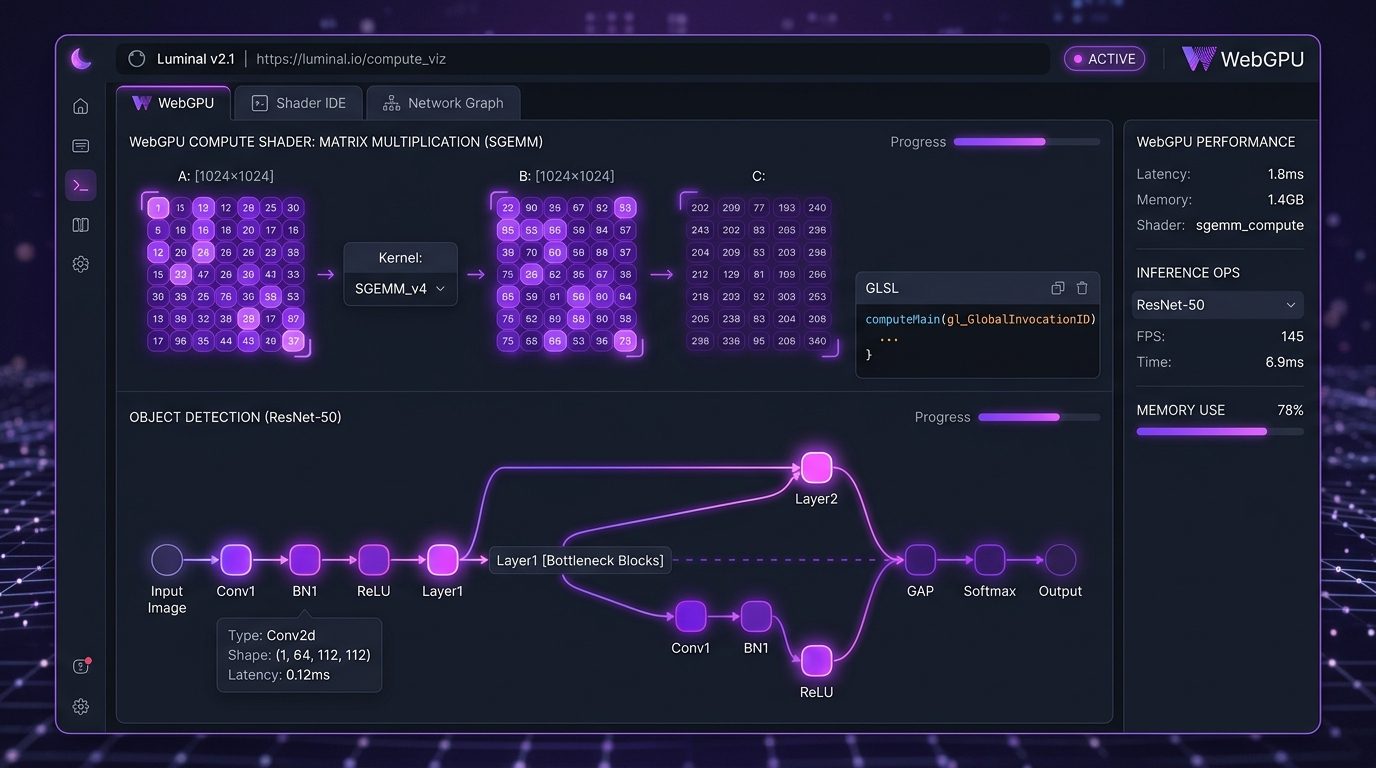
The promise of client-side artificial intelligence reached a major milestone on September 28, 2026, with the public release of MicroLLM Lab—an interactive open-source demonstration platform that runs seven distinct sub-1B foundation models directly inside the browser using WebGPU.
Built by web graphics and machine learning engineers at State of Utopia, MicroLLM Lab bypasses the need for server backends, remote API keys, or specialized native desktop installations like Ollama.
When a user loads the application, the model weights are retrieved once via HTTP range requests and cached locally in the browser's Origin Private File System (OPFS). From that point forward, all tokenization, KV-cache management, and matrix multiplications occur entirely inside WebGPU compute shaders.
The laboratory features a roster of seven lightweight models, including SmolLM2-360M, Qwen2.5-0.5B, and Danube3-500M. Using hand-tuned WGSL (WebGPU Shading Language) GEMM kernels and 3-bit AWQ quantization, the engine delivers blistering generation speeds of 45 to 65 tokens per second on mid-range laptop integrated graphics.
Because inference occurs within the browser sandbox, the architecture guarantees absolute privacy: user inputs, prompt history, and generated responses never touch a remote network socket.
The achievement foreshadows a new paradigm in web software development, where search auto-completion, contextual summaries, grammar correction, and local form assistants are bundled directly into web applications as zero-cost, offline client assets.