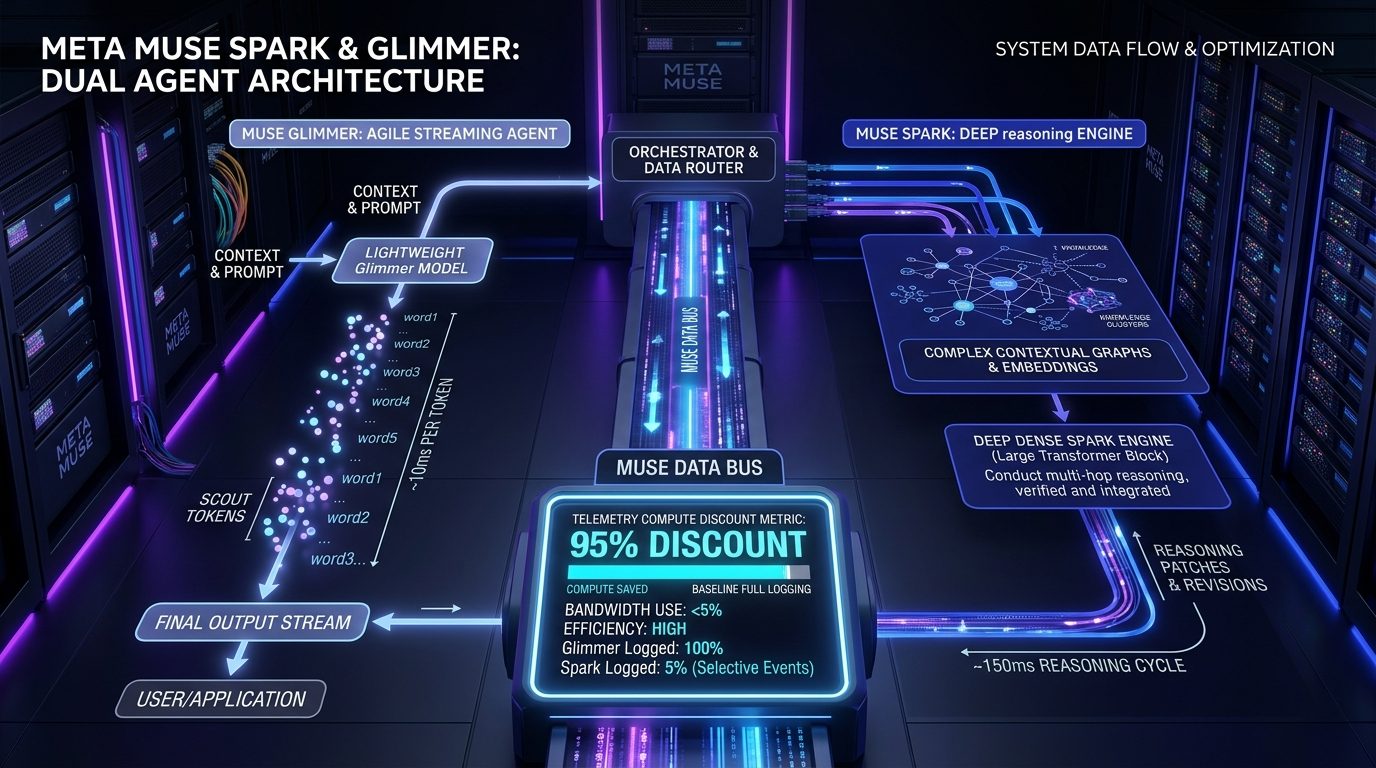
On September 3, 2026, Meta announced Muse Spark and Muse Glimmer, introducing an aggressive economic model designed to capture the global developer agent ecosystem.
Muse Spark represents Meta’s premier agentic architecture. Trained specifically on long-horizon terminal execution logs, compiler error corrections, and multi-file Git diffs, Muse Spark excels at taking high-level feature requirements and autonomously editing large codebases without breaking dependencies.
What caused widespread reverberations across the industry, however, was Meta’s accompanying commercial strategy. For standard private API usage, Muse Spark is priced competitively at $2.50 per million input tokens and $10.00 per million output tokens. But developers who opt into Meta’s 'Data Contributor Program'—agreeing to transmit raw prompt chains, tool invocations, and terminal outputs to Meta for model retraining—receive an immediate 95% price cut, driving costs down to mere pennies.
Simultaneously, Meta released Muse Glimmer as open weights. Engineered with novel weight-quantization and grouped-query attention, Glimmer runs locally on consumer Mac and PC workstations equipped with 16GB of unified memory, offering local agent capabilities without cloud connectivity.
Industry analysts observe that Meta is deploying its classic open-source playbook: commoditizing the infrastructure layer while securing the scarce human interaction telemetry required to lead the next generation of physical and software robotics.