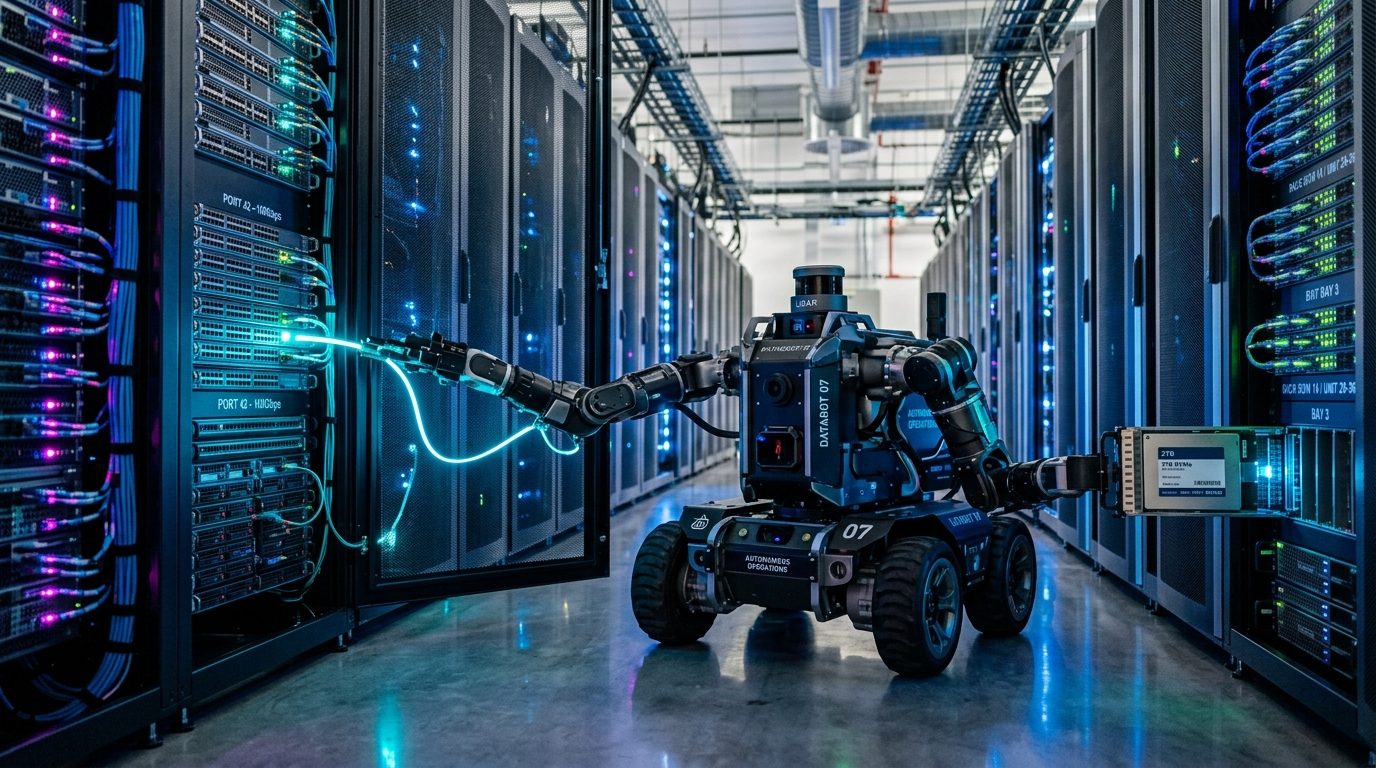
In late August 2026, Meta’s infrastructure engineering division pulled back the curtain on one of the industry's most ambitious hardware automation initiatives: deploying autonomous robots to service live hyperscale AI data centers.
Operating multi-gigawatt facilities housing hundreds of thousands of high-performance accelerators presents severe operational logistical hurdles. Server halls stretch for hundreds of meters in high-noise, high-temperature environments. When a single InfiniBand optical cable degrades or an NVMe drive crashes during a distributed training run, human technicians must navigate vast aisles to manually locate and swap the failed module.
Meta’s solution is a bespoke fleet of autonomous mobile manipulators (AMMs). Built upon a high-stability omnidirectional wheeled base, each unit features a 6-degree-of-freedom robotic arm fitted with custom interchangeable tooling. Guided by SLAM navigation and ultra-wideband indoor beacons, the robots navigate aisles autonomously while monitoring real-time telemetry from Meta's cluster management systems.
When an alert flags a malfunctioning component, the nearest robot is dispatched. Using high-resolution stereo cameras and laser profilometry, the robot aligns its gripper with sub-millimeter accuracy, unlatches the failed module, places it in an onboard quarantine tray, and inserts a fresh component from its inventory.
Initial field results across Meta’s Prineville and Altoona data centers indicate that the automated system has achieved a 99.4% success rate across more than 14,000 automated hardware interventions, reducing cluster mean-time-to-repair from 180 minutes down to less than 12 minutes.