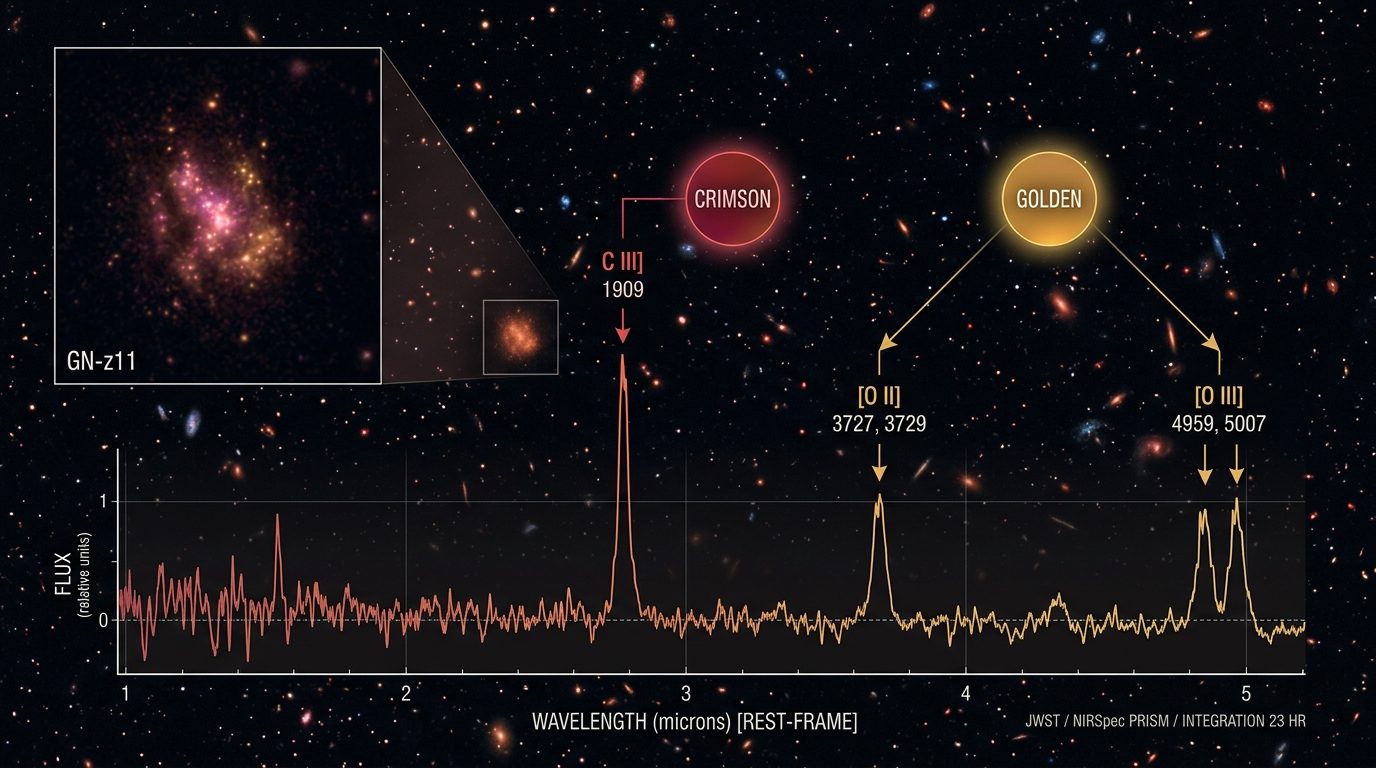
On September 8, 2026, an international collaboration of astronomers operating NASA's James Webb Space Telescope (JWST) published peer-reviewed spectroscopic findings confirming anomalous, rapid heavy-element enrichment within primordial galaxy J1120+0641 at a confirmed redshift of z = 8.64.
Light captured from J1120+0641 was emitted just 570 million years after the Big Bang, during the heart of the Epoch of Reionization when the universe was less than 5% of its present age. Under prevailing cosmological orthodoxy, structures formed during this epoch were presumed to consist almost entirely of pristine hydrogen and helium forged in primordial nucleosynthesis, with only trace abundances of heavier elements synthesized by the earliest stellar generations.
However, deep spectroscopic integration conducted with JWST's Near-Infrared Spectrograph (NIRSpec) utilizing its micro-shutter array over a 23.4-hour exposure revealed clear, unmistakable spectral emission signatures of ionized oxygen ([O III] λλ4959, 5007Å) and semi-forbidden carbon (C III] λ1909Å). Flux calibration and photoionization modeling indicate a gas-phase metallicity of approximately 20% of the solar value ([O/H] ≈ -0.7).
This finding presents a profound challenge to standard galaxy evolution timelines. In standard astrophysical models, building up 20% of solar metallicity requires billions of years of cumulative stellar birth, nucleosynthesis, and asymptotic giant branch (AGB) mass loss. In J1120+0641, this chemical enrichment occurred within an ultra-compressed window of less than 300 million years following the formation of the first dark matter halos.
Astrophysicists hypothesize that the extreme metallicity was catalyzed by an initial burst of hypermassive Population III stars (exceeding 200 solar masses) that ended their brief, several-million-year lifespans in cataclysmic pair-instability supernovae. Rather than collapsing directly into black holes without ejecta, these hypernovae completely atomized their stellar cores, ejecting dozens of solar masses of synthesized carbon, oxygen, and silicon directly into the circumgalactic medium at thousands of kilometers per second.
The observations suggest that the cosmic dawn was chemically far more violent, dynamic, and rapidly mature than previously recognized, fundamentally recalibrating models of early star formation, interstellar dust production, and the seeding of supermassive black holes.