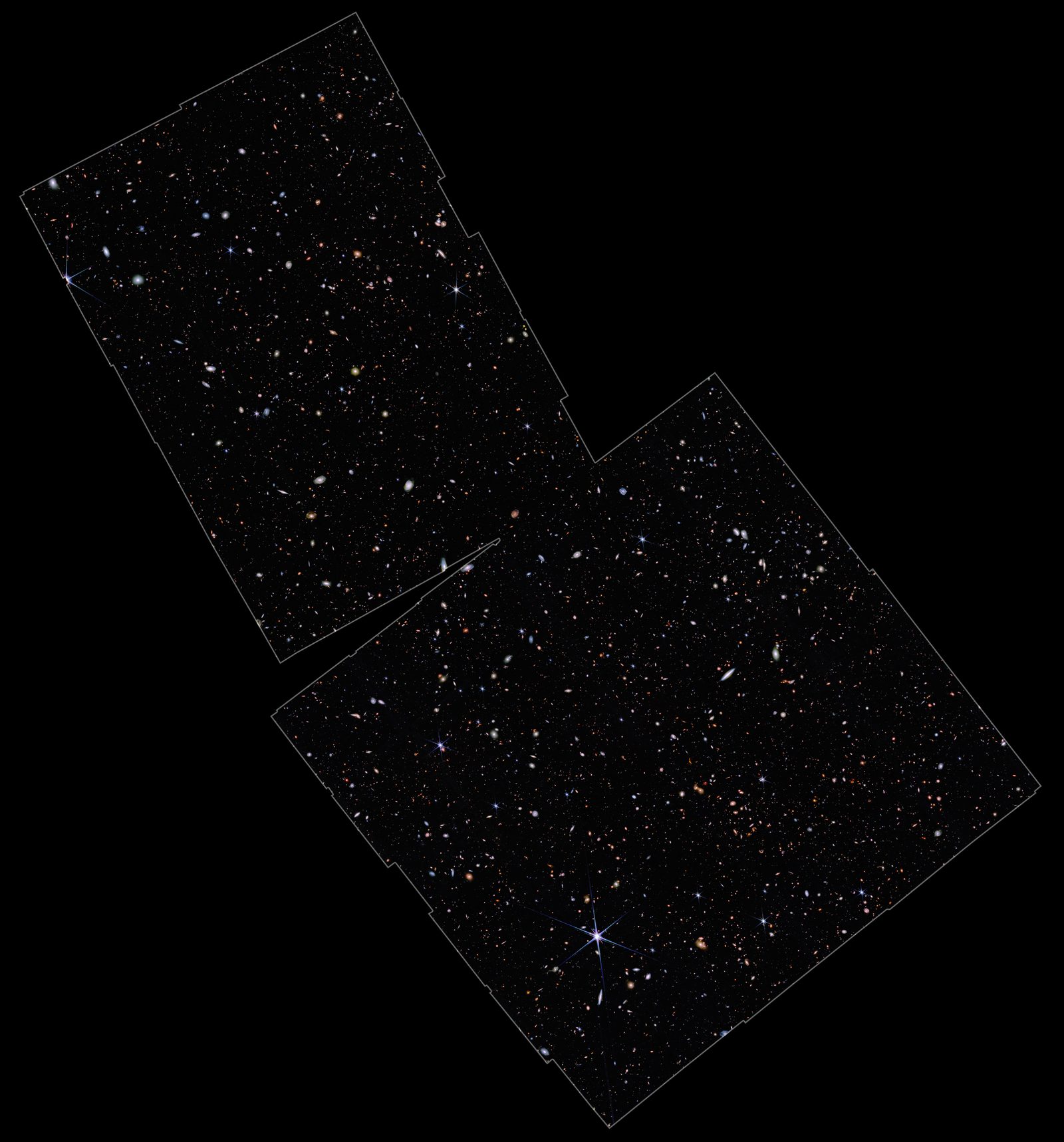
On August 22, 2026, the international astrophysics community celebrated a watershed discovery as NASA, ESA, and CSA scientists confirmed that the James Webb Space Telescope had definitively broken the cosmic distance record by spectroscopically observing galaxy JADES-GS-z14-0.
Prior to JWST's launch, the earliest observable galaxies observed by the Hubble Space Telescope dated to approximately 400 to 500 million years after the Big Bang. Theoretical models of structure formation suggested that the first 300 million years—known as the Cosmic Dawn—were dominated by dark matter halos slowly accreting pristine hydrogen and helium, forming only tiny, faint proto-clusters.
JADES-GS-z14-0 defies these assumptions entirely. Observed as part of the JWST Advanced Deep Extragalactic Survey (JADES), the galaxy was captured with NIRSpec during a 10-hour exposure. The resulting spectrum exhibited a distinct Lyman-break feature at a redshift of 14.32.
More startling than its distance was its physical scale. The galaxy is remarkably bright, emitting a blue rest-frame continuum that implies hundreds of millions of solar masses worth of young stars. Crucially, researchers identified strong forbidden emission lines of doubly ionized oxygen ([O III] at 500.7nm rest-frame). Because oxygen cannot form during the Big Bang and must be forged through nuclear fusion inside massive stars, its presence proves that multiple generations of stars had already exploded as supernovae within the first 2% of the universe's current age.
The discovery compels cosmologists to reconsider mechanisms of star formation efficiency and black hole seeding in the infant cosmos.