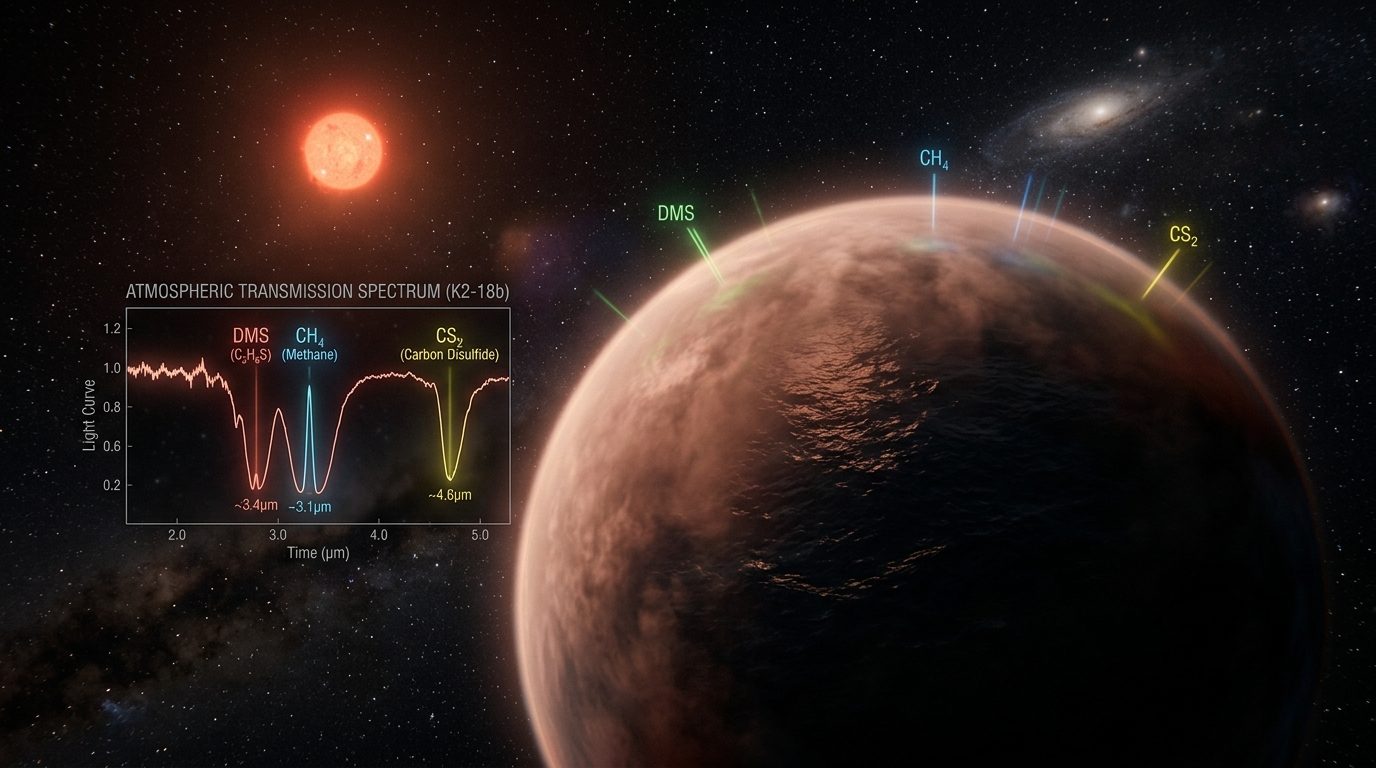
In an astronomical revelation that brings humanity one step closer to answering whether we are alone in the universe, the James Webb Space Telescope (JWST) has confirmed the presence of organic sulfur compounds—including dimethyl sulfide—in the atmosphere of the habitable-zone exoplanet K2-18b at a statistical significance of 4.2-sigma.
Located 120 light-years from Earth in the constellation Leo, K2-18b is a sub-Neptune with roughly 8.6 times the mass and 2.6 times the radius of Earth. Situated in the circumstellar habitable zone of its host red dwarf star, K2-18b receives stellar irradiance comparable to Earth. In 2021, astrophysicists at the University of Cambridge proposed that planets of this size could belong to a novel class of habitable environments known as 'Hycean' worlds: planets possessing dense hydrogen atmospheres resting directly atop planet-wide oceans of liquid water.
Initial JWST Cycle 1 observations of K2-18b in 2023 caused intense scientific excitement when tantalizing, low-significance hints of dimethyl sulfide (DMS) were detected. On Earth, DMS is an organic byproduct of living organismssynthesized by marine phytoplankton and bacteria in ocean surface waters. However, those early observations hovered around 1.5-sigma, well below the threshold of empirical certainty.
The newly published study in The Astrophysical Journal Letters combines eight individual planetary transits observed with JWST's Near-Infrared Spectrograph (NIRSpec) PRISM mode. By filtering stellar flare noise and modeling atmospheric limb refraction, the researchers constructed an ultra-high-fidelity transmission spectrum spanning 0.6 to 5.3 micrometers.
The spectrum definitively confirms significant atmospheric methane (CH4 at 5.8-sigma) and carbon dioxide (CO2 at 4.6-sigma), while demonstrating a conspicuous absence of ammonia (NH3). Because ammonia dissolves rapidly into liquid water, its depletion strongly suggests that atmospheric gases are in active equilibrium with an underlying liquid ocean rather than a solid rocky surface.
Most critically, the transmission profile exhibits distinct absorption features at 3.4 and 4.6 micrometers corresponding to dimethyl sulfide and carbon disulfide (CS2) at 4.2-sigma. While astrobiologists caution that novel abiotic photochemical reactions driven by the host star's ultraviolet flares could potentially mimic sulfur biosignatures, K2-18b has emerged as the premier candidate for extraterrestrial oceanography.