Inside today's frontier AI training facilities, compute clusters consuming upwards of 100 megawatts are running into a hard law of physics: electrical copper interconnects can no longer keep pace with GPU bandwidth demands without boiling their cooling loops.
At per-lane speeds of 212 Gbps and beyond, copper cables suffer severe high-frequency attenuation. Maintaining signal integrity over distances greater than two meters requires aggressive retimers, equalizers, and power-hungry serializer/deserializer (SerDes) silicon—dissipating as much as 12 picojoules per bit and consuming nearly a third of all rack electricity.
At ECOC 2026, hyperscalers Google, Microsoft, and Meta, in partnership with TSMC, Broadcom, and Intel, delivered their unified answer: standardized Co-Packaged Optics (CPO).
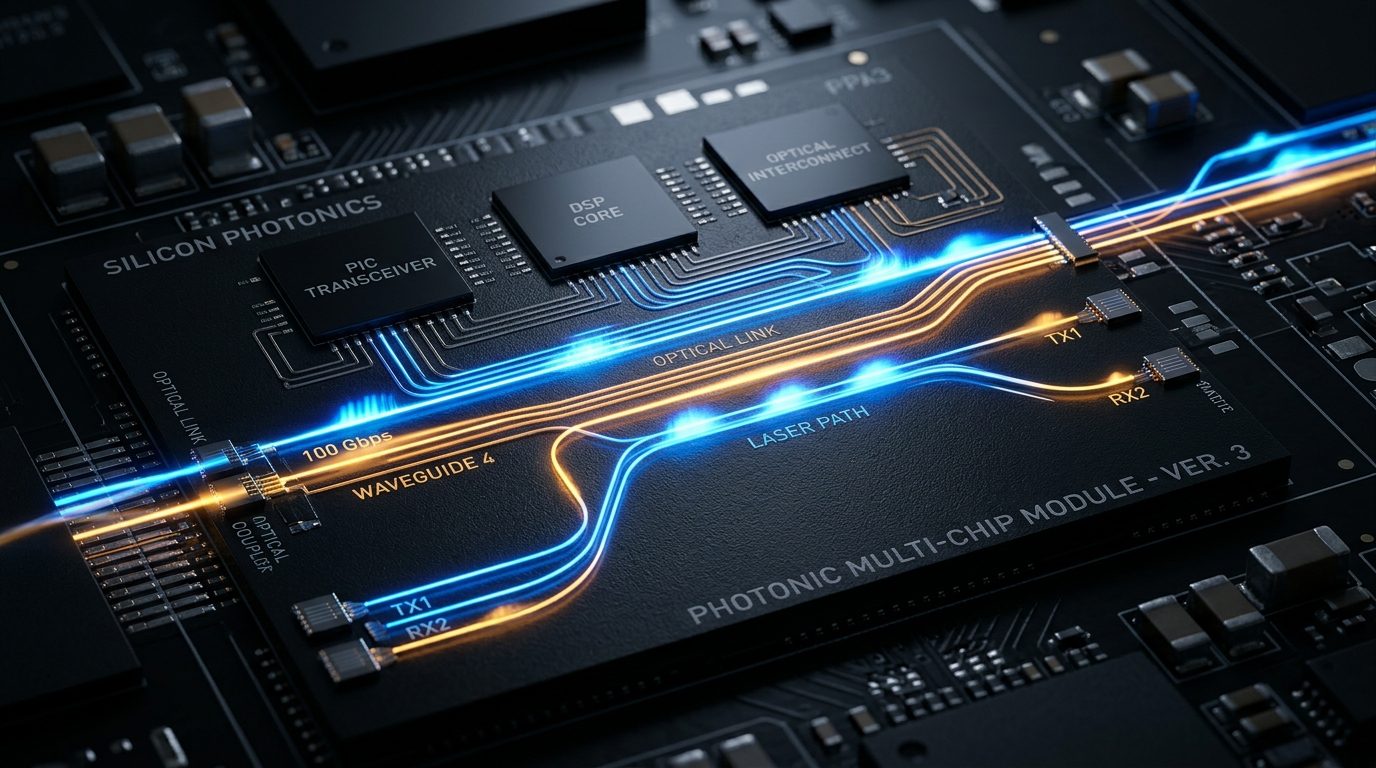
Instead of routing high-speed electrical signals through motherboards to front-panel pluggable optical transceivers, CPO places miniature silicon photonic engines directly onto the processor interposer alongside the GPU and High Bandwidth Memory (HBM). Modulated continuous-wave lasers convert electrical signals to photons within millimeters of the compute logic.
The efficiency gains are transformative. Network interconnect energy dissipation plummets from 12 pJ/bit to less than 3.5 pJ/bit—a 65% net reduction in cluster networking power. Furthermore, because light experiences virtually zero attenuation over hundreds of meters of single-mode fiber, data center designers can expand cluster fabrics from a single row of racks across entire multi-building campuses without latency penalties.
With commercial volume production of 102.4 Tbps optical switch engines scheduled for early 2027, the transition from electrons to photons marks the most consequential infrastructural shift in hyperscale AI computing since the introduction of liquid cooling.