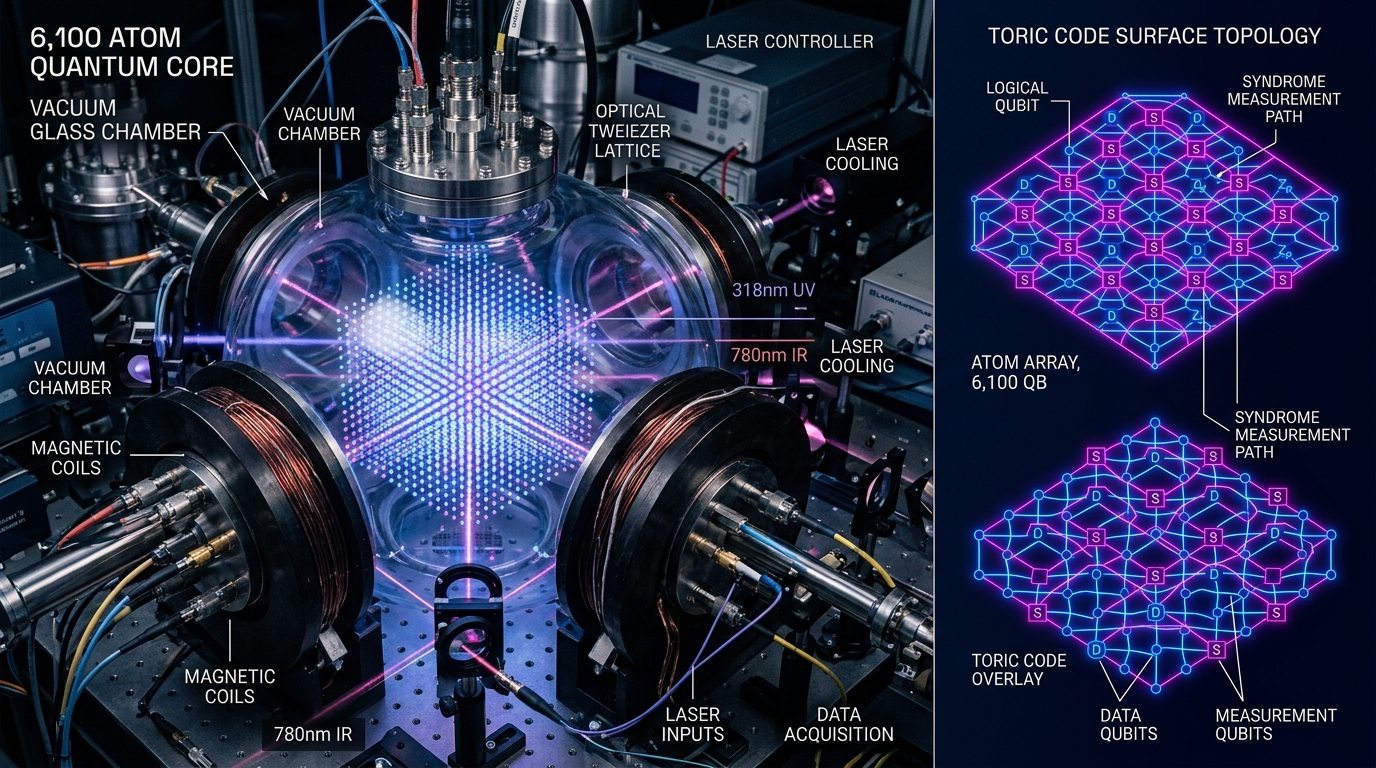
In a peer-reviewed paper published in Nature, physicists from Harvard University and QuEra Computing announced a decisive breakthrough in the race toward scalable, fault-tolerant quantum computation: the continuous operation of a 6,100-qubit neutral-atom quantum processor implementing topological toric codes.
For years, quantum computing has been confined to the Noisy Intermediate-Scale Quantum (NISQ) regime, where physical qubits suffer from environmental decoherence and gate infidelity, rendering deep circuits error-prone. While quantum error correction (QEC) provides a mathematical roadmap to encode 'logical qubits' across many redundant physical qubits, implementing QEC requires thousands of pristine physical qubits and real-time non-destructive syndrome measurements.
The Harvard-QuEra architecture utilizes neutral rubidium-87 (^87Rb) atoms trapped in high-vacuum optical tweezer arrays generated by high-power spatial light modulators. Unlike solid-state superconducting circuits or silicon spin qubits, every neutral atom is inherently identical in physical mass and electronic structure, eliminating device-to-device fabrication variance.
The core architectural breakthrough lies in 3D dynamic rearrangement. Using dual-axis acousto-optic deflectors (AODs), researchers physically shuttled individual atoms across the optical lattice at velocities up to 55 centimeters per second, allowing entangling Rydberg gates (via 318nm ultraviolet lasers) between arbitrary pairs of atoms without nearest-neighbor wire constraints.
Using this dynamic connectivity, the team implemented topological toric code and 2D color code surface patches, demonstrating distance-5 (d=5) and distance-7 (d=7) logical qubits. Crucially, the system executed continuous rounds of non-destructive syndrome measurements by shuttling ancilla atoms into auxiliary readout zones, extracting error syndromes without collapsing the quantum superposition of the data qubits.
The measured logical error rate decreased exponentially with increasing code distance, proving that the physical two-qubit gate fidelity (99.52%) operated decisively below the fault-tolerance threshold. With 6,100 trapped atoms, the processor sustained dozens of fault-tolerant logical qubits simultaneously, marking the beginning of the commercial fault-tolerant quantum computing era.