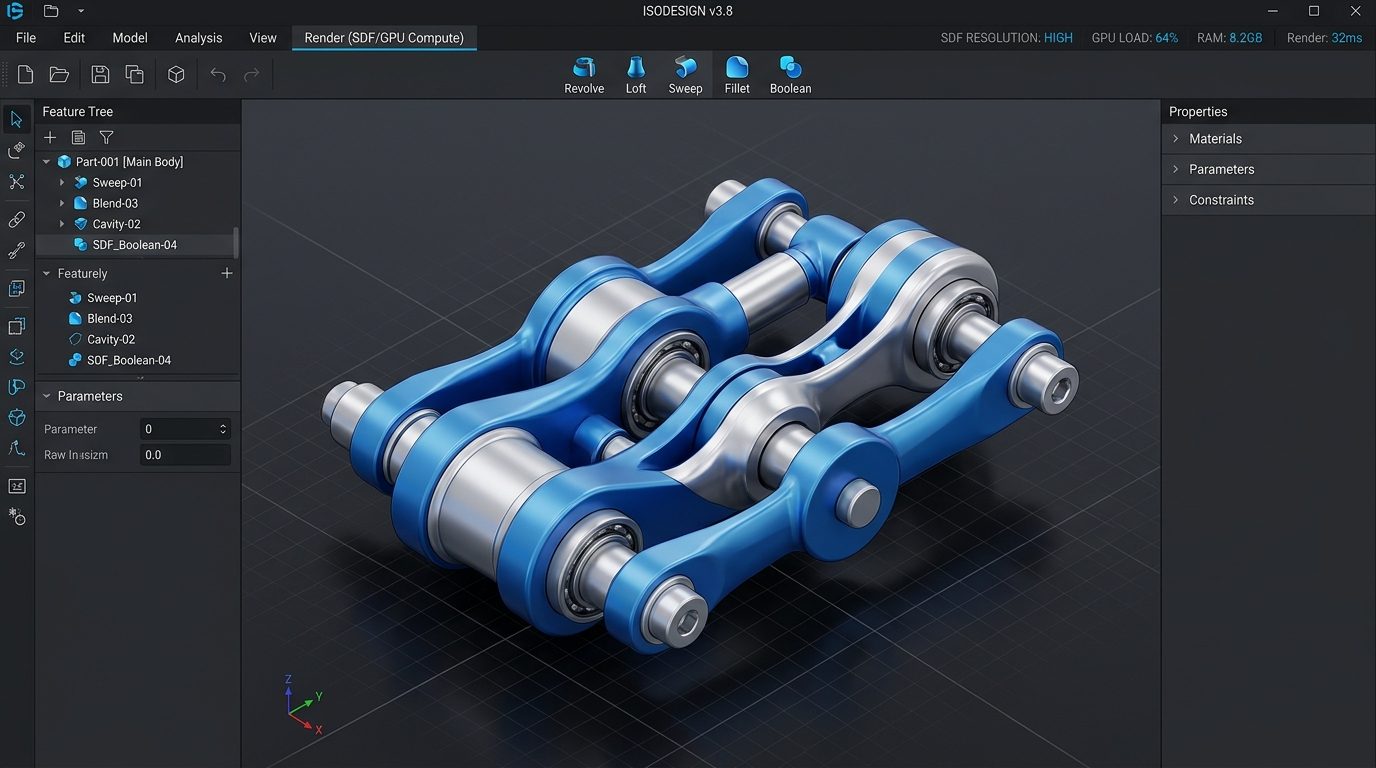
For decades, the foundational math underpinning Computer-Aided Design (CAD) has remained largely unchanged, relying on Boundary Representation (B-Rep) and faceted polygonal meshes that frequently crash or produce corrupt topologies when executing complex geometric intersections.
On September 30, 2026, acclaimed graphics engineer Matt Keeter unveiled Halfspace—an experimental CAD integrated development environment that demonstrates what solid modeling looks like when rebuilt from the ground up around Signed Distance Fields (SDFs).
In an SDF architecture, a physical solid object is not defined by a collection of connected vertices and faces. Instead, it is described by a mathematical equation that calculates the exact shortest distance from any point in 3D space to the object's surface.
This mathematical paradigm makes boolean operations trivial and completely immune to errors: taking the union of two parts is simply finding the mathematical minimum of their distance functions, while a subtraction is taking the maximum of inverted distances.
Fillets, chamfers, and smooth organic transitions—notoriously fragile operations in traditional parametric CAD—can be rendered instantaneously by blending mathematical distance fields with zero risk of self-intersecting surface geometry.
Leveraging high-performance Rust and WebGPU compute shaders, Halfspace raymarches complex mechanical assemblies with dynamic lighting and interactive sliders in real time at 60 frames per second.
By eliminating the computational friction of polygonal tessellation, Halfspace provides a compelling glimpse into the future of additive manufacturing, generative structural engineering, and programmatic mechanical design.