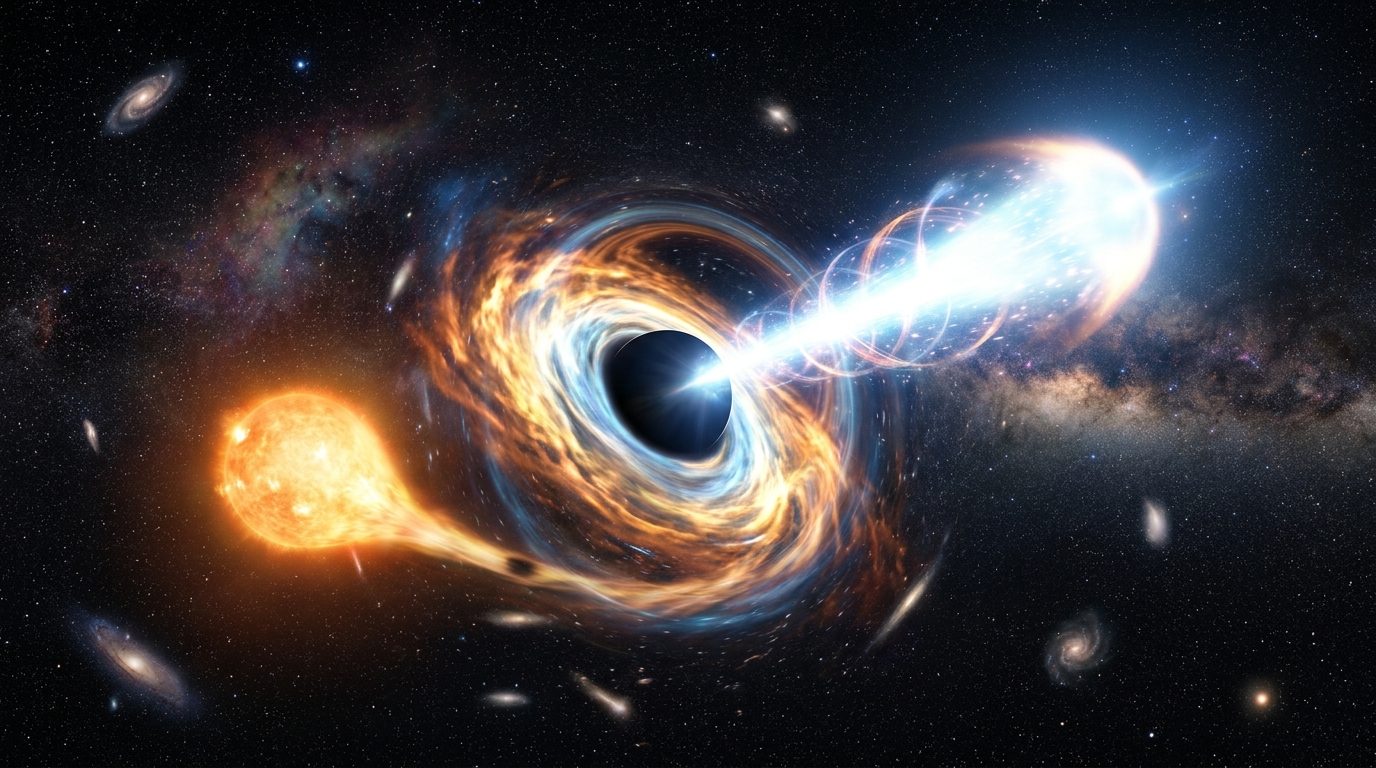
In an astronomical revelation that provides scientists with an unprecedented front-row view of extreme black hole physics, an international research consortium confirmed the discovery of the first known microblazar within our home galaxy.
Published in the journal Astronomy & Astrophysics, the discovery centers on IRAS 18293−0941, an X-ray binary system located roughly 12,000 light-years from Earth in the plane of the Milky Way.
Blazars are among the most violent objects in the cosmos: supermassive black holes at the centers of distant active galaxies that consume vast quantities of gas and propel relativistic plasma jets across intergalactic space directly aligned with Earth's line of sight. While thousands of distant blazars are cataloged, their multi-billion-light-year distances blur fine structural details.
A microblazar is the compact, stellar-mass equivalent of this phenomenon. In IRAS 18293−0941, a stellar-mass black hole roughly ten times more massive than our Sun orbits an energetic blue supergiant star, gravitationally pulling tendrils of hydrogen into a superheated accretion disk.
Immense magnetic field lines twisted by the black hole's frame-dragging rotation collimate plasma into twin jets fired at 75% the speed of light (225,000 kilometers per second). What makes the discovery historic is the viewing geometry: one of these relativistic jets is aligned within 4 degrees of Earth's direct line of sight.
Due to special relativity, radiation emitted along the line of motion experiences intense Doppler boosting, making IRAS 18293−0941 appear hundreds of times brighter in high-energy gamma and radio spectra than ordinary microquasars.
Radio observations from South Africa's MeerKAT array revealed that the opposing jet has carved a hollow cocoon over 100 light-years across in an adjacent interstellar molecular cloud. Astrophysical modeling indicates the shock front accelerates cosmic ray protons to PeV energy levels—confirming that Galactic microblazars act as primary particle accelerators responsible for Earth's cosmic ray background.