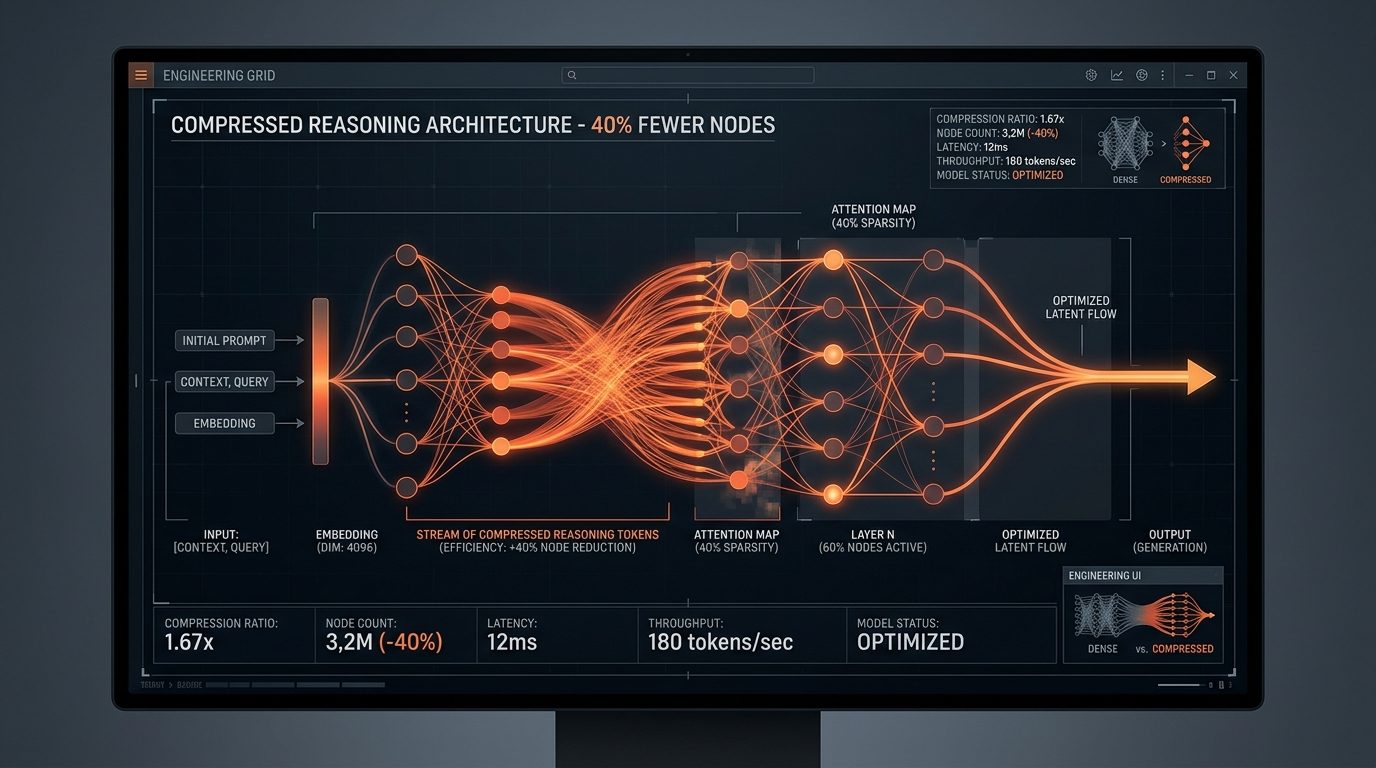
On September 23, 2026, cloud inference provider Fireworks AI announced the release of Ember-1, an experimental reasoning foundation model engineered specifically to tackle one of the most frustrating bottlenecks in modern generative AI: reasoning token bloat.
Over the past twelve months, the industry's shift toward test-time compute scaling—popularized by models that deliberate extensively before emitting an answer—has dramatically elevated benchmark scores in mathematics and coding. However, this has come at the expense of extreme verbosity. Models routinely burn 3,000 to 8,000 internal thinking tokens repeating sub-clauses, backtracking on trivial syntax, and generating lengthy monologues, causing catastrophic latency in real-time software development.
Ember-1 is built directly upon Moonshot AI's Kimi K3 base architecture. Through a novel post-training curriculum combining reinforcement learning with brevity-penalized reward modeling, Fireworks researchers trained the model to compress its chain-of-thought representations. The model retains only the mathematically necessary logical pivots while pruning rhetorical padding.
Empirical evaluations on SWE-bench Verified, LiveCodeBench, and AIME 2026 indicate that Ember-1 matches the accuracy of Kimi K3 while producing 38% to 42% fewer total generated tokens. In multi-step agentic workflows where latency compounds across successive tool invocations, this translates to a 40% reduction in wall-clock execution time.
The model supports an expansive 1,048,576 token context window, structured JSON output, native tool-calling primitives, and multimodal visual comprehension. Served via Fireworks' proprietary FireAttention v3 engine, Ember-1 achieves sustained output speeds exceeding 180 tokens per second.
Fireworks has priced Ember-1 at $3.00 per million input tokens ($0.30/1M for cached context) and $15.00 per million output tokens. Because output tokens are billed on total generation, the 40% compression ratio effectively slashes the net cost per resolved programming task by nearly half compared to unconstrained reasoning architectures.