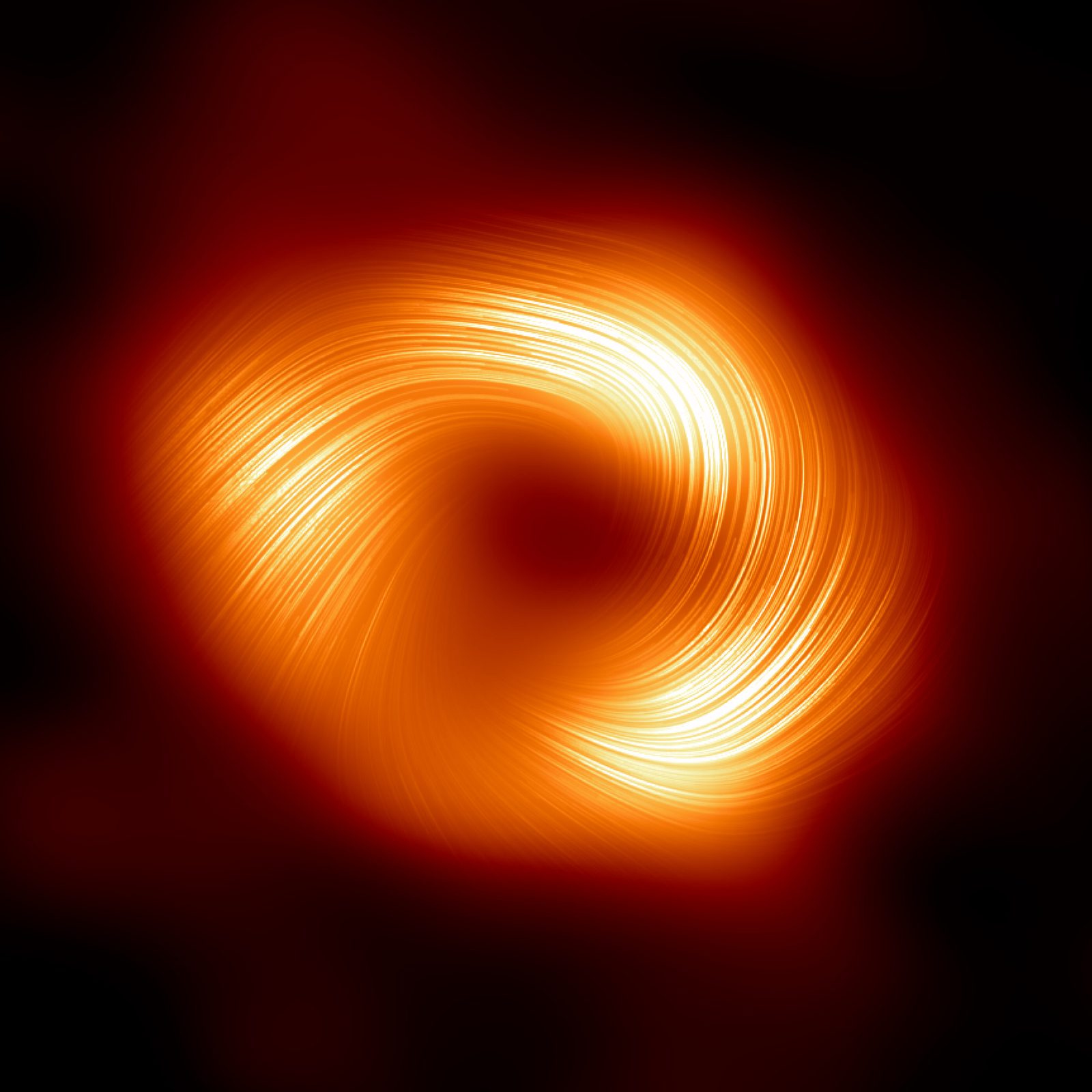
On August 19, 2026, the Event Horizon Telescope (EHT) collaboration released groundbreaking polarized images of Sagittarius A*, revealing the intense, swirling magnetic field lines that govern the center of the Milky Way galaxy.
Two years after capturing the first direct shadow of Sagittarius A*, researchers analyzed the linear polarization of millimeter-wavelength light emitted by relativistic electrons spiraling through magnetized plasma near the event horizon. Because light becomes polarized perpendicular to the local magnetic field direction, mapping polarization angles reconstructs the underlying magnetic field lines in curved spacetime.
The resulting image reveals sharp, tightly wound spiral polarization patterns tracing the inner edge of the photon ring. Despite Sagittarius A* possessing a mass of 4.3 million suns—vastly smaller and quieter than the 6.5-billion-solar-mass black hole M87*—the two black holes exhibit virtually identical magnetic field topologies.
This structural similarity strongly suggests that strong, ordered magnetic fields are universal properties of black hole accretion disks, regardless of mass, galaxy environment, or accretion rate. These fields generate magnetohydrodynamic pressures that channel gravitational energy and may power an undiscovered, faint relativistic jet emanating from our galaxy's center.
The observations provide a crucial test of General Relativity in the extreme gravitational regime, affirming Einstein's equations at the ultimate cosmic frontier.