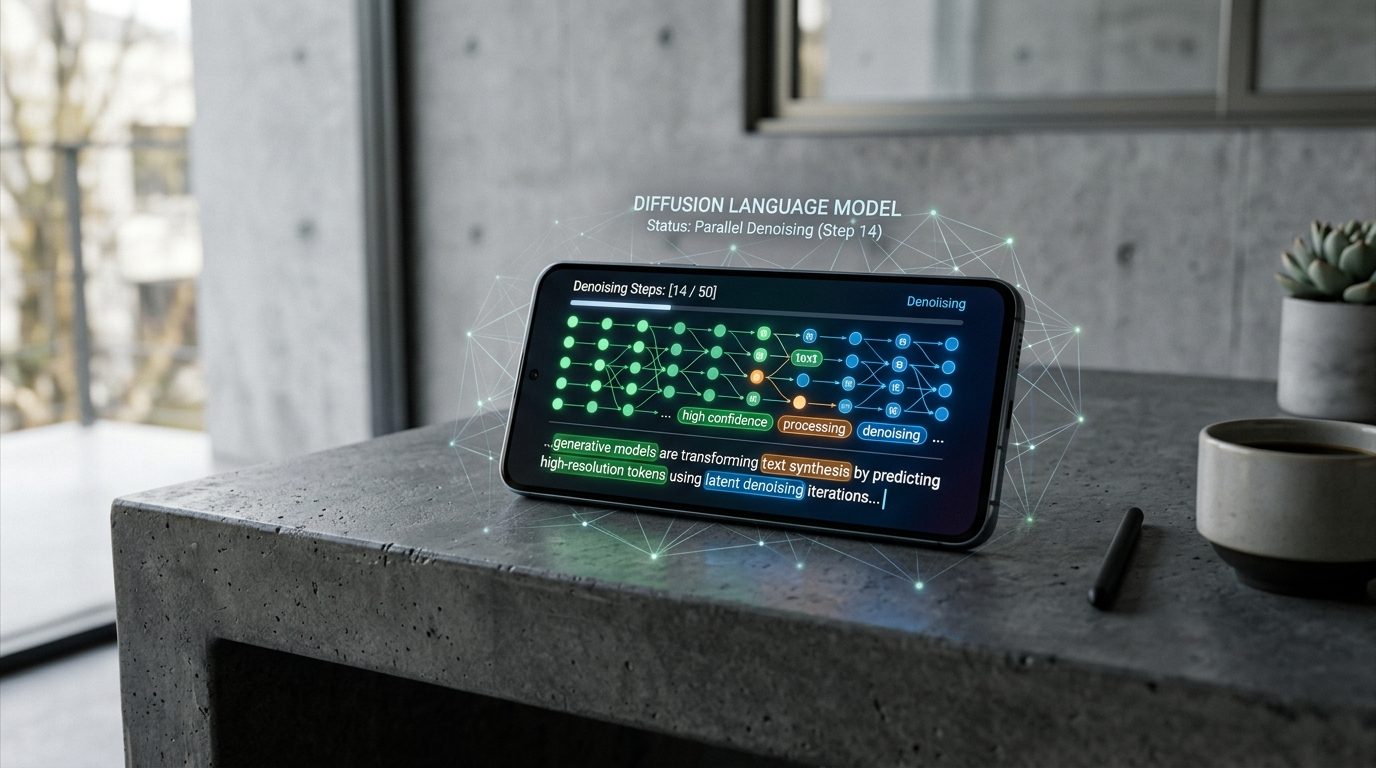
The decade-long monopoly of sequential autoregressive transformers in natural language processing is facing its most credible architectural challenger yet. In a landmark paper presented by researchers from Carnegie Mellon, Apple, and Cohere, Diffusion Language Models (DLMs) have officially matched the performance of frontier autoregressive models on mainstream reasoning benchmarks while dramatically reducing on-device inference latency.
For years, text generation has been defined by next-token prediction: given a prompt, a language model predicts token t+1, feeds it back into its input, and predicts token t+2. While remarkably capable, this sequential paradigm is intrinsically inefficient for edge hardware. On mobile phones, laptops, and robotics controllers, compute is abundant, but memory bandwidth between system DRAM and the Neural Processing Unit (NPU) is severely restricted. Each autoregressive step requires reading gigabytes of model parameters from memory to generate just a single token, resulting in low arithmetic intensity and rapid battery depletion.
Diffusion Language Models replace sequential generation with iterative parallel denoising. Starting with a sequence of pure noise tokens or masked tokens, the model updates all positions simultaneously across a handful of continuous score-matching steps. By refining an entire paragraph in 12 to 16 parallel passes instead of hundreds of sequential iterations, the hardware achieves near-ideal tensor saturation.
Until recently, DLMs suffered from a noticeable 'accuracy penalty' on complex logical reasoning and coding tasks compared to causal transformers. The CMU-Apple-Cohere team solved this through Continuous-Discrete Hybrid Coupling (CDHC) and trajectory-level self-consistency distillation. On MMLU-Pro, the researchers' 8B DLM scored 58.4%, statistically indistinguishable from Llama-3.1-8B (58.2%), while achieving 71.2% pass@1 on HumanEval code synthesis.
The deployment implications on consumer silicon are profound. Tested on Apple Silicon M4 and Qualcomm Snapdragon X Elite NPUs, the 8B DLM generated complete 256-token responses in 210 millisecondsa 4.2x speedup compared to the 890 milliseconds required by an equivalent causal transformer. Furthermore, because diffusion models do not maintain an expanding key-value (KV) cache, DRAM memory bandwidth consumption dropped by 68%.
Beyond raw speed, DLMs possess a native capability that autoregressive models lack: arbitrary bidirectional context awareness. Because all token positions are generated and refined simultaneously, DLMs can infill code snippets, execute mid-sentence grammar corrections, and rewrite entire paragraphs without requiring complex prompt scaffolding. As device makers push to embed autonomous agent capabilities directly into mobile operating systems, diffusion language models are poised to redefine edge intelligence.