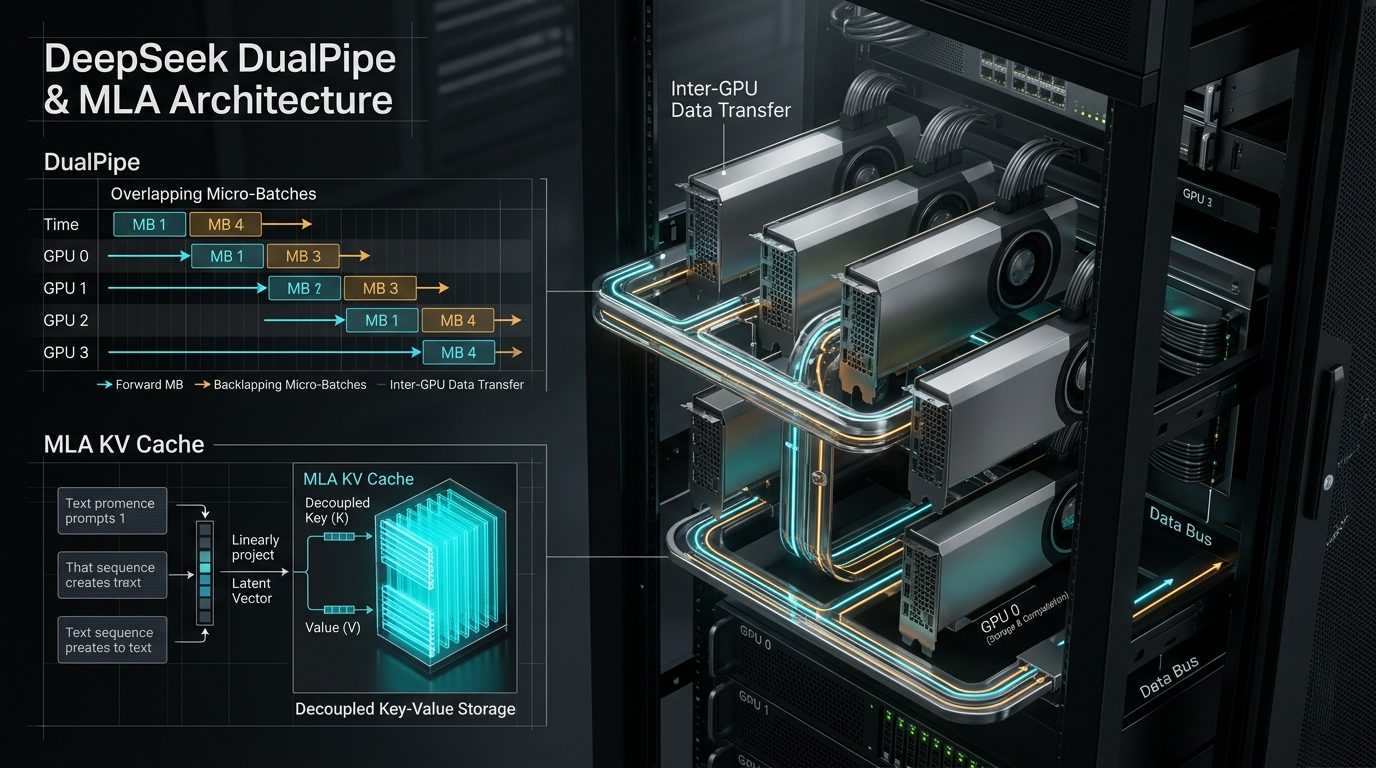
In a detailed technical whitepaper published on September 8, 2026, DeepSeek disclosed the architectural innovations powering its latest foundation model releases, centering on Multi-Head Latent Attention (MLA) and DualPipe parallelism.
Traditional Multi-Head Attention (MHA) and Grouped-Query Attention (GQA) store separate key and value projection matrices across every token in the context window. At context lengths exceeding 64k tokens, KV cache memory allocation rapidly exhausts high-bandwidth GPU memory (HBM), throttling batch size and concurrency. DeepSeek's MLA solves this by compressing key and value matrices into a low-dimensional latent vector via down-projection before storage, decompressing only inside attention heads during computation. This reduces memory footprint per token by 93.3% compared to conventional MHA.
Complementing MLA at the distributed training layer is DualPipe, an execution scheduler that addresses pipeline bubbles in large-scale cluster training. In conventional 1F1B (one-forward-one-backward) pipeline schedules, GPUs frequently idle waiting for gradient synchronization. DualPipe splits execution into bidirectional overlapping micro-batches, concurrently running forward computation on one pipeline phase while transmitting gradients for another.
The architecture also implements fine-grained FP8 mixed-precision training. By introducing tile-level quantization and decoupled scaling factors across tensor tiles, the training run maintained mathematical gradient stability across thousands of accelerators without encountering the sudden loss spikes typical of low-precision regimes.
The release has sent shockwaves through the AI infrastructure ecosystem, proving that architectural algorithmic efficiency can achieve superior economic performance without relying solely on brute-force hardware scaling.