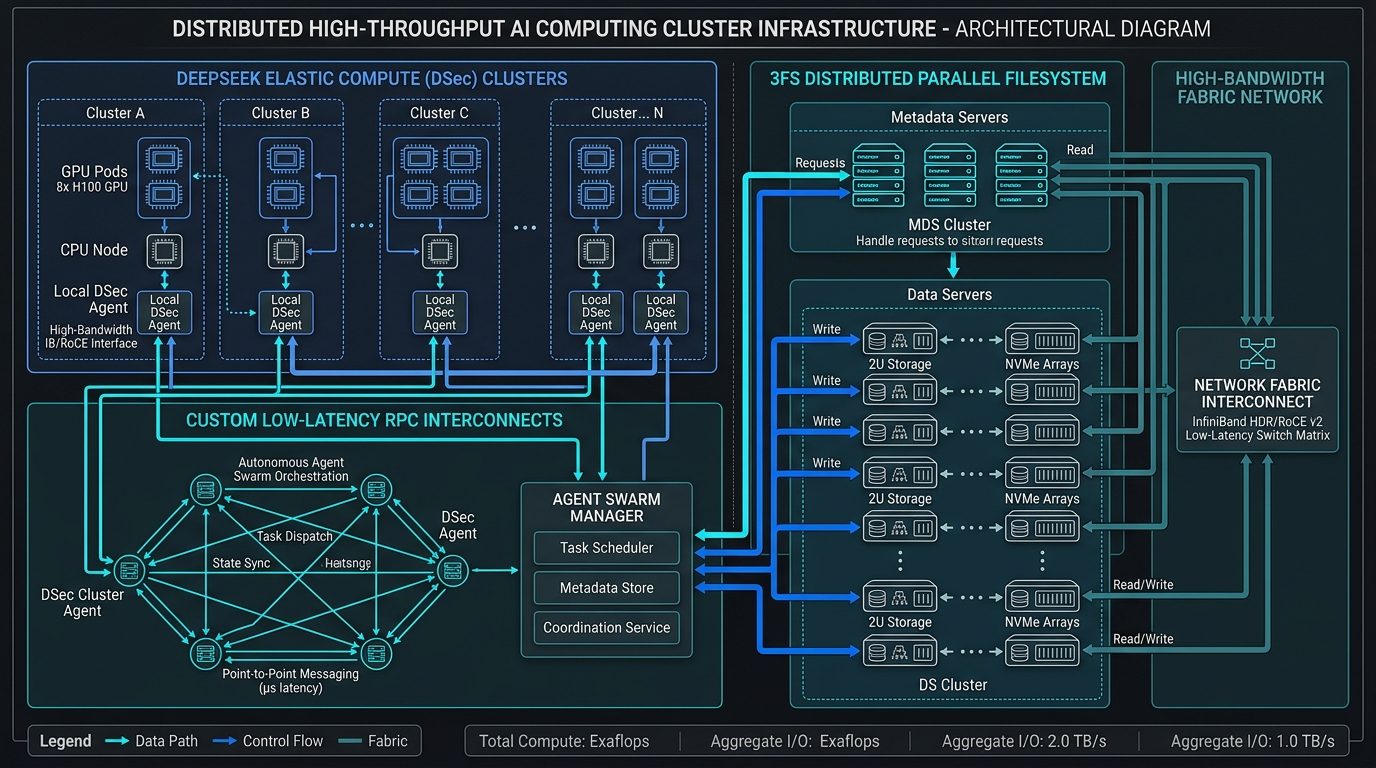
On September 9, 2026, DeepSeek disclosed comprehensive architectural details of an extensive infrastructure expansion for its DSec (DeepSeek Elastic Compute) cloud clusters, deploying over 150 dedicated systems engineers to overcome the severe storage and networking bottlenecks generated by global autonomous AI agent workloads.
Following the worldwide adoption of DeepSeek's open-weights models for automated software development and background task execution, the lab experienced unprecedented cluster strain. Unlike conversational chat requests, autonomous agents maintain complex long-lived runtime environments. An individual agent may execute bash commands, compile multiple software libraries, query local databases, and serialize multi-gigabyte KV cache states every few seconds. When scaled across hundreds of thousands of concurrent active agent threads, traditional network-attached storage (NAS) and POSIX filesystems suffered from extreme metadata lock contention and severe I/O degradation.
To resolve this crisis, DeepSeek re-architected its storage tier from first principles around 3FS (Fire-Flyer File System), an ultra-high-throughput distributed parallel filesystem designed specifically for AI compute fabrics. 3FS leverages NVMe-over-Fabrics (NVMe-oF) and the Storage Performance Development Kit (SPDK) to run zero-copy storage drivers in Linux userspace, completely eliminating kernel context-switching overhead.
Coupled with a custom kernel-bypass Remote Procedure Call (RPC) network protocol operating over InfiniBand and RoCE v2 networks, DSec delivers over 2.1 Terabytes per second of sustained aggregate read bandwidth across a 60,000-accelerator deployment. Inter-node synchronization latency has been driven down to under 50 microseconds, allowing distributed agent swarms to exchange intermediate reasoning graphs without incurring compute stalls.
By solving the fundamental I/O and storage bottlenecks of agentic computing at the hardware and kernel level, DeepSeek maintains its reputation for radically low-cost inference infrastructure, keeping production API prices orders of magnitude below Western hyperscalers while running continuous test-time reasoning compute.