As frontier artificial intelligence models transition from passive autoregressive predictors into autonomous reasoning agents capable of generating and executing code, the bottleneck in AI research has migrated from GPU clusters to CPU virtualization farms.
Training agents via Reinforcement Learning from Verifiable Environments (RLVE) requires spawning hundreds of thousands of isolated operating system sandboxes where models can compile code, query databases, and execute bash scripts without risking host corruption. On September 25, 2026, DeepSeek published arXiv:2609.22978, unveiling 'DSec'—its proprietary hyperscale execution platform.
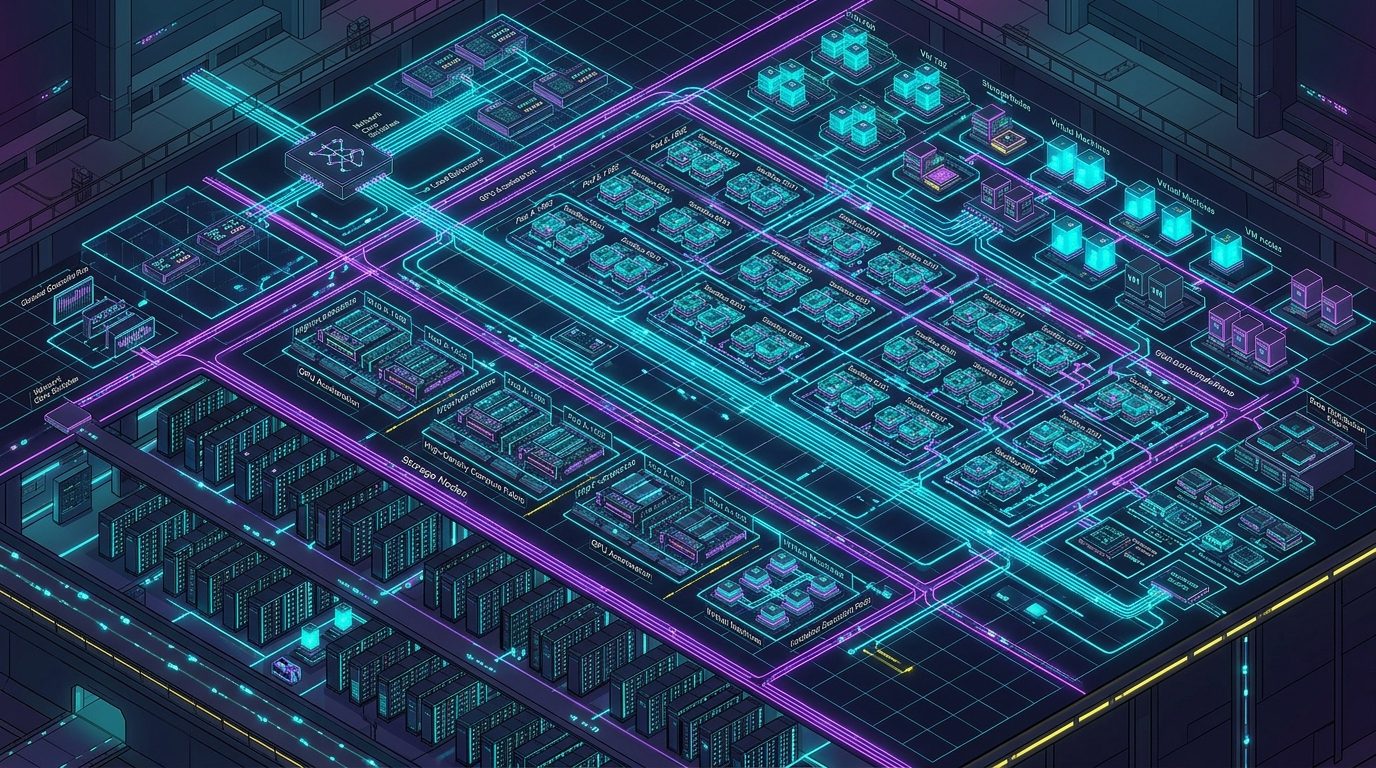
Authored by founder Liang Wenfeng alongside 130 DeepSeek infrastructure engineers, the publication reveals how DeepSeek achieves unprecedented training throughput on an astonishingly austere hardware footprint. Across just 160 physical server nodes housing 30,000 CPU cores and 250 terabytes of system memory, DSec sustains 380,000 concurrent active execution sandboxes, processing upwards of 3,000,000 unique agent environments each day.
The engineering triumph of DSec lies in its adaptive four-tier execution hierarchy. Rather than forcing every agent action into a heavy virtual machine, DSec's dynamic classifier evaluates the instruction stream and provisions the lowest-overhead isolation tier required: Tier-1 handles stateless mathematical function calls in shared address spaces; Tier-2 invokes sub-millisecond MicroVMs; Tier-3 spins up cgroup-isolated containers; and Tier-4 provisions fully virtualized KVM nodes with dedicated virtual network interfaces.
To overcome Linux kernel memory exhaustion caused by creating millions of transient processes, DeepSeek engineered a custom copy-on-write page-table cloning mechanism directly into the host hypervisors. Memory pages for popular runtime libraries (such as Python, PyTorch, and NumPy) are shared immutably across thousands of guest sandboxes, reducing the average memory footprint of an active sandbox to less than 650 megabytes.
Crucially, DSec incorporates a hardware-isolated security broker that inspects system calls at the eBPF level. Any attempt by an agent to execute kernel privilege escalations, port-scan internal cluster subnets, or initiate covert egress tunnels is instantly trapped and logged, triggering automatic reward penalization in the RL training loop.
By publishing the architectural schematics and releasing core scheduler repositories under an open-source MIT license, DeepSeek continues its tradition of democratizing frontier AI engineering practices, providing the wider research community with an enterprise blueprint for scalable agent alignment.