Since the formal standardization of HTTP/1.1 in RFC 2616 nearly three decades ago, the 'Vary' response header has maintained a notorious reputation among systems architects and network operators as the most brittle mechanism in internet infrastructure.
Designed to support content negotiation, the Vary header allows an origin server to instruct downstream caches that a cached response is valid only if specific incoming request headers—such as 'Accept-Encoding', 'Accept-Language', or 'User-Agent'—match exactly. In theory, this allows a single URL to serve German to German speakers and English to English speakers. In practice, however, it creates catastrophic cache fragmentation.
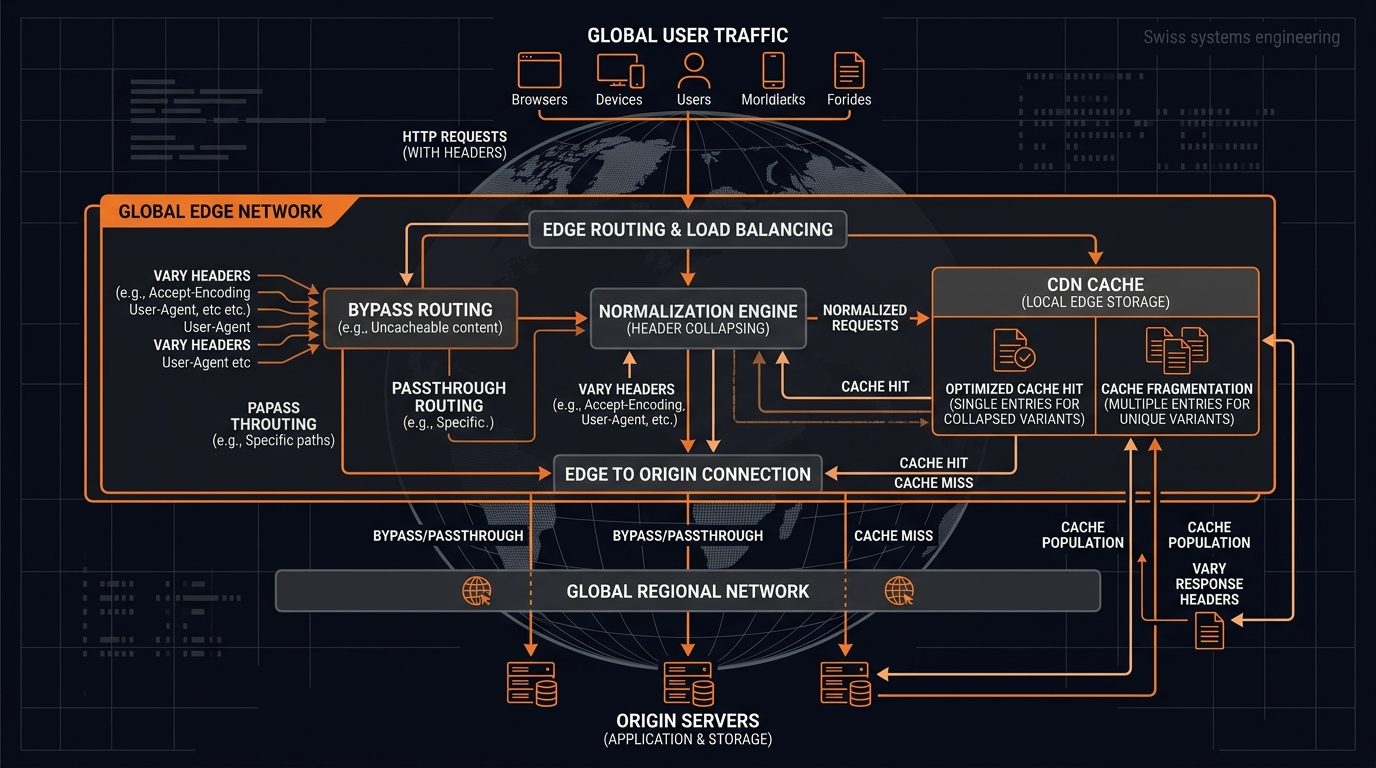
Because user-agents send unpredictable combinations of quality weights, casing, and whitespace (for instance, 'en-US,en;q=0.9' versus 'en;q=0.8,en-US;q=0.9'), naive caches treat every slight variation as a completely unique resource. A global edge server might store hundreds of identical copies of a homepage, dropping cache hit ratios from 95% down to single digits and overwhelming origin databases.
On September 23, 2026, Cloudflare rolled out its long-awaited solution: native support for HTTP Vary within its edge Cache Rules engine across all service tiers, including the Free plan.
Cloudflare's implementation resolves the fragmentation paradox by introducing per-header normalization rules. Network administrators can configure edge nodes to parse and normalize incoming headers prior to computing the cache key—lowercasing character strings, stripping whitespace, and sorting language tokens alphabetically. Semantically identical requests are collapsed into a single cache entry, recovering up to 84% of lost hit rates while ensuring accurate content delivery.
For APIs requiring exact header fidelity, Cloudflare offers strict passthrough routing, while allowing unpredictable variants to cleanly bypass the cache. By providing granular edge controls for HTTP Vary, Cloudflare has eliminated one of the longest-standing architectural headaches in modern web performance.