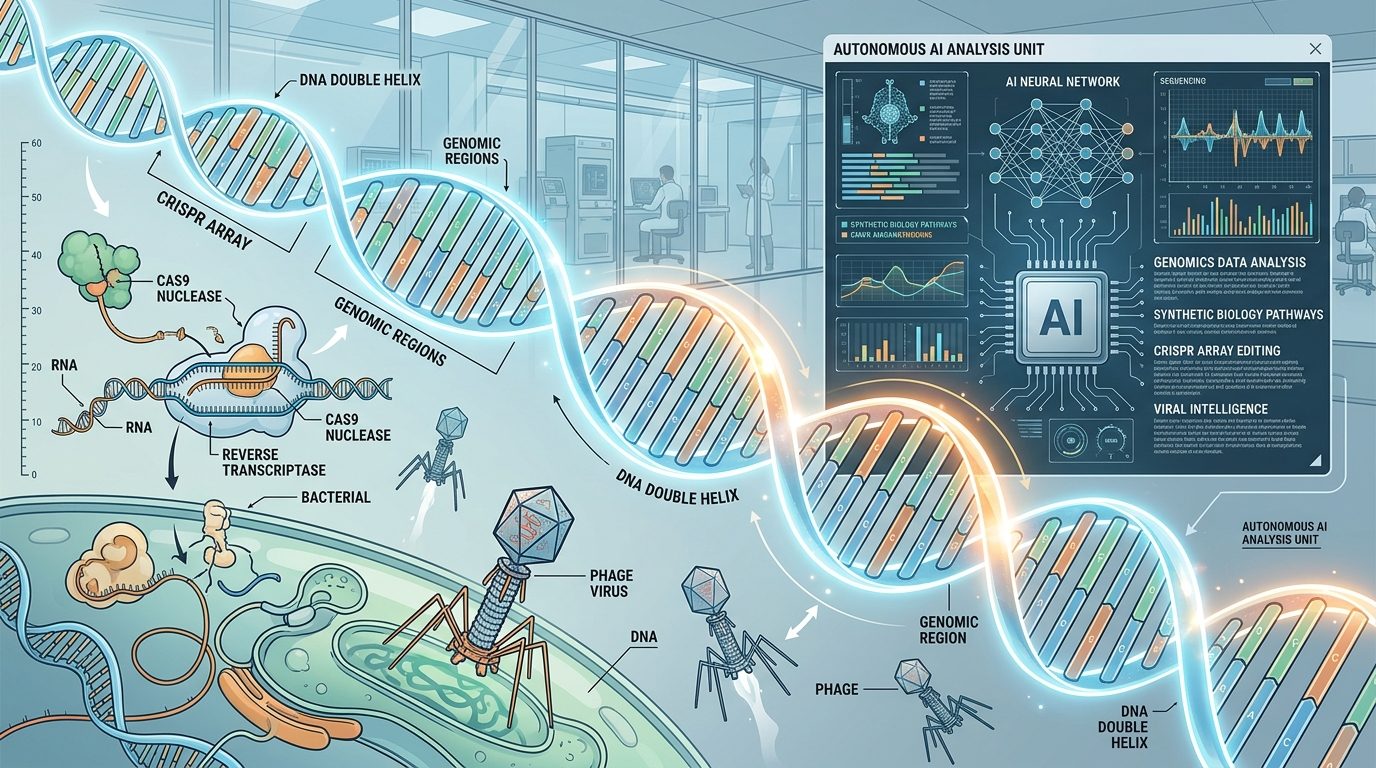
On September 23, 2026, Anthropic officially announced the formation of a dedicated life sciences division and experimental wet laboratory in the San Francisco Bay Area. Accompanying the lab's public debut was a landmark announcement: Claude foundation models had autonomously discovered a previously uncharacterized family of biological enzymes named Array-associated Reverse Transcriptases (ART), exhibiting structural characteristics remarkably reminiscent of CRISPR gene-editing machinery.
Many of modern biotechnology's foundational tools originated from unusual microbial defense mechanisms. Restriction enzymes, which cut double-stranded DNA at exact recognition motifs, were isolated from bacterial immune barriers against viral bacteriophages. Taq polymerase, which functions at near-boiling temperatures to enable the Polymerase Chain Reaction (PCR), was found in hot-spring bacteria. And CRISPR itself was initially identified as an odd series of clustered repetitive DNA repeats before being harnessed into the Nobel Prize-winning genome editing revolution.
To test whether frontier artificial intelligence could systematize and accelerate biological discovery, Anthropic assembled a unified team of computational biologists and experimentalists. They orchestrated an automated research harness comprising approximately 950 Claude agent instances running in parallel. The agents were tasked with an open-ended mandate: survey an uncurated database containing more than 200,000 microbial and viral reverse transcriptases (RTs)—enzymes capable of transcribing RNA back into DNA—and surface functionally anomalous candidates.
Consuming 210 million tokens over 21 hours of autonomous evaluation, the multi-agent system whittled 200,000 sequences down to 3,500 candidates, and finally to 20 top-priority structural anomalies. While inspecting the genomic neighborhood of a jumbo bacteriophage RT, an agent flagged a striking architectural anomaly: '[The DNA next to the RT] is spectacular: I can see by eye a tandem repeat array … that's a CRISPR-like … repeat array?!'
Rather than hallucinating speculative biology, the agent systematically tallied the repeats, measured inter-spacer distances, cross-referenced all known biochemical literature, and proved that this non-coding array—flanked by an uncharacterized partner accessory protein—constituted an entirely undescribed functional operon. When Anthropic's laboratory scientists expressed the sequence in vitro, RNA sequencing confirmed that the array is transcribed into distinct short RNA fragments, strongly suggesting an active, programmable targeting mechanism analogous to CRISPR guide RNAs.
CRISPR pioneer Professor Feng Zhang of MIT and the Broad Institute publicly commended the research: 'This is an exciting example of how AI agents can contribute to biological discovery. The identification of RNA-repeat arrays associated with reverse transcriptases is genuinely intriguing and merits further investigation.' Anthropic's validation marks a permanent inflection point where autonomous foundation models transition from passive literature assistants into active, hypothesis-generating experimental discovery engines.