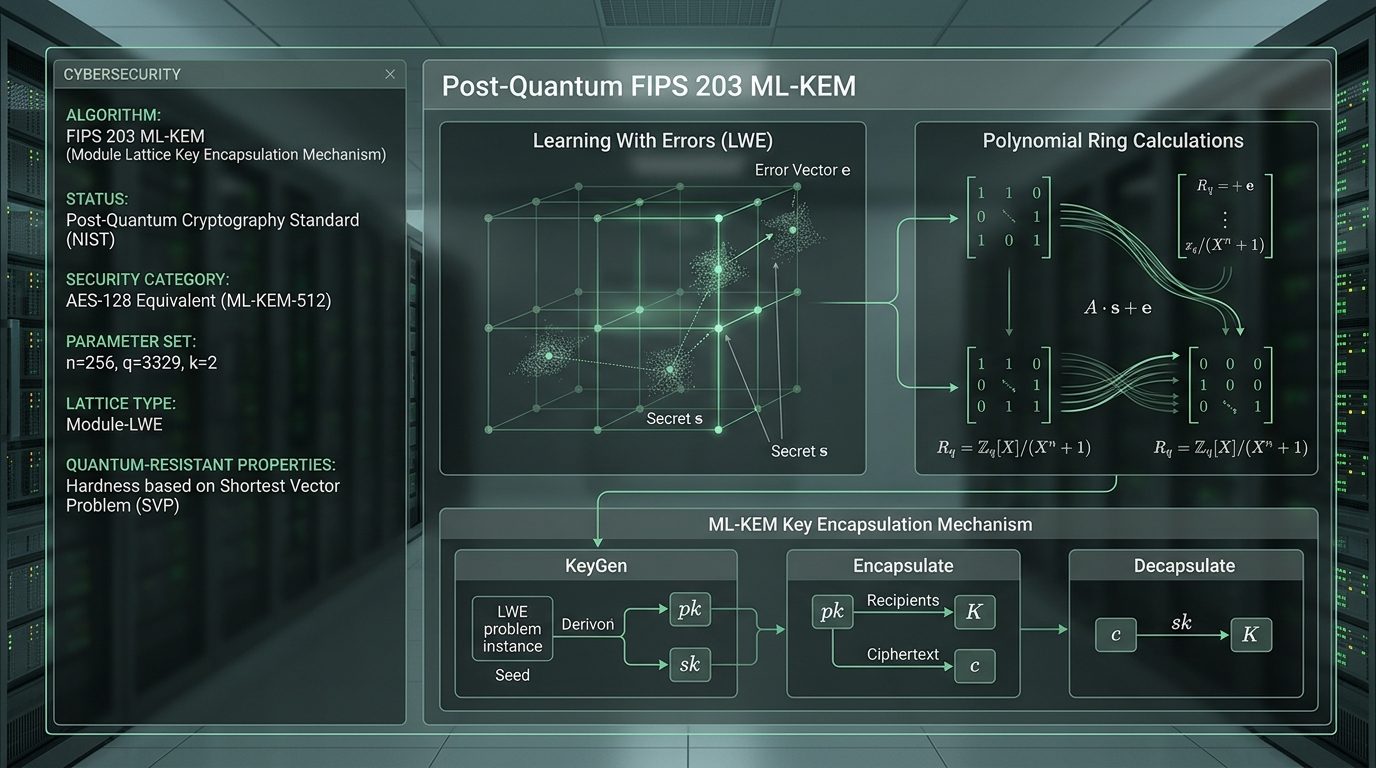
On September 10, 2026, the Cybersecurity and Infrastructure Security Agency (CISA) issued a definitive Binding Operational Directive governing the migration of federal information systems to quantum-resistant cryptography, marking the formal sunset of legacy public-key encryption.
The directive follows the National Institute of Standards and Technology's (NIST) formal release of Federal Information Processing Standards (FIPS) 203, 204, and 205. For nearly five decades, global financial systems, defense communications, and internet protocols have relied on RSA and Elliptic Curve Cryptography (ECC). These algorithms depend on the computational hardness of prime factorization and discrete logarithms—problems that Shor's algorithm can solve in polynomial time on a sufficiently scaled quantum computer.
Intelligence agencies worldwide have observed foreign adversaries conducting systematic 'Store Now, Decrypt Later' (SNDL) operations, intercepting exabytes of encrypted diplomatic cables, intellectual property, and defense telemetry. CISA's directive establishes a bifurcated enforcement schedule to neutralize this threat immediately.
Under Tier 1 ('Widely Available Products'), federal agencies must enforce quantum-resistant key encapsulation on all external web endpoints, cloud API gateways, and commercial browsers within six months. The primary standard mandated is FIPS 203 (ML-KEM), formerly known as Crystals-Kyber, operating under the Module Learning With Errors (M-LWE) lattice hardness assumption. Digital signatures must transition to FIPS 204 (ML-DSA) or FIPS 205 (SLH-DSA).
The migration poses immediate engineering challenges. Unlike classical X25519 keys, which occupy a compact 32 bytes, ML-KEM-768 requires an 1,184-byte public key and a 1,088-byte ciphertext. This significant payload expansion increases TLS handshake packets beyond typical Maximum Transmission Unit (MTU) boundaries, causing packet fragmentation and connection latency if TCP windows and TLS 1.3 buffers are not correctly tuned.
The Linux Foundation's Post-Quantum Cryptography Alliance (PQCA)—whose founding members include Google, AWS, Cisco, and NVIDIA—has committed upstream kernel and OpenSSL patches to accelerate lattice polynomial arithmetic via AVX-512 and ARM Neon instructions, ensuring that quantum resistance does not degrade global internet throughput.