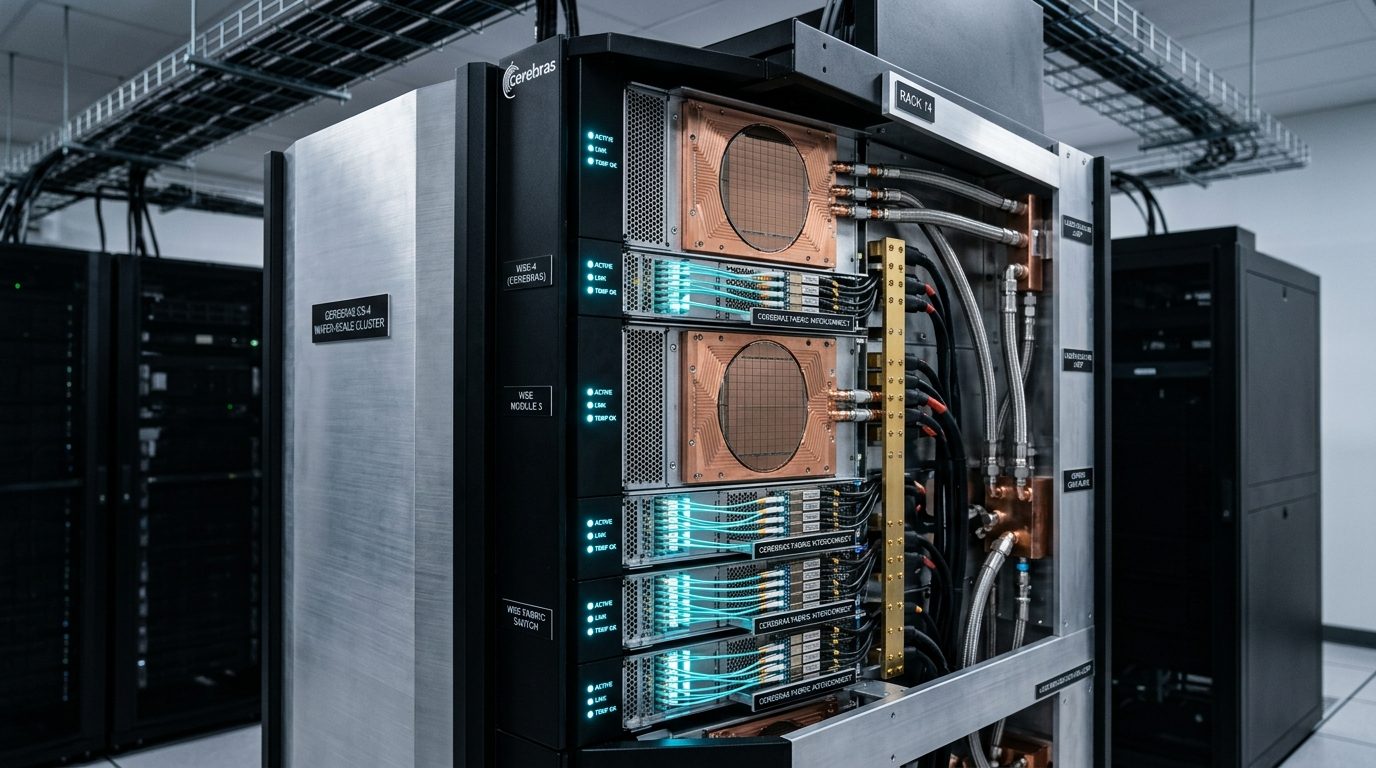
Following its initial public offering on Nasdaq, Cerebras Systems made its most ambitious architectural announcement to date: the commercial release of the CS-4 AI supercomputer rack, uniting four continuous 300mm silicon wafers into a single, unified compute fabric.
Since its inception, Cerebras has championed wafer-scale computing as the ultimate antidote to the 'memory wall.' In conventional AI clusters powered by NVIDIA or AMD accelerators, silicon dies are limited by the lithographic reticle limit to roughly 850 square millimeters. To train and serve frontier foundation models, hundreds or thousands of these individual chips must be wired together across circuit boards, copper cables, and optical InfiniBand or Ethernet switches. While compute floating-point operations (FLOPs) have scaled rapidly, interconnect latency and off-chip memory bandwidth have lagged, creating severe communication bottlenecks during multi-turn agent execution.
The Cerebras Wafer Scale Engine-4 (WSE-4) sidesteps this constraint by keeping an entire 300mm wafer intact. Fabricated on TSMC's advanced semiconductor node, each WSE-4 contains 900,000 AI-optimized tensor cores and 44 Gigabytes of ultra-fast on-chip SRAM. In the newly unveiled CS-4 rack, four of these monolithic wafers are stacked vertically within a proprietary 40U closed-loop liquid cooling manifold.
To connect the four wafers without latency penalties, Cerebras engineered a direct-wafer optical interconnect. Micro-laser transceiver arrays mounted directly to the perimeter of the wafer substrate deliver 3.6 Terabits per second of optical bandwidth per wafer, creating an aggregate memory fabric spanning 1.2 Petabytes per second at sub-10-nanosecond latency.
For inference workloads, this monolithic architecture changes the economics of foundation model deployment. While distributed GPU clusters must divide attention heads across separate chips (tensor parallelism) and suffer memory starvation when processing large prompt batches, the CS-4 executes multi-head attention entirely within on-chip SRAM. In verified production benchmarks, the system demonstrated inference speeds exceeding 2,500 tokens per second on 70-billion-parameter open-weights models—roughly 20 times faster than hyperscale GPU clusters.
With frontier AI architectures pivoting aggressively toward autonomous agent workflows that require iterative planning and hundred-thousand-token multi-turn loops, Cerebras' wafer-scale memory architecture establishes a potent alternative to the classical discrete accelerator paradigm.