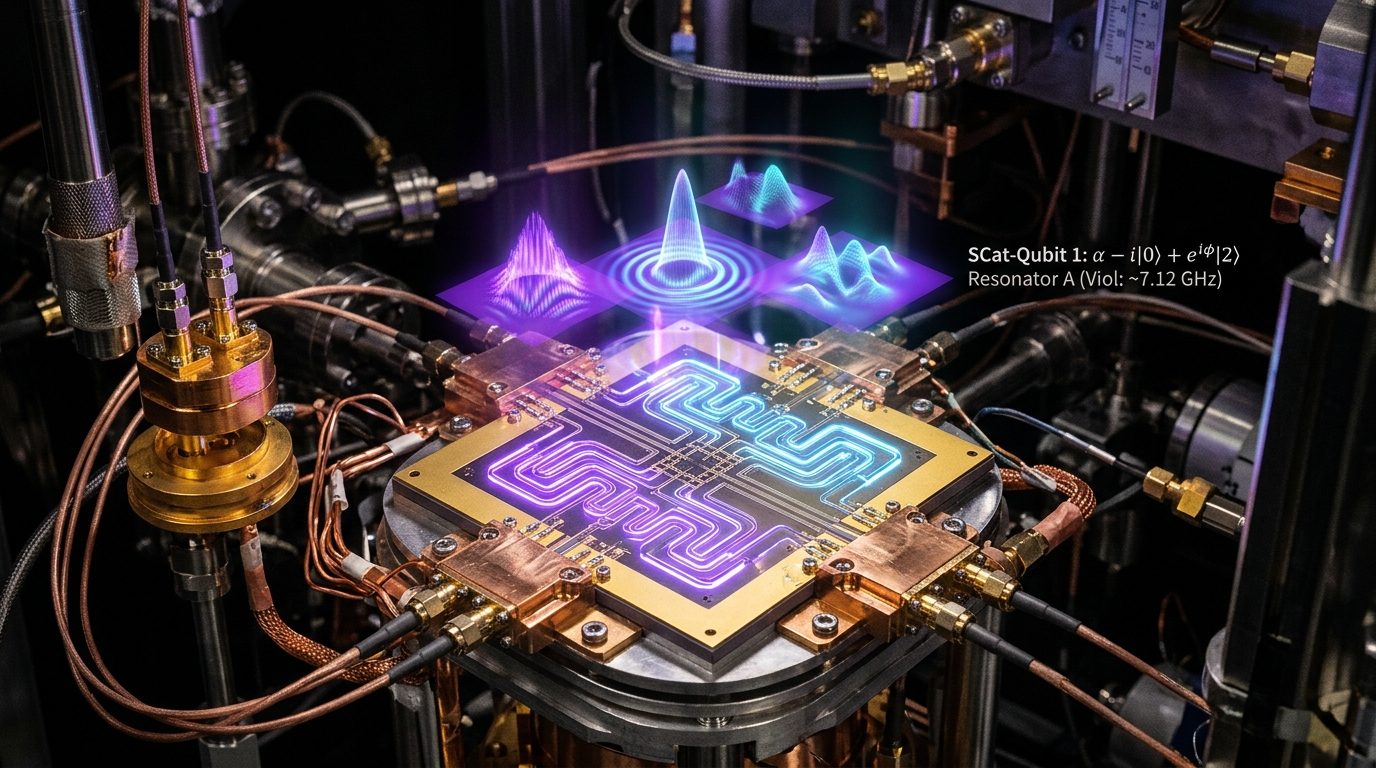
In a breakthrough published in Science that could drastically accelerate the timeline toward commercial fault-tolerant quantum computing, researchers from Caltech and the AWS Center for Quantum Computing have demonstrated a working fault-tolerant logical quantum gate using superconducting bosonic cat qubits with an unprecedented 9:1 physical-to-logical overhead ratio.
To date, the central dilemma of quantum computing has been quantum decoherence. Fragile quantum superpositions are routinely corrupted by environmental noise, causing two fundamental types of errors: bit-flips (where a |0> flips to a |1>) and phase-flips (where the quantum relative phase is inverted). In standard quantum error correction architectures based on transmon qubits—such as the 2D surface code championed by Google and IBM—both bit-flips and phase-flips occur at roughly equal rates. Protecting against both simultaneously requires hundreds or thousands of physical qubits per logical qubit, creating a crippling scaling bottleneck.
The Caltech-AWS collaboration bypassed this bottleneck through biased-noise quantum engineering. Rather than encoding quantum information in discrete two-level transmon circuits, the researchers encode quantum information in the infinite-dimensional Hilbert space of a superconducting harmonic oscillator—specifically in superpositions of coherent microwave states known as Schrödinger cat states.
By injecting non-linear two-photon driven dissipation into the microwave cavity, the quantum state is continuously confined to a two-dimensional manifold in phase space. Any physical perturbation attempting to induce a bit-flip is counteracted by the driven dissipative reservoir. In their experimental chip, the researchers extended the bit-flip lifetime from microseconds to an astounding 78.4 seconds—effectively extinguishing bit-flips as a significant noise source.
With bit-flips eliminated at the hardware level, the quantum error correction protocol needs to address only phase-flip errors. Protecting against a single noise channel does not require a complex 2D surface code lattice; it can be accomplished with a simple 1D repetition code. The team linked nine physical cat qubits in a linear chain, extracting phase-flip error syndromes via dynamical decoupling.
The resulting logical qubit demonstrated an error rate per gate cycle of less than 1.2 x 10^-5—well below the threshold required to run thousands of consecutive quantum operations without error accumulation. By reducing the physical-to-logical qubit ratio from 1,000:1 down to 9:1, the Caltech-AWS architecture provides the clearest engineering roadmap yet toward compact, commercially viable quantum supercomputers.