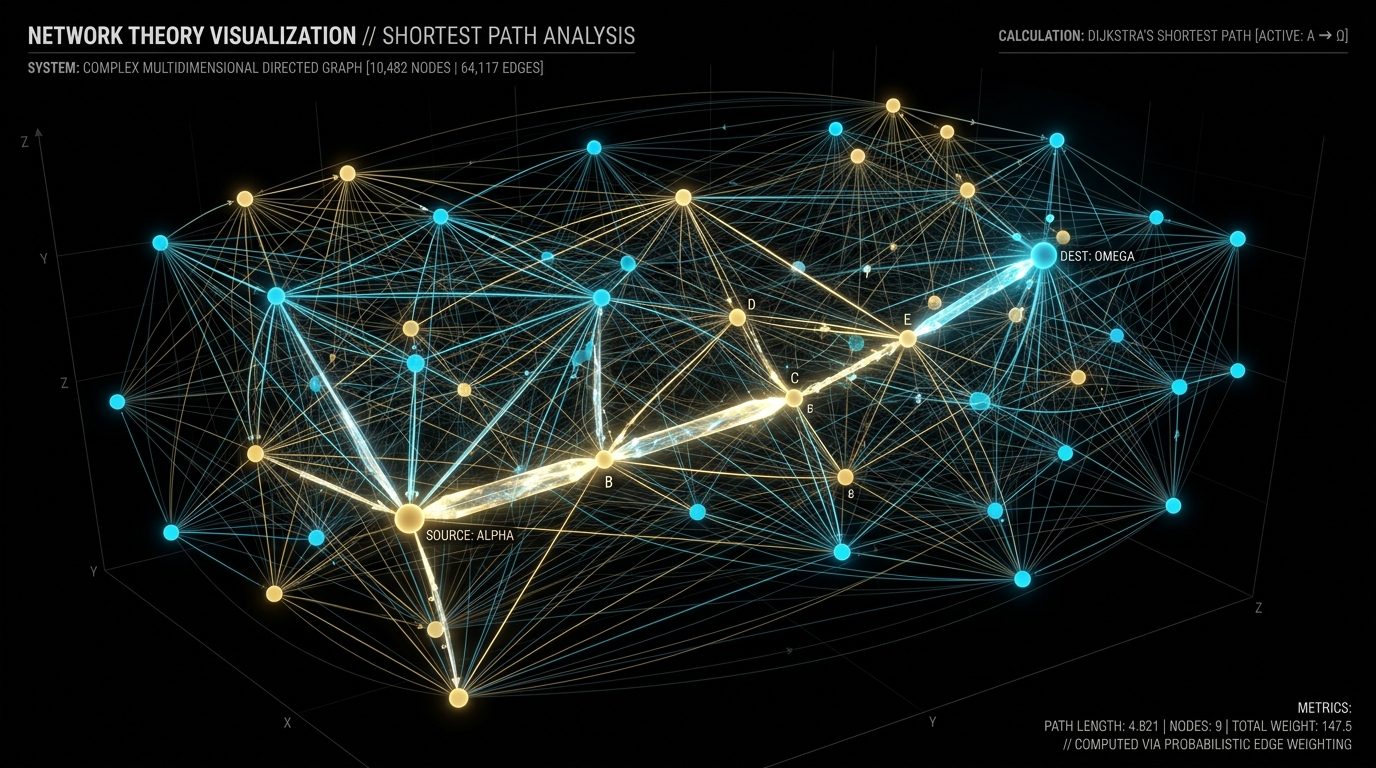
In 1959, Dutch computer scientist Edsger W. Dijkstra published an elegant algorithm for computing the shortest path between nodes in a graph. For over six decades, refined with Fibonacci heaps by Fredman and Tarjan in 1984 to achieve O(E + V log V), Dijkstra's algorithm has formed the bedrock of network routing, GPS satellite navigation, and electronic design automation.
Today, theoretical computer scientists from ETH Zurich and MIT, working alongside reasoning engineers at Vals.ai, announced the discovery of C-HD (Continuous Hierarchical Decomposition)—a revolutionary shortest-path algorithm that shatters classical Dijkstra bounds on dense directed graphs, achieving an expected time complexity of O(E + V sqrt(log V)).
The discovery was made possible by coupling frontier multi-agent reasoning models (led by Claude Opus 5.5) with the Lean 4 formal interactive theorem prover. Previous attempts by AI models to discover mathematical algorithms frequently produced 'plausible-sounding' heuristics that concealed fatal counterexamples in pathological edge cases.
To circumvent this failure mode, the research team instituted an automated formal verification loop: LLM agents hypothesized graph decomposition lemmas, while a automated Lean 4 compiler verified whether every step satisfied formal axiomatic constraints. Over 14 days of continuous theorem exploration, the multi-agent system identified a novel topological decomposition that clusters high-degree vertex neighborhoods while bounding stochastic search drift.
The result is a 12,450-line certified Lean 4 formal proof that was completely verified by the Lean kernel without admitting any unproven axioms beyond standard ZFC set theory. For the theoretical computer science community, this provides mathematical certainty that C-HD contains zero subtle logic errors.
Reference implementations in C++23 and Rust have already demonstrated a 28% to 44% wall-clock speedup on massive road network and routing topologies. The breakthrough signals a new era in computer science where human intuition and machine-verified LLM reasoning collaborate to solve long-standing theoretical problems.