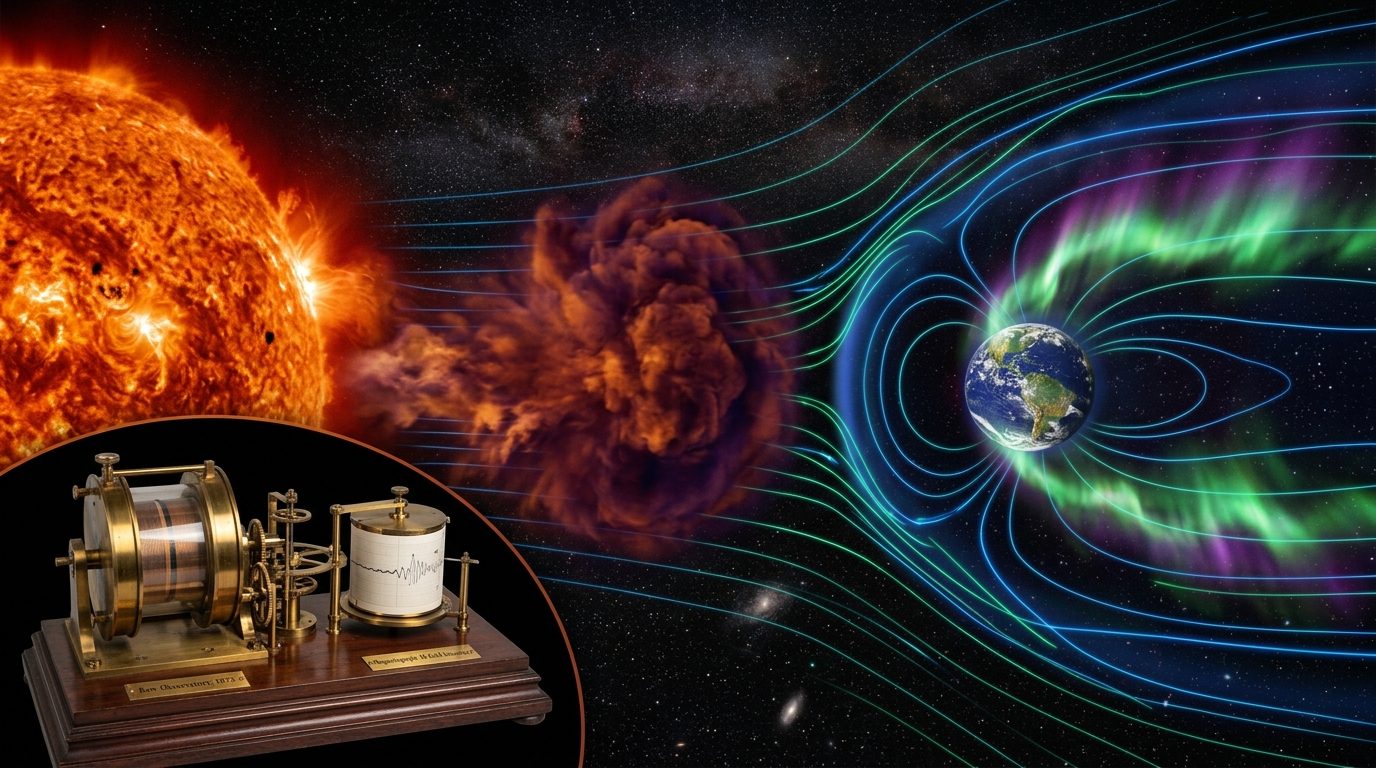
For nearly two centuries, solar physicists have puzzled over why certain coronal mass ejections (CMEs) travel from the Sun to Earth at record-breaking velocities while causing catastrophic ground-level magnetic disruptions, while other apparently identical flares dissipate harmlessly into the interplanetary medium.
On September 28, 2026, an international research team led by astrophysicists at University College London and the University of Colorado published an explanation in Nature Astronomy after solving a century-old historical puzzle dating back to the 1840s.
Using modern computer vision and physics-informed neural networks, researchers digitized and restored fragile paper magnetogram rolls recorded at the Greenwich, Kew, and Toronto geomagnetic observatories between 1840 and 1858—the decades immediately preceding the famous 1859 Carrington Event.
The high-resolution digitized magnetic curves revealed that extreme solar events are never isolated phenomena. Instead, an earlier, slower-moving CME erupts 24 to 36 hours prior, acting like a cosmic snowplow that sweeps interplanetary dust and ambient solar wind plasma out of the Sun-Earth corridor.
When a secondary, magnetically intense CME erupts shortly thereafter, it encounters virtually zero hydrodynamic drag, traversing the 93-million-mile void in just 14 hours—nearly three times faster than standard propagation speeds.
Furthermore, the Victorian magnetograms demonstrated that the magnetic polarity of the cleared corridor twists the secondary cloud's orientation directly perpendicular to Earth's geomagnetic field lines, driving maximum magnetic reconnection and inducing lethal electrical currents across continental power grids.
'By listening to the magnetic whispers recorded by Victorian scientists on paper photographic drums, we have unlocked the physical formula that predicts when a solar storm transitions from an auroral light show into a grid-collapsing emergency,' said lead author Dr. Harriet Vance.