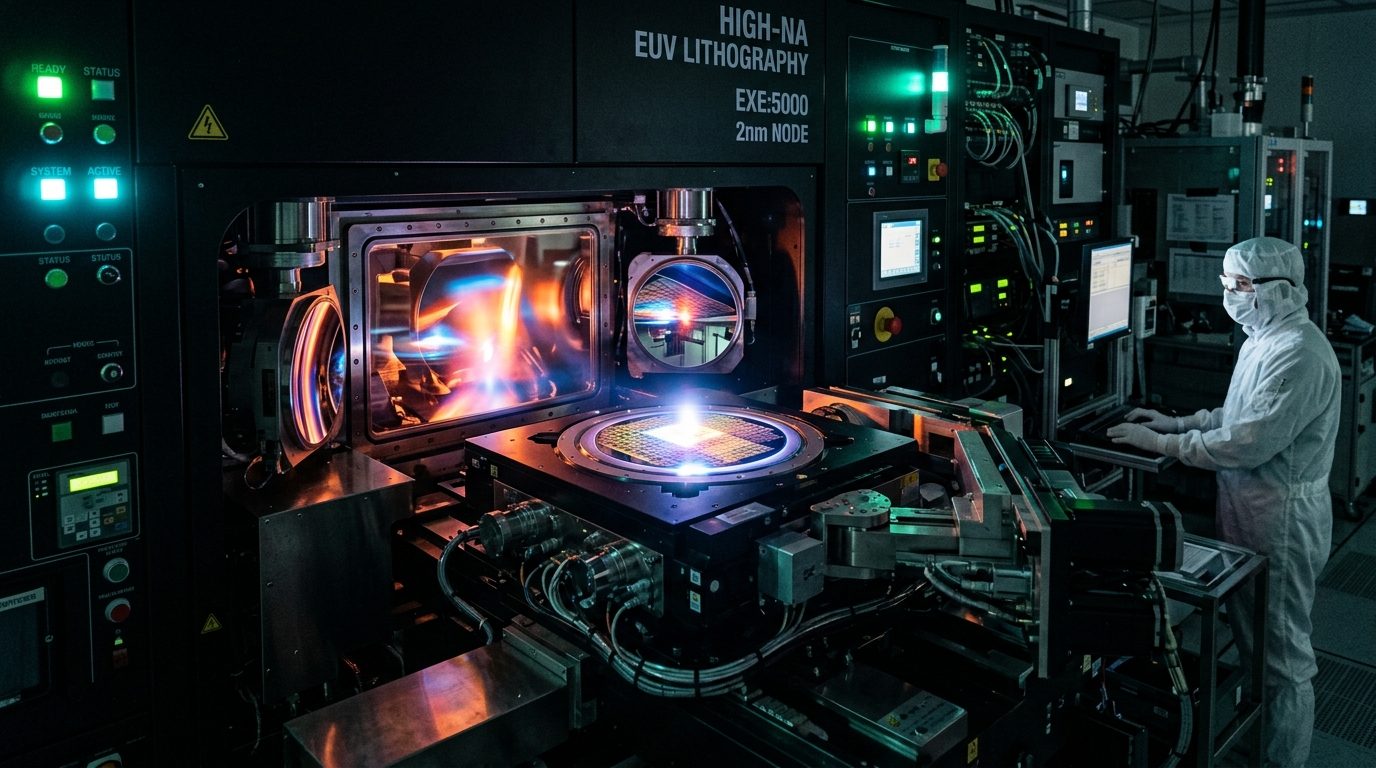
In the Dutch town of Veldhoven stands the cleanroom complex of ASML, the world's sole manufacturer of the extreme ultraviolet (EUV) photolithography machines required to etch leading-edge microchips. Yet according to ASML's latest quarterly shipment disclosures, not a single EUV machine—let alone the revolutionary $380 million High-NA Twinscan EXE scanners—was delivered to a fab within the European Union over the past 12 months.
Instead, 100% of the world's most advanced lithography hardware sailed overseas: 48% to TSMC in Taiwan, 28% to Intel and TSMC facilities in the United States, and 24% to Samsung in South Korea. While Europe builds the machines that power the artificial intelligence revolution, it does not use them to manufacture its own frontier processors.
This stark asymmetry has exposed the structural limitations of the €43 billion European Chips Act passed in 2023. European chipmakers like STMicroelectronics, Infineon, and NXP specialize in automotive microcontrollers, power discretes, and sensor silicon produced on mature nodes (14nm to 90nm). These lagging nodes require conventional deep ultraviolet (DUV) immersion lithography, not EUV.
The few planned leading-edge European mega-fab projects have faced crippling delays. High industrial electricity tariffs across Germany and France, bureaucratic environmental approval cycles, and staggering operational costs have led global foundries to prioritize expansion in Arizona, Ohio, and Kumamoto over European soil.
The strategic implications for European technology sovereignty are severe. Every single accelerator chip running European sovereign AI initiatives—whether Mistral in Paris or Aleph Alpha in Heidelberg—must be printed in Taiwan or the United States. In the event of a geopolitical blockade in the Taiwan Strait or tightened transatlantic export mandates, Europe would possess the capability to build lithography tools but lack the domestic facilities to fabricate a single frontier wafer.
European industrial ministers have convened in Brussels to review the Chips Act guidelines, debating whether to offer direct operational power subsidies to entice next-generation 1.4nm foundries before the compute gap becomes irreversible.