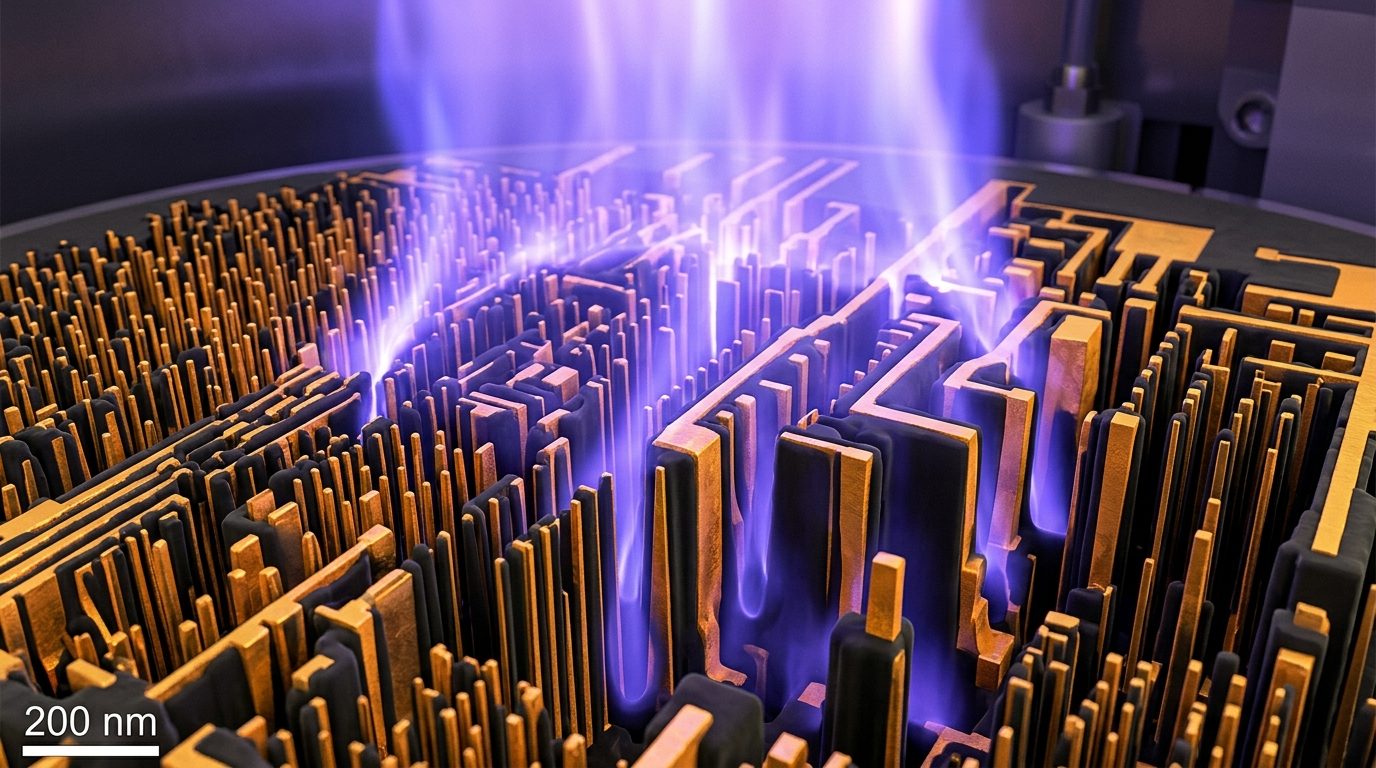
As leading-edge semiconductor foundries push transistor geometries past the 2-nanometer threshold, materials engineers face an increasingly perilous geometric challenge: how to coat, planarize, and etch structures that resemble deep microscopic canyons.
On September 22, 2026, European semiconductor equipment pioneer ASM International announced the commercial debut of XP8 Vertos Flowable Carbon, introducing the microchip manufacturing sector to its first plasma-enhanced chemical vapor deposition (PECVD) flowable carbon film designed for high-volume fab production.
In modern 3D semiconductor architectures—such as Gate-All-Around (GAA) nanosheets, backside power delivery networks, and 300-layer 3D NAND flash memory—vertical etch aspect ratios regularly exceed 60:1. Traditional vapor deposition creates 'pinching' at the mouth of the trench, trapping microscopic voids that lead to device electrical failure.
To circumvent this, foundries historically relied on wet Spin-On Carbon (SOC) formulations. However, SOC requires a cumbersome sequence of fluid dispensing, centrifugal spinning, high-temperature thermal baking, and destructive Chemical Mechanical Planarization (CMP) to polish the surface flat.
Vertos Flowable Carbon collapses this entire sequence into a single, clean vacuum chamber. When introduced under specific low-temperature plasma frequencies, the hydrocarbon gas precursors exhibit transient liquid-like mobility, flowing downward to fill deep, high-aspect-ratio trenches from the bottom up without seams.
As deposition completes, the film cross-links into a diamond-like amorphous carbon matrix with exceptional etch selectivity. Crucially, the surface self-planarizes during growth, achieving surface roughness under 2 nanometers and completely eliminating the need for abrasive downstream CMP polishing.
By stripping complexity and defect risks out of advanced patterning modules, ASM International's platform provides foundries with a critical manufacturing weapon as the industry races toward 1.4nm Angstrom-era logic and multi-terabit memory scaling.