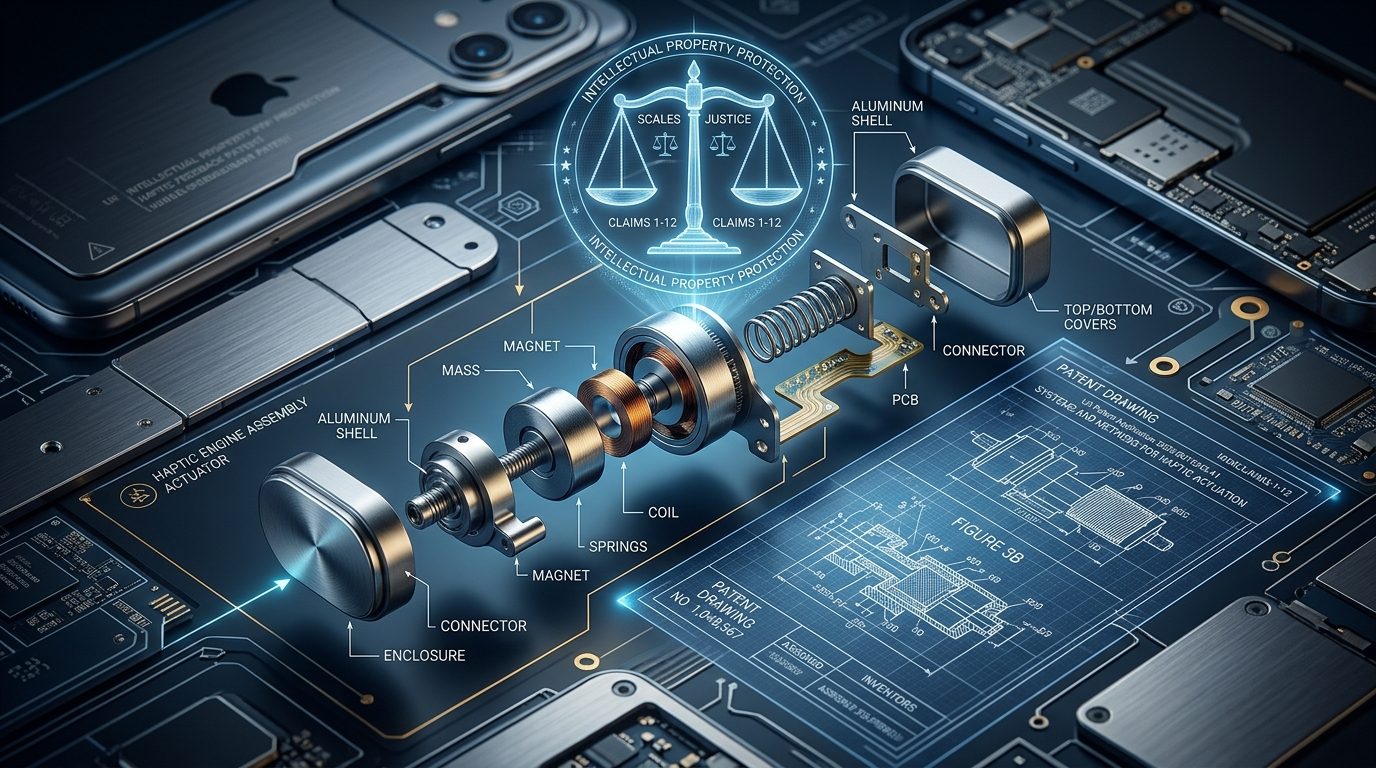
On September 26, 2026, a federal jury in San Diego delivered a historic legal earthquake, ordering Apple Inc. to pay $5,700,000,000 in damages to Taction Technology Inc. for willful and direct infringement of foundational haptic actuator patents.
The massive verdict, handed down in the United States District Court for the Southern District of California after a three-week trial, stands as the single largest patent infringement damages award in the history of the American legal system, eclipsing previous multibillion-dollar awards against tech conglomerates.
The patents in dispute—U.S. Patent Nos. 10,659,885 and 10,820,117—cover sophisticated electro-mechanical transducer architectures that utilize balanced dual-suspension spring configurations and damping fluids to produce sharp, transient tactile sensations without parasitic ringing or acoustic buzz.
Taction Technology, an intellectual property firm founded by pioneering audio and haptics engineers, demonstrated to jurors that Apple representatives met with Taction executives in 2013 and 2014 under non-disclosure agreements to review proprietary prototype haptic modules. Apple subsequently rejected a commercial licensing partnership, only to debut its proprietary 'Taptic Engine' in the Apple Watch in 2015 and iPhone 6s in 2016.
Throughout the trial, Apple's defense counsel argued that its internal engineering teams developed the Taptic Engine independently, relying on distinct planar linear resonant actuators that operated outside the claims of Taction's patents. Apple further challenged the validity of Taction's patents, alleging prior art in legacy pager buzzers and audio speakers.
However, the jury was unswayed by Apple's defense, finding that every iPhone shipped from the iPhone 7 through current flagship models, alongside Apple Watches and Force Touch MacBook trackpads, infringed multiple independent claims. In calculating the $5.7 billion award, the jury applied a negotiated reasonable royalty rate against hundreds of millions of commercial devices sold across the statutory damages window.
Crucially for Apple, the jury determined that the infringement was not willful, sparing the Cupertino giant from potential treble damages that could have skyrocketed total liabilities past $17 billion.
In a public statement, Apple expressed profound disappointment with the outcome, confirming that it will petition the court to set aside the verdict before initiating a formal appeal before the Court of Appeals for the Federal Circuit in Washington, D.C.