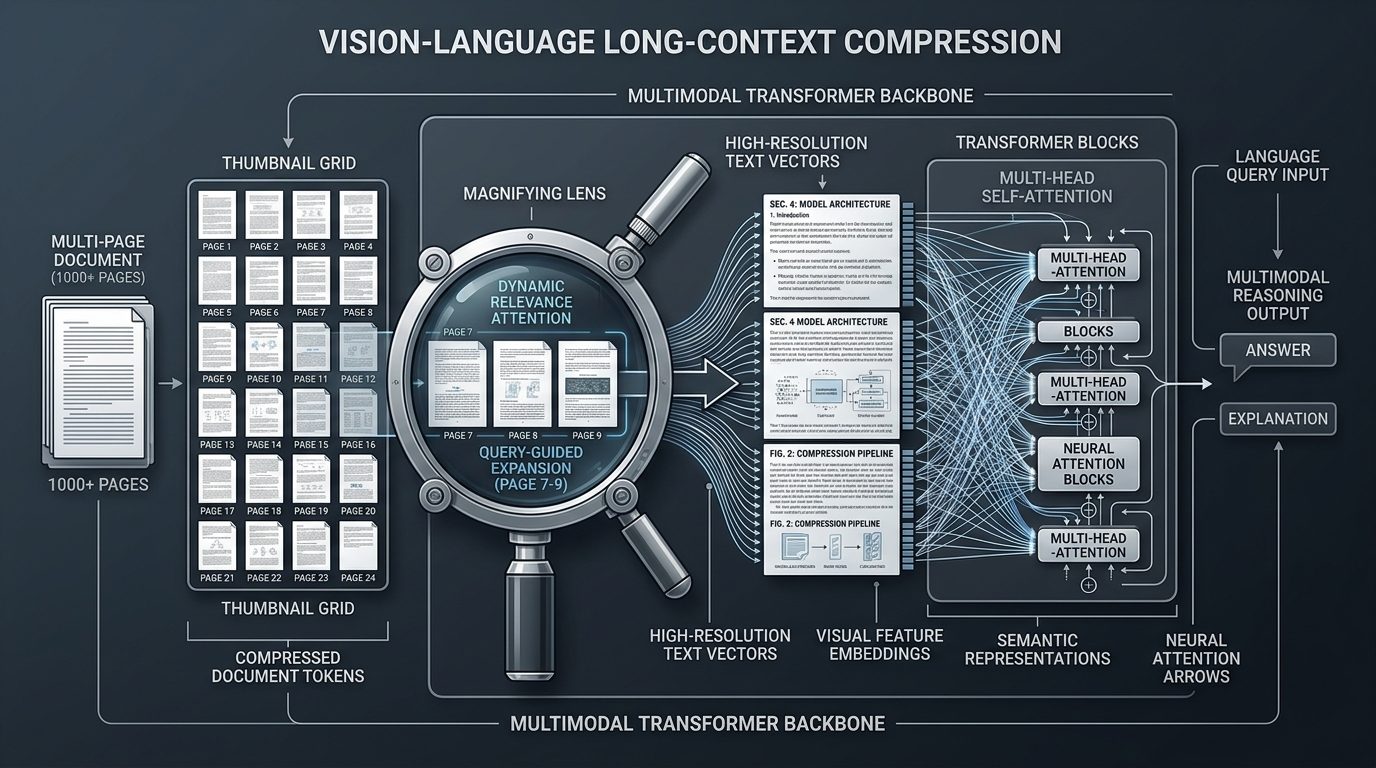
As foundation models process increasingly massive contexts—spanning multi-gigabyte codebases, complex legal contracts, and books—systems architects face a crippling memory bottleneck: the Key-Value (KV) cache. Even with grouped-query attention and flash-decoding kernels, maintaining millions of textual tokens across multiple conversation turns rapidly exhausts GPU and unified memory bandwidth.
On September 23, 2026, Apple's AI/ML Research group released LensVLM-9B, a 9.4-billion-parameter open-weights vision-language model that proposes an ingenious solution: treating document context not as text tokens, but as rendered visual images with selective resolution expansion.
LensVLM capitalizes on a core architectural property of modern Vision-Language Models: vision encoders map fixed-size image patches into a constant, predictable number of visual tokens regardless of semantic density. By rendering multi-page documents as compact visual thumbnail grids, LensVLM compresses long textual documents into an information-dense visual representation, slashing token count by a factor of 4.3× to 10.1×.
The primary failure mode of naive visual document compression has historically been text degradation: at high compression ratios, fine typography shrinks into indistinguishable pixel noise. LensVLM circumvents this through an active inference framework termed Selective Context Expansion.
When presented with a user query, LensVLM first evaluates the low-resolution thumbnail grid to identify candidate pages containing relevant answers. It then autonomously issues a tool call to its internal rendering engine to 'zoom in,' expanding only the critical pages into full, native-resolution image patches while leaving irrelevant pages compressed. In benchmark evaluations against Document VQA, FinQA, and long-horizon needle-in-a-haystack tasks, LensVLM matched full-text accuracy within 2% while reducing peak KV cache allocation by up to 90%.
By releasing the model weights under its AMLR license on Hugging Face and publishing the full inference pipeline on GitHub, Apple has delivered a practical architectural path for executing long-context reasoning directly on local consumer hardware without cloud dependency.