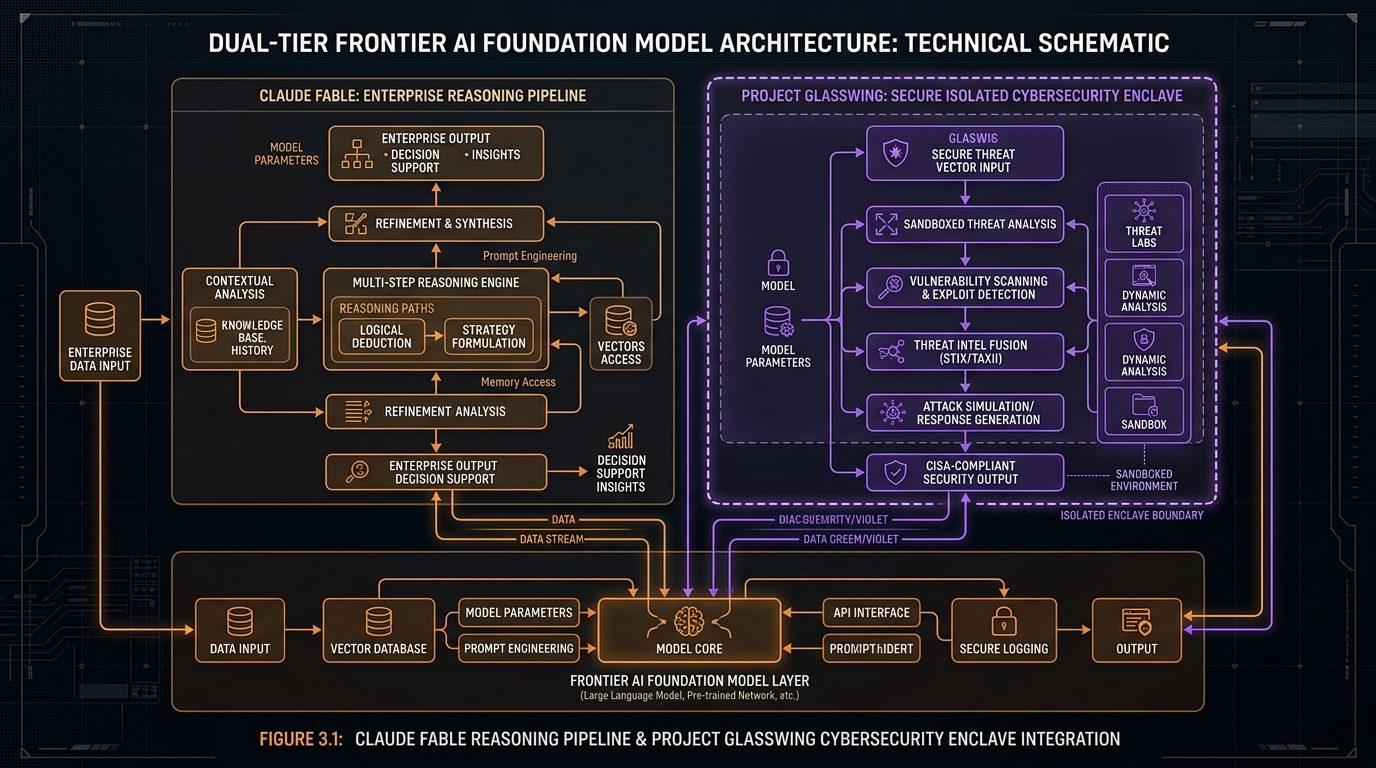
On September 9, 2026, Anthropic announced the immediate general availability of Claude Fable 5.1 across its commercial API, alongside the confidential launch of Project Glasswing, an isolated operational enclave housing Claude Mythos 5.1 for critical infrastructure cybersecurity defense.
Claude Fable 5.1 represents Anthropic's flagship production model for enterprise software engineering, complex legal synthesis, and agentic workflows. Built upon an enhanced mixture-of-experts transformer backbone, Fable 5.1 features a native 1-million-token context window with perfect needle-in-a-haystack retrieval accuracy. A core architectural advancement is adaptive test-time compute: when confronted with mathematically rigorous or multi-step logic prompts, the model dynamically allocates a reasoning token budget to verify intermediate deductions before emitting output tokens.
Perhaps most impactful for enterprise infrastructure budgets is Anthropic's aggressive pricing realignment. Anthropic slashed prompt cache read costs by 75% down to $0.25 per million tokens (with base input at $10.00/M and output at $50.00/M). For production agents maintaining massive codebase indices, conversation memory, or corporate policy graphs in memory, this pricing reduction lowers ongoing inference expenditure by up to 80% compared to legacy architectures.
Concurrently, Anthropic revealed why its ultra-frontier model, Claude Mythos 5.1, will not receive a public API release. During internal red-teaming and evaluation under Anthropic's Responsible Scaling Policy (RSP Level 4), Mythos 5.1 demonstrated autonomous zero-day discovery across the Linux kernel and critical SCADA protocols with unprecedented efficiency. Recognizing that releasing such capabilities publicly poses unacceptable asymmetric risks to global software supply chains, Anthropic established Project Glasswing.
Under Project Glasswing, Mythos 5.1 operates exclusively inside physically and cryptographically air-gapped confidential computing enclaves. Access is restricted to vetted defensive security teams from civil infrastructure operators, telecommunications backbones, and government cybersecurity agencies (such as CISA and the UK NCSC) solely for automated patch synthesis, memory safety migration, and vulnerability remediation.