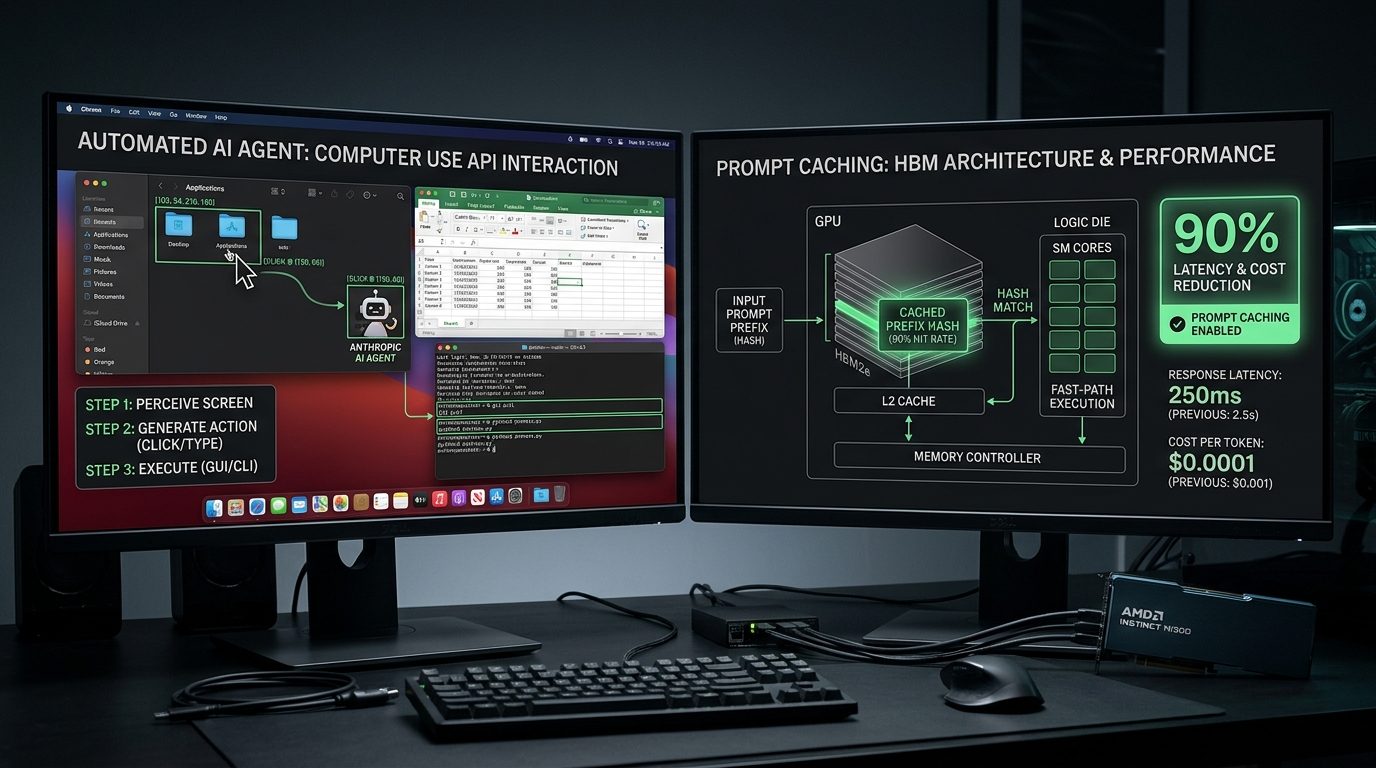
On September 7, 2026, Anthropic rolled out two transformative additions to its developer platform: Prompt Caching and direct OS-level Computer Use for Claude 3.5 Sonnet.
For enterprise software teams building autonomous agent loops, prompt caching addresses the single largest cost bottleneck in generative AI. In complex workflows like automated repository refactoring or legal contract review, developers repeatedly send hundreds of thousands of identical tokens—representing API schemas, test harnesses, and documentation—with every iterative question. Anthropic's caching architecture keeps the compiled attention key-value states in memory across API requests. When a prompt hits a cached breakpoint, Anthropic bills those tokens at a 90% discount ($0.30 per million tokens on Sonnet compared to standard $3.00), while reducing Time-To-First-Token (TTFT) by up to 80%.
Simultaneously, the Computer Use API unlocks direct graphical user interface manipulation. Rather than relying on rigid JSON API connectors, Claude can view a computer screen through sequential high-resolution screenshots, calculate precise (x, y) coordinate targets, click UI buttons, enter keyboard input, and navigate legacy software that lacks modern APIs.
On initial developer evaluations, Claude 3.5 Sonnet achieved strong scores on OSWorld and internal computer task benchmarks, outperforming human novices on multi-step spreadsheet and web browser data entry tasks.
Anthropic stressed that Computer Use remains in experimental release, mandating that developers isolate instances within virtual machines (VMs) without production internet connectivity to prevent prompt-injection attacks from malicious web pages.