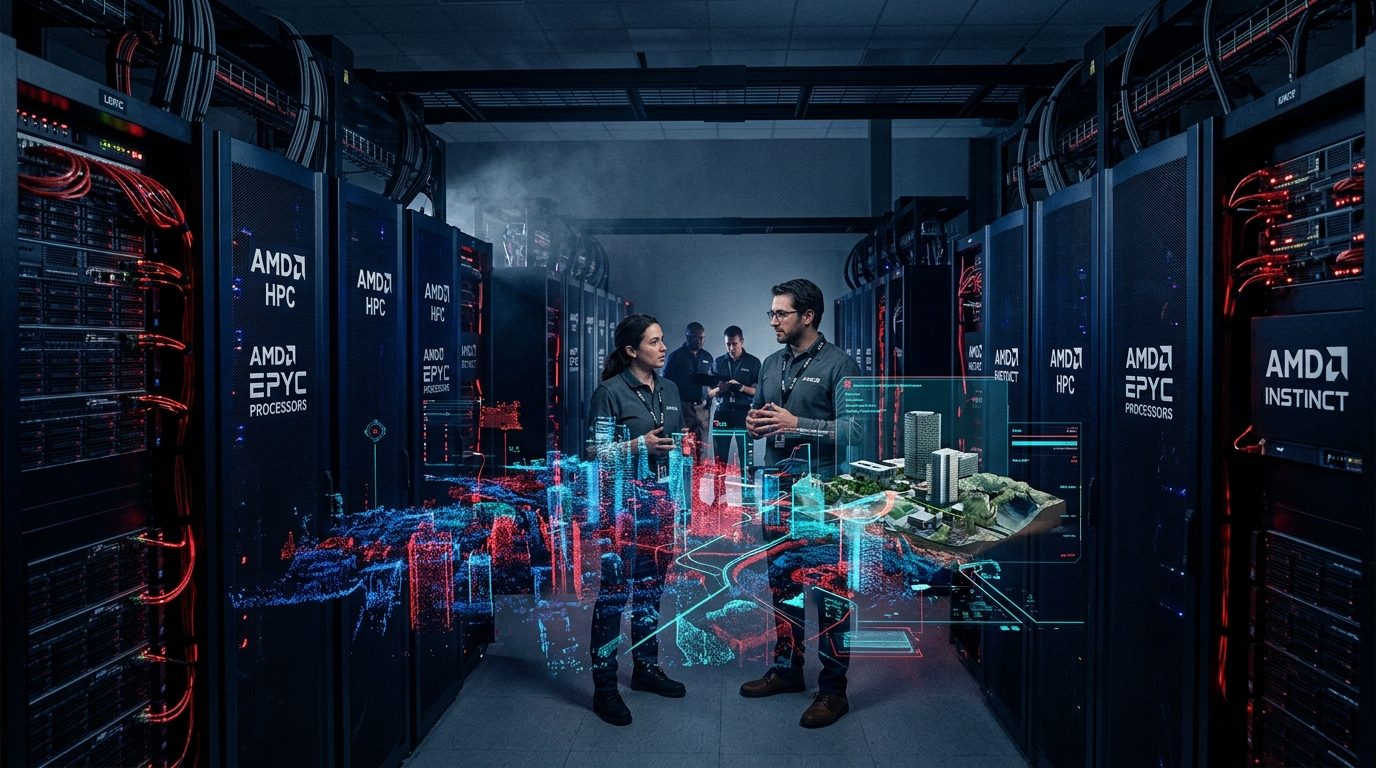
In the most significant artificial intelligence acquisition of 2026, semiconductor powerhouse AMD announced a definitive agreement on September 28 to acquire World Labs in an all-stock transaction valued at approximately $8.2 billion.
World Labs was co-founded by Dr. Fei-Fei Li—widely recognized as the godmother of modern computer vision for creating ImageNet—alongside computer graphics and vision pioneers Justin Johnson and Ben Mildenhall. The startup raised over $1 billion earlier in 2026 to pioneer 'spatial intelligence,' designing AI systems that move beyond text and 2D video to perceive, simulate, and generate persistent, interactive 3D virtual worlds.
Under the terms of the transaction, Dr. Fei-Fei Li will join AMD's executive leadership team as Executive Vice President and Chief Scientist, reporting directly to AMD Chair and CEO Dr. Lisa Su. Co-founders Johnson and Mildenhall will continue to lead World Labs' engineering division within AMD's broader Artificial Intelligence Group.
The acquisition marks a major strategic evolution for AMD. While AMD's Instinct MI300 and MI350 accelerator platforms have gained significant market traction in cloud hyperscaler clusters, NVIDIA's primary competitive moat has long resided in its software and simulation stack, anchored by CUDA, Omniverse, and the newly launched Cosmos physical world foundation models.
By bringing World Labs in-house, AMD acquires the foundational algorithmic IP and research talent necessary to co-design future GPU silicon around the memory bandwidth and compute requirements of real-time 3D diffusion and physics simulation.
'Spatial intelligence is the bridge that connects digital cognition to the physical world,' stated Dr. Lisa Su during the joint announcement. 'Integrating World Labs' world-model breakthroughs with our high-performance Instinct compute roadmaps establishes AMD as the premiere full-stack platform for the next era of embodied AI and physical simulation.'
For Dr. Li, the acquisition provides unprecedented computational firepower. Training foundation models that comprehend real-world geometry, gravity, and material dynamics demands massive heterogeneous GPU clusters—resources AMD can furnish at sovereign scale.