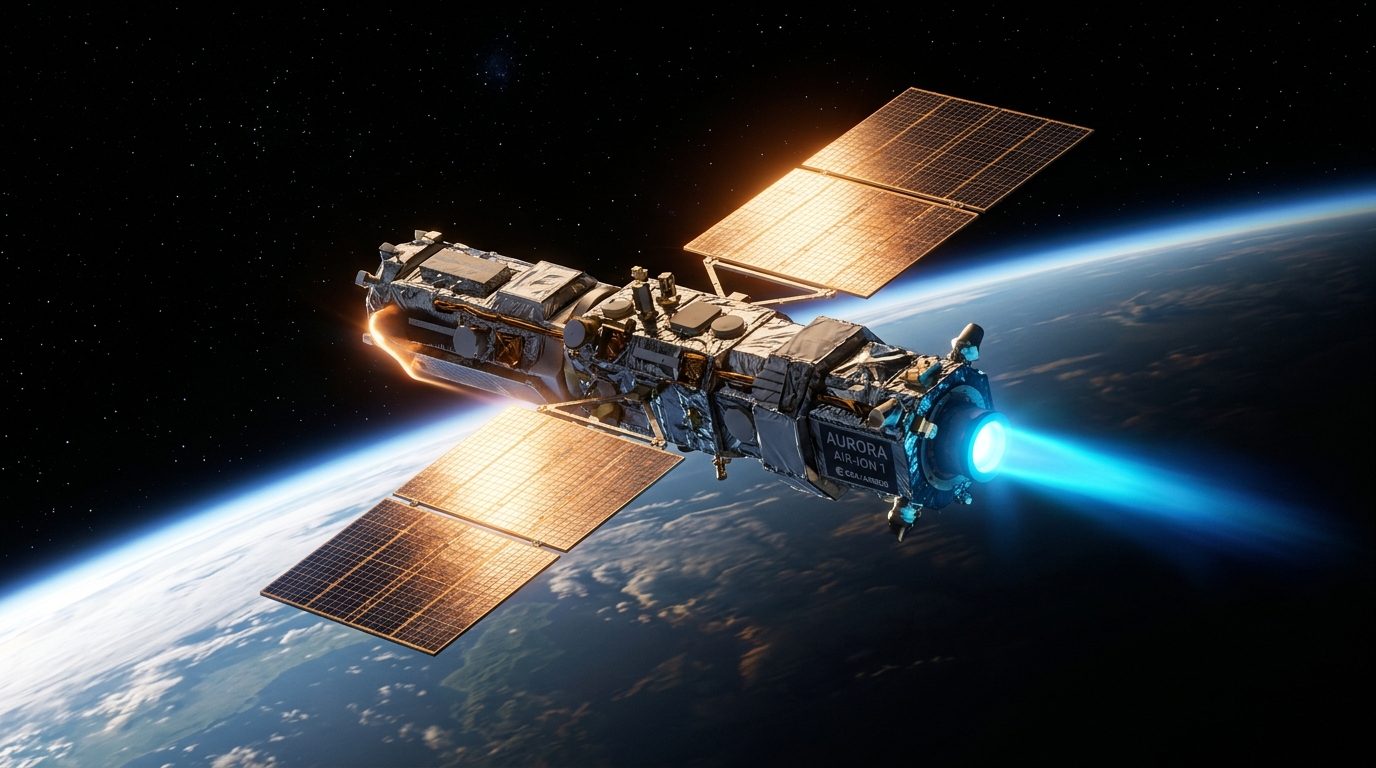
In the physics of spaceflight, the region known as Very Low Earth Orbit (VLEO)—stretching between 180 and 250 kilometers above the planet—has long represented a tantalizing yet forbidden frontier for satellite operators.
At these low altitudes, earth-observing optical cameras can achieve sub-10-centimeter ground resolution with dramatically smaller telescope apertures, and communications payloads achieve round-trip latencies under 5 milliseconds. Furthermore, space debris risks are virtually non-existent, as dead satellites deorbit naturally within days.
However, operating in VLEO presents a punishing barrier: residual atmospheric drag. The wisps of upper-atmospheric gases constantly rob satellites of orbital energy. To prevent reentry, spacecraft must fire thrusters continuously, consuming expensive onboard xenon or krypton propellants within months and terminating the mission.
On September 26, 2026, propulsion researchers from the European Space Agency (ESA) and SITAEL announced a historic technological breakthrough: the full-system vacuum chamber validation of a flight-grade Air-Breathing Electric Propulsion (ABEP) engine capable of providing indefinite station-keeping.
The ABEP engine replaces stored chemical or noble-gas propellants with an ingenious open-cycle ram design. A custom intake cowl facing the spacecraft's velocity vector scoops ambient neutral nitrogen and atomic oxygen molecules from the rarified thermosphere.
These collected atmospheric particles are channeled into an electrodeless radio-frequency (RF) ionization chamber, where inductive coils strip their electrons, transforming the ambient air into a dense, magnetized plasma. A multi-grid electrostatic accelerator then expels the ionized nitrogen and oxygen ions at velocities exceeding 30 kilometers per second, generating smooth, continuous thrust that precisely balances the spacecraft's aerodynamic drag.
By matching thrust output directly to incoming drag forces, the satellite becomes energetically self-sustaining, powered entirely by its solar arrays. The only limit to the spacecraft's mission lifetime is component degradation and solar array wear, completely disconnecting operational endurance from propellant tank capacity.
With ESA locking in its 'Aurora Air-Ion 1' demonstration mission for late 2027, the commercial space sector is preparing for a paradigm shift, laying the foundation for ultra-compact, hyper-resolution orbital sensor constellations skimming the outer fringes of Earth's atmosphere.